

Electoral body defers notification of new lawmakers on reserved seats in Punjab

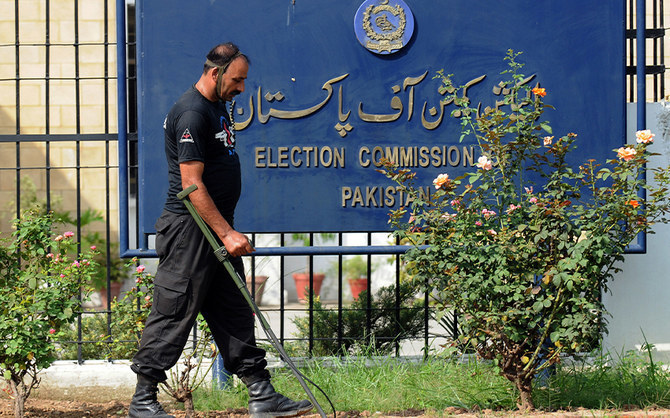
A Pakistan anti-terrorist force personal uses a metal detector to check the area of the Election Commission in Islamabad on August 26, 2008. (AFP/File)
Short Url
Updated 02 June 2022
Follow

Electoral body defers notification of new lawmakers on reserved seats in Punjab

  • The seats fell vacant last month after 25 dissident lawmakers from ex-PM Khan’s party were disqualified
  • The former prime minister’s party criticized the judgment and vowed to challenge it in the supreme court

ISLAMABAD: Pakistan’s electoral body on Thursday deferred notification of five new legislators on Punjab Assembly’s reserved seats for women and minorities until the by-election in 20 provincial constituencies following the de-seating of dissident lawmakers belonging to former prime minister Imran Khan’s Pakistan Tehreek-e-Insaf (PTI) party.

The reserved seats are allocated to parliamentary parties on a proportionate basis as per their strength in an assembly. Last month, the Election Commission of Pakistan (ECP) de-seated 25 dissident PTI lawmakers, including five legislators on reserved seats, for switching loyalties and voting for the Pakistan Muslim League-Nawaz (PML-N) party’s candidate for the position of Punjab chief minister.

The PTI had moved the ECP for the issuance of notification, though its petition was rejected when the election regulatory authority decided to wait until the by-election took place on vacant general seats.

“We deem it appropriate to defer the filling of vacant reserved seats till the outcome of by-elections on twenty general seats in the provincial assembly of Punjab,” the ECP said in a 13-page verdict.

Responding to the development, PTI vice president Chaudhry Fawad Hussain criticized the commission and vowed to challenge the verdict in the supreme court.

During the hearing, attorney general Ashtar Ausaf said the filling of reserved seats and proportional representation were interlinked. “If the number of general seats decreases, then the representation [on reserved seats] would not remain proportionate,” he said.

“The solution to resolve this controversy is to conduct by-elections on twenty vacant general seats and then calculate the quota for reserved seats on the basis of proportional representation of the parties in the assembly,” he added.

The ECP also went along with the same argument and disposed of PTI’s application.

“We have come to the conclusion that the scheme of proportional representation provided in the constitution is mandatory for filling of vacant reserved seats for women and non-Muslim,” it said.


Pakistan forms committee to negotiate financial advisory services for Islamabad airport privatization

Updated 18 February 2026
Follow

Pakistan forms committee to negotiate financial advisory services for Islamabad airport privatization

  • Committee to engage Asian Development Bank to negotiate terms of financial advisory services agreement, says privatization ministry
  • Inaugurated in 2018, Islamabad airport has faced criticism over construction delays, poor facilities and operational inefficiencies

ISLAMABAD: Pakistan’s Privatization Ministry announced on Wednesday that it has formed a committee to engage the Asian Development Bank (ADB) to negotiate a potential financial advisory services agreement for the privatization of Islamabad International Airport.

The Islamabad International Airport, inaugurated in 2018 at a cost of over $1 billion, has faced criticism over construction delays, poor facilities, and operational inefficiencies.

The Negotiation Committee formed by the Privatization Commission will engage with the ADB to negotiate the terms of a potential Financial Advisory Services Agreement (FASA) for the airport’s privatization, the ministry said. 

“The Negotiation Committee has been mandated to undertake negotiations and submit its recommendations to the Board for consideration and approval, in line with the applicable regulatory framework,” the Privatization Ministry said in a statement. 

The ministry said Islamabad airport operations will be outsourced under a concession model through an open and competitive process to enhance its operational efficiency and improve service delivery standards. 

Pakistan has recently sought to privatize or outsource management of several state-run enterprises under conditions agreed with the International Monetary Fund (IMF) as part of a $7 billion bailout approved in September last year.

Islamabad hopes outsourcing airport operations will bring operational expertise, enhance passenger experience and restore confidence in the aviation sector.

In December 2025, Pakistan’s government successfully privatized its national flag carrier Pakistan International Airlines (PIA), selling 75 percent of its stakes to a consortium led by the Arif Habib Group. 

The group secured a 75 percent stake in the PIA for Rs135 billion ($482 million) after several rounds of bidding, valuing the airline at Rs180 billion ($643 million).

Pakistan’s Finance Minister Muhammad Aurangzeb said this week the government has handed over 26 state-owned enterprises to the Privatization Commission.