

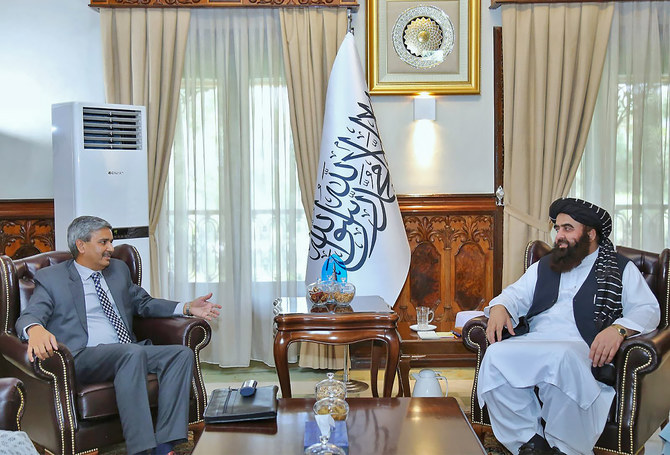

NEW DELHI: Indian foreign ministry officials held talks with the Afghan government in Kabul on Thursday, in the first such meeting since the Taliban took control of the country last year.
India has no diplomatic ties with Afghanistan and closed its embassy in Kabul in August last year, after US-led forces left the landlocked country and the Taliban took over.
Ahead of the visit, India’s Ministry of External Affairs said in a statement the delegation would meet senior members of the Taliban to “hold discussions on India’s humanitarian assistance to the people of Afghanistan.”
The ministry said its team would oversee delivery of Indian humanitarian aid and meet representatives of the international organizations involved in distribution, as it had dispatched 20,000 metric tons of wheat and 13 tons of medicines to Afghanistan, where repeated economic shocks, political crises, and a series of environmental disasters such as drought have left more than 24 million people requiring life-saving assistance to prevent famine.
On Thursday afternoon, J. P. Singh, the ministry’s joint secretary who leads the Indian team, met Afghanistan’s acting Foreign Minister Amir Khan Muttaqi and Abdul Qahar Balkhi, the Taliban foreign ministry’s spokesperson.
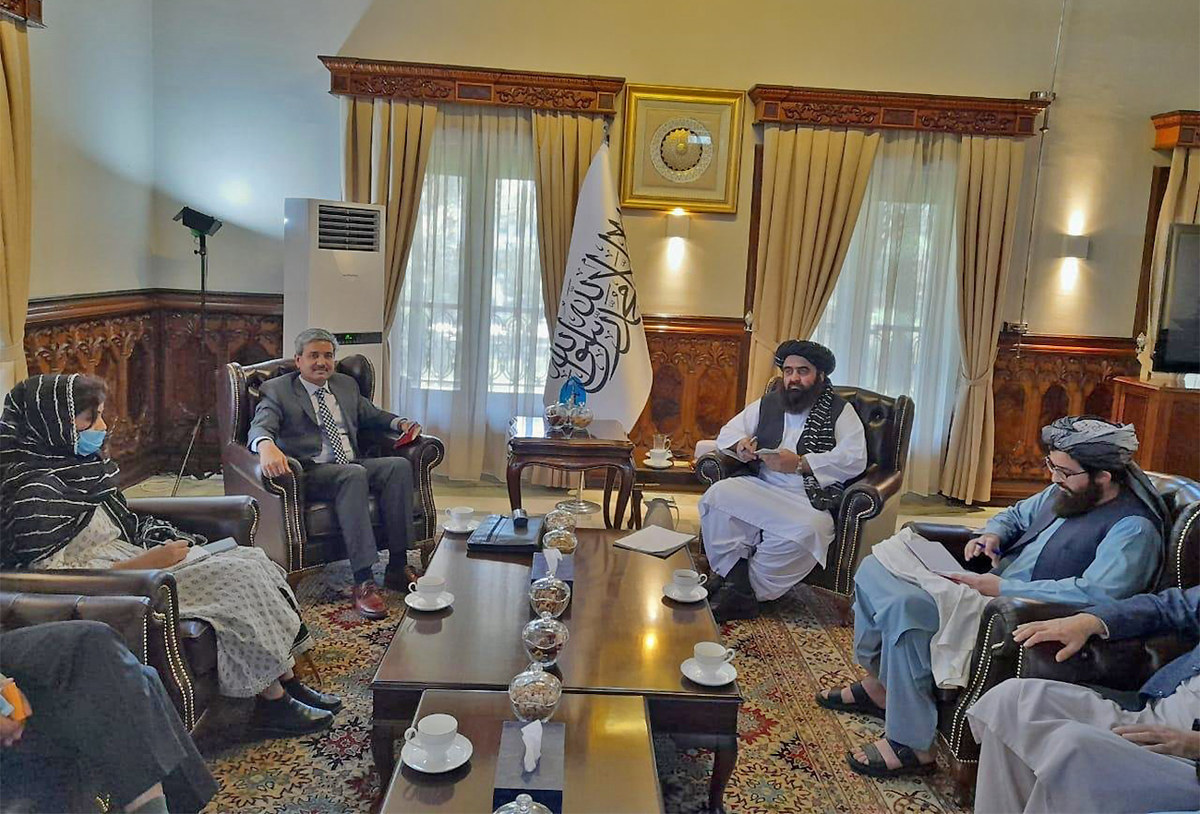
Indian MEA Joint Secretary J.P. Singh (center left) meets Afghanistan's acting foreign minister Mawlawi Amir Khan Muttaqi (center right) in Kabul, Afghanistan, on June 2, 2022.. (Social media)
After the meeting, Balkhi tweeted they had discussed diplomatic relations and bilateral trade and that the visit was “a good start between the two countries.” He also thanked New Delhi for humanitarian assistance.
The Indian delegation is expected to visit the sites where various Indian investment programs have been implemented for the past two decades.
New Delhi spent billions of dollars on infrastructure and humanitarian assistance in Afghanistan after the previous Taliban regime was toppled in a US-led invasion in 2001.
With over $3 billion invested in Afghanistan on constructing highways, transporting food and building schools and hospitals, India has been the second largest donor to the war-battered country after the US.
Amar Sinha, New Delhi’s former ambassador to Afghanistan, told Arab News the first official visit since August last year indicates attempts to re-establish ties with the country where India’s arch-enemy, Pakistan, wields considerable influence.
“Clearly, India does not wish to be seen as the only one not dealing with Afghanistan. There has to be a clear understanding of the new reality in Kabul,” he said. “India, as a neighbor, has immense goodwill for Afghans.”
While Indian diplomats have not officially visited Afghanistan since last year, they have met Taliban representatives in Doha, Qatar.
“India feels it’s well located in terms of its history and in terms of geography to reach out to Afghanistan and provide some kind of help and also politically engage with them,” Sanjay Kapoor, analyst and chief editor of the political magazine Hard News, said.
“By engaging with the Taliban, India also recognizes that it will build a countervailing force to Pakistan.”


