

PM Sharif meets Erdogan, Turkish officials to visit Pakistan for high-level moot in September

Turkish President Recep Tayyip Erdogan (L) walks with Prime Minister of Pakistan Shehbaz Sharif upon his arrival during an official ceremony at the Presidential Complex in Ankara, Turkey, on June 1, 2022. (AFP)
Short Url
Updated 01 June 2022
Follow

PM Sharif meets Erdogan, Turkish officials to visit Pakistan for high-level moot in September

  • Erdogan says the two countries will sign strategic and economic framework agreement in Pakistan
  • Pakistan and Turkey want to increase the quantum of bilateral trade to $5 billion in coming years

ISLAMABAD: Prime Minister Shehbaz Sharif on Wednesday held a meeting with Turkish President Recep Tayyip Erdogan in Ankara wherein they decided to hold the next round of high-level consultations between the two countries in the month of September in Pakistan’s federal capital.

Sharif was warmly received by Erdogan after he arrived at the Presidential Complex during his first official visit to Turkey since assuming the top political office of his country on April 11.

Both leaders introduced each other to their cabinet members who were also present at the ceremony.

Addressing a gathering attended by senior Pakistani and Turkish officials, Erdogan said the two countries had reaffirmed their determination to increase the scope of their cooperation at the bilateral and international platforms.

He noted that high-level strategic cooperation councils between the two countries would continue their consultations to further broaden and deepen the ties between the two countries.

“During the talks we held today, we have come to terms that hopefully and most probably this meeting will take place in September in Pakistan,” he said.
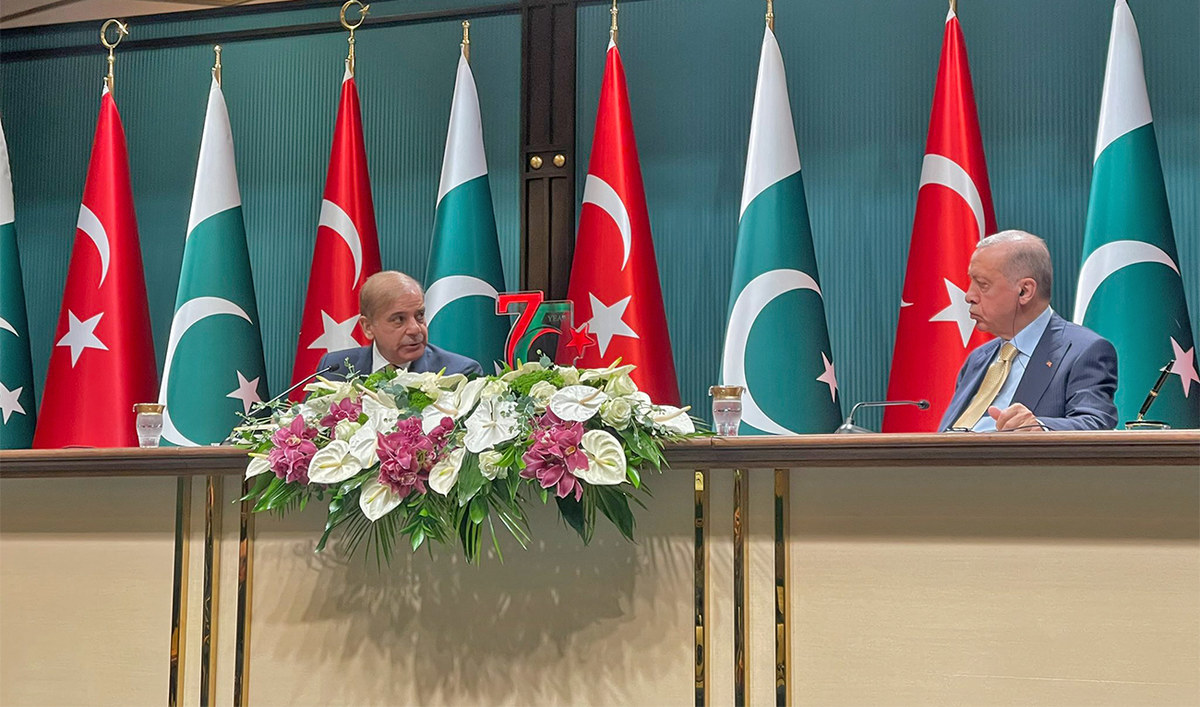


Pakistan Prime Minister Shehbaz Sharif (left) and Turkish President President Recep Tayyip Erdogan address a joint press conference in Ankara, Turkey, on June 1, 2022. (@Marriyum_A/Twitter)

Erdogan added the two countries would also sign a strategic and economic framework agreement in Islamabad that would encompass areas ranging from bilateral trade to defense industry.

“We have grown our mutual trade volume which has exceeded the figure of $1 billion for the first time after 2010,” he said. “Our aim is to achieve a figure of $5 billion.”

Speaking at the occasion, Sharif applauded the “unique bond” between the two countries which he said was rooted in history.

“We look at these relations as a sacred trust that has been passed on to us by our forefathers and which we are committed to handing over to our succeeding generations,” he maintained.

The prime minister also invited Erdogan to come to Islamabad in September for the next round of bilateral consultations.

“Pakistan and Turkey are natural partners,” he continued. “Many of our challenges are the same as are our opportunities. Our two nations have stood by each other in times of need and on issues of core interests.”
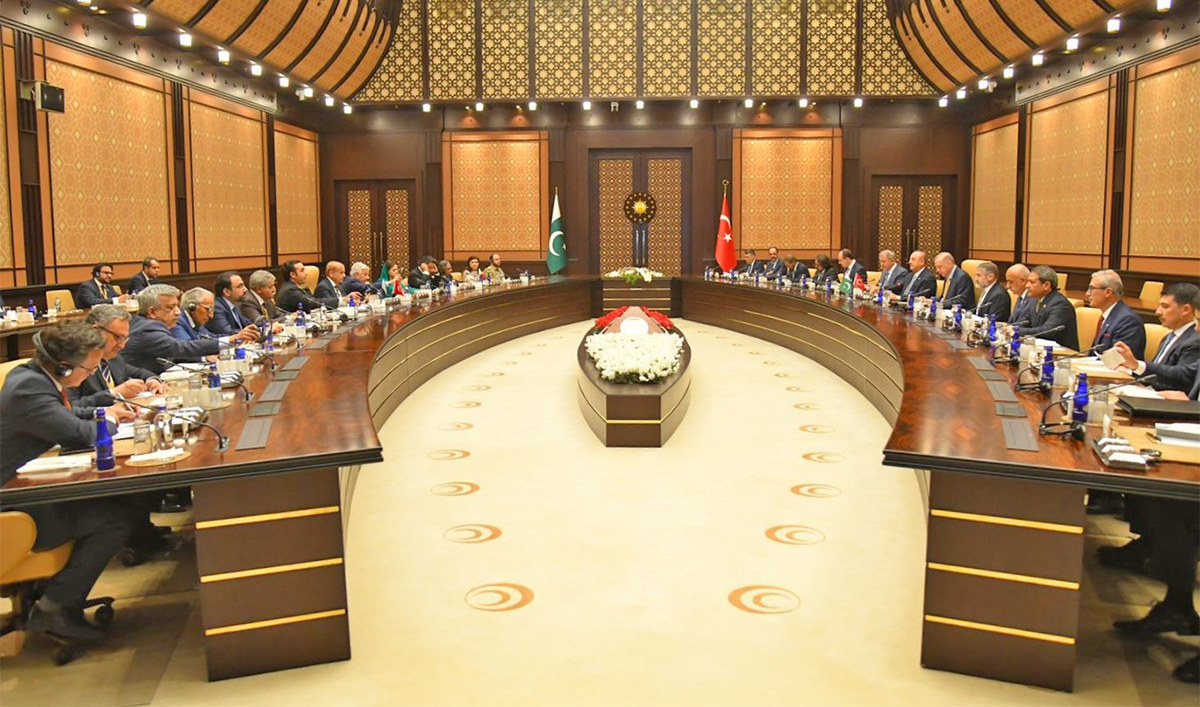


Pakistani delegation led by Prime Minister Shehbaz Sharif (left) and Turkish delegation let by President President Recep Tayyip Erdogan hold consultative meeting in Ankara, Turkey, on June 1, 2022. (Government of Pakistan)

Earlier, the two leaders witnessed the signing of several memoranda of understanding by their cabinet members which ranged from highway engineering to economic relations and debt management.

Sharif arrived in the Turkish capital of Ankara on Tuesday with a high-level political delegation while business leaders from Pakistan and representatives of leading companies across sectors also traveled separately to participate in business engagements.

Turkish companies have already invested more than $1 billion in different sectors in Pakistan, including construction, power, solid waste management, hygiene products, electronics and dairy.

“Foreign investment is critical to our efforts to stabilize the economy,” Sharif said in a Twitter post. “In my meeting with leading Turkish investors today, I invited them to invest in the energy & infrastructure sectors. My government will be there to facilitate them proactively.”


EU, Pakistan sign €60 million loan agreement for clean drinking water in Karachi

Updated 5 sec ago
Follow

EU, Pakistan sign €60 million loan agreement for clean drinking water in Karachi

  • Project will finance rehabilitation, construction of water treatment facilities in Karachi city, says European Investment Bank
  • As per a report in 2023, 90 percent of water samples collected from various places in city was deemed unfit for drinking

ISLAMABAD: The European Investment Bank (EIB) and Pakistan’s government on Wednesday signed a €60 million loan agreement, the first between the two sides in a decade, to support the delivery of clean drinking water in Karachi, the EU said in a statement. 

The Karachi Water Infrastructure Framework, approved in August this year by the EIB, will finance the rehabilitation and construction of water treatment facilities in Pakistan’s most populous city of Karachi to increase safe water supply and improve water security. 

The agreement was signed between the two sides at the sidelines of the 15th Pak-EU Joint Commission in Brussels, state broadcaster Radio Pakistan reported. 

“Today, the @EIB signed its first loan agreement with Pakistan in a decade: a €60 million loan supporting the delivery of clean drinking water for #Karachi,” the EU said on social media platform X. 

https://x.com/eupakistan/status/2001258048132972859

Radio Pakistan said the agreement reflects Pakistan’s commitment to modernize essential urban services and promote climate-resilient infrastructure.

“The declaration demonstrates the continued momentum in Pakistan-EU cooperation and highlights shared priorities in sustainable development, public service delivery, and climate and environmental resilience,” it said. 

Karachi has a chronic clean drinking water problem. As per a Karachi Water and Sewerage Corporation (KWSC) study conducted in 2023, 90 percent of water from samples collected from various places in the city was deemed unsafe for drinking purposes, contaminated with E. coli, coliform bacteria, and other harmful pathogens. 

The problem has forced most residents of the city to get their water through drilled motor-operated wells (known as ‘bores’), even as groundwater in the coastal city tends to be salty and unfit for human consumption.

Other options for residents include either buying unfiltered water from private water tanker operators, who fill up at a network of legal and illegal water hydrants across the city, or buying it from reverse osmosis plants that they visit to fill up bottles or have delivered to their homes.

The EU provides Pakistan about €100 million annually in grants for development and cooperation. This includes efforts to achieve green inclusive growth, increase education and employment skills, promote good governance, human rights, rule of law and ensure sustainable management of natural resources.