UK’s Rwanda deportation plans leading to suicide attempts: Charities

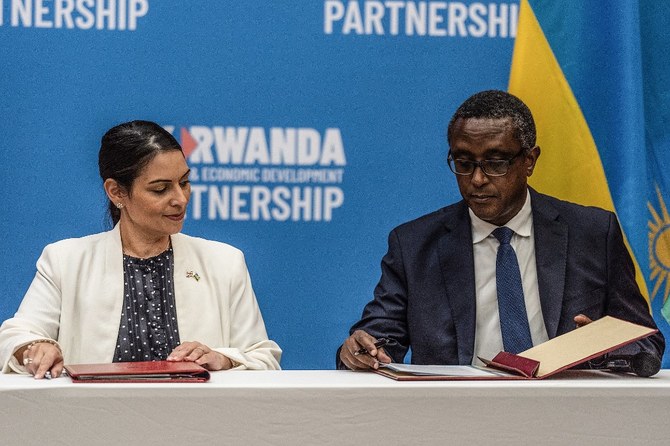
UK Home Secretary Priti Patel and Rwandan Minister of Foreign Affairs Vincent Biruta sign an agreement at Kigali Convention Center in Rwanda. (File/AFP)
Short Url
Updated 01 June 2022
Follow

UK’s Rwanda deportation plans leading to suicide attempts: Charities

  • First group of asylum seekers who entered Britain via English Channel to be sent to African country on June 14
  • Charity head: ‘Refugees have suffered terrible oppression. Yet our goal is to deter them using the fear of more injury and oppression’

LONDON: Suicide attempts by asylum seekers in Britain threatened with being sent to Rwanda under new deportation plans have been reported to refugee charities, which warn that they are being “driven to despair.”
The reports of suicide attempts were made as Home Secretary Priti Patel announced that the first group of asylum seekers who entered Britain via the English Channel will be deported to Rwanda on June 14.
A female Iranian asylum seeker told charity representatives that she attempted suicide because she thought she faced being sent to the African country.
A Yemeni asylum seeker, 40, sent a video to Patel and British Prime Minister Boris Johnson saying he had “no other choice but to kill myself” after arriving in the UK in April and being informed about the Rwanda offshoring plans.
More recently, an Afghan asylum seeker attempted suicide after being detained in preparation for being offshored to Rwanda.
A young Sudanese asylum seeker died in Calais on May 11, with charity workers being told that he wanted to die because of the Rwanda offshoring plans. French authorities are investigating the case.
Clare Moseley, CEO of the charity Care4Calais, said the prospect of being forcibly sent to Rwanda has distressed a lot of asylum seekers who could be traumatized from the lives they are escaping.
The Home Office deals with thousands of vulnerable asylum seekers every year, with its own assessments of the widespread vulnerability of asylum seekers being revealed in an investigation by The Guardian.
Some 17,440 asylum seekers were determined to be vulnerable last year. They were referred to so-called “safeguarding hubs.”
The Home Office said it records 26 different vulnerabilities that can lead to an asylum seeker or migrant being sent to a safeguarding hub, including suicide and self-harm, torture, trafficking and mental health problems.
Moseley said: “The aim of the Rwanda plan is to act as a deterrent by being even more terrifying to refugees than the journeys they make in flimsy boats across the Channel.
“Refugees have suffered terrible oppression. Yet our goal is to deter them using the fear of more injury and oppression. This is not the act of a civilized or compassionate nation.
“Little wonder that Priti Patel’s actions are driving the world’s victims to take their own lives in despair.”


Ethiopia’s prime minister accuses Eritrea of mass killings during Tigray war

Updated 03 February 2026
Follow

Ethiopia’s prime minister accuses Eritrea of mass killings during Tigray war

  • Landlocked Ethiopia says that Eritrea is arming rebel groups, while Eritrea says Ethiopia’s aspiration is to gain access to a seaport
  • Ethiopia lost sovereign access to the Red Sea when Eritrea seceded in 1993 after decades of guerrilla warfare

ADDIS ABABA: Ethiopia’s government Tuesday for the first time acknowledged the involvement of troops from neighboring Eritrea in the war in the Tigray region that ended in 2022, accusing them of mass killings, amid reports of renewed fighting in the region.
Ethiopian Prime Minister Abiy Ahmed, while addressing parliament Tuesday, accused Eritrean troops fighting alongside Ethiopian forces of mass killings in the war, during which more than 400,000 people are estimated to have died.
Eritrean and Ethiopian troops fought against regional forces in the northern Tigray region in a war that ended in 2022 with the signing of a peace agreement.
Eritrea’s Information Minister Yemane Gebremeskel told The Associated Press that Ahmed’s comments were “cheap and despicable lies” and did not merit a response.
Both nations have been accusing each other of provoking a potential civil war, with landlocked Ethiopia saying that Eritrea is arming and funding rebel groups, while Eritrea says Ethiopia’s aspiration is to gain access to a seaport.
“The rift did not begin with the Red Sea issue, as many people think,” Ahmed told parliamentarians. “It started in the first round of the war in Tigray, when the Eritrean army followed us into Shire and began demolishing houses, massacred our youth in Axum, looted factories in Adwa, and uprooted our factories.”
“The Red Sea and Ethiopia cannot remain separated forever,” he added.
Ethiopia lost sovereign access to the Red Sea when Eritrea seceded in 1993 after decades of guerrilla warfare.
Gebremeskel said the prime minister has only recently changed his tune in his push for access to the Red Sea.
Ahmed “and his top military brass were profusely showering praises and State Medals on the Eritrea army and its senior officers. … But when he later developed the delusional malaise of ‘sovereignty access to the sea’ and an agenda of war against Eritrea, he began to sing to a different chorus,” he said.
Eritrea and Ethiopia initially made peace after Abiy came to power in 2018, with Abiy winning a Nobel Peace Prize for his efforts toward reconciliation.
In June, Eritrea accused Ethiopia of having a “long-brewing war agenda” aimed at seizing its Red Sea ports. Ethiopia recently said that Eritrea was “actively preparing to wage war against it.”
Analysts say an alliance between Eritrea and regional forces in the troubled Tigray region may be forming, as fighting has been reported in recent weeks. Flights by the national carrier to the region were canceled last week over the renewed clashes.