

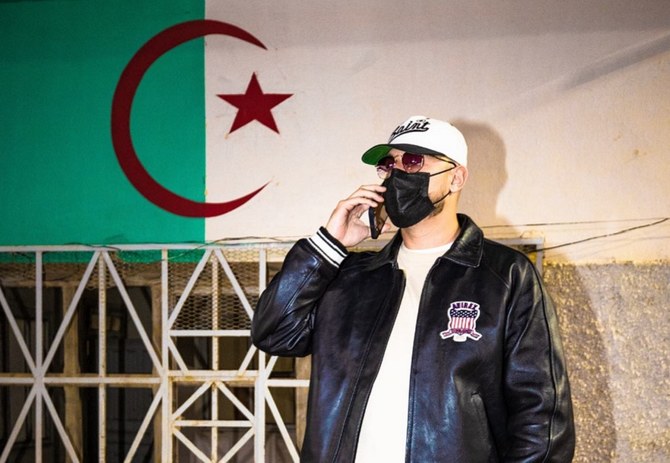
DJ Snake pays homage to Algerian roots in latest release

DJ Snake was born in Paris to Algerian parents. Instagram
Short Url
Updated 03 June 2022
Follow

DJ Snake pays homage to Algerian roots in latest release

DUBAI: Award-winning French music producer DJ Snake has dropped what is perhaps his most personal project.

The French DJ, who is of Algerian descent, released his new single today on Wednesday — and it pays tribute to his North African roots.

Titled “Disco Maghreb,” the rai-infused dancefloor anthem takes its title from the iconic Algerian music label and record shop of the same name. The single, which comes just in time for his upcoming headlining show at Paris Saint Germain’s Parc Des Prince on June 11, is accompanied by a music video filmed in Oran, a coastal city located in the north-west of Algeria from where his family originate.

“I imagined ‘Disco Maghreb’ as a bridge between different generations and origins, linking North Africa, the Arab world and beyond,” wrote the artist on Twitter, calling the song “a love letter to my people.”

The video, produced and directed by a local team, opens with a shot of the iconic record shop’s storefront before panning to clips of a sheep spraypainted with an image of a snake, Algerian sweets, scenes from a traditional wedding and finally, DJ Snake dancing while adlibbing in Darija, a dialect of Arabic spoken in Algeria and Morocco.

The Grammy-nominated producer, whose real name is William Sami Étienne Grigahcine, was born in Paris to Algerian parents and grew up in Ermont, a district outside of the capital.

When he was younger, Grigahcine used to dabble in graffiti, earning him the nickname “Snake” because he was able to consistently evade the police. He started DJing aged 14, and later producing at 19. 

He would go on to produce hits such as “Turn Down for What” featuring Lil Jon, “Lean On” with Major Lazer and “Taki Taki” with Selena Gomez and Cardi B.


Madeeha Qureshi’s new cookbook brings Saudi flavors to the world 

Updated 12 March 2026
Follow

Madeeha Qureshi’s new cookbook brings Saudi flavors to the world 

  •  The former ‘MasterChef UK’ contestant’s recipes pay homage to her childhood in the Kingdom

JEDDAH: Born in Pakistan, raised in Saudi Arabia, and now living in the UK, Madeeha Qureshi says she belongs to “a third-culture space.” Her debut publication, “The Red Sea Cookbook,” is her way of coming home to Saudi Arabia. 

“Among the vibrancy of Saudi food and picturesque landscape, you will find a little girl’s heartwarming stories and memories,” Qureshi, a food writer, recipe developer and content creator who has more than 300,000 followers on Instagram, tells Arab News. “I cannot separate Saudi Arabia from my core DNA. It is with me wherever I go. It is the place where I was brought up, where my memories were made.” 

Born in Pakistan, raised in Saudi Arabia, and now living in the UK, Madeeha Qureshi says she belongs to “a third-culture space.” (Supplied)

British food writer Tom Parker Bowles hailed “The Red Sea Cookbook” as “a joyous introduction to the wonders of Saudi Arabian cookery.” It is part memoir, part culinary atlas, and, Qureshi says, “an applaudable ending to the person who wrote my beginning” — her late father.  

Qureshi arrived in the Kingdom as a baby in the early 1980s, when her father worked on Royal Commission projects in Yanbu and Jubail. Her earliest memories are of living in a community of expatriate families from around the world. 

“We talk about diversity in the West, but Saudi Arabia, at its core, is as diverse as anywhere,” she says. “I was surrounded by people from all walks of life, from every corner of the world.” 

This is the Saudi Arabia that rarely reaches Western audiences: a civilization influenced by centuries of trade routes and pilgrimage.  

Qureshi as a child with her father at the Red Sea coast in Saudi Arabia. (Instagram)

In “The Red Sea Cookbook,” Qureshi writes of a land where the scent of cardamom and dried limes drifts through historic markets, where fishermen along the Red Sea coast haul in grouper and emperor fish at dawn, and where family meals stretch into long evenings filled with coffee and conversation. And Saudi cuisine, she argues, has long been misunderstood and pigeonholed into a vague notion of “Arab food.” 

“There is a general misconception in the West that it’s bland, beige, boring. But it is the polar opposite,” she notes. 

The book’s origins are inseparable from personal loss. When her father — whom she refers to as her “safe space” and the “core of my whole existence”— died, she found herself unable to process the grief.  

“So much happened in such a short time,” she recalls. “I had a rainbow baby, then another baby. Then the (COVID-19) pandemic happened and I lost my job.”  

The cover of Madeeha Qureshi's 'The Red Sea Cookbook.' (Supplied)

The latter shock did mean, however, that she was able to join “MasterChef UK” as a contestant in 2021. 

In the quarterfinals of the famed culinary show, contestants were asked to create a dish that carried deep personal meaning. The challenge transported Qureshi back to the beaches of Yanbu and a childhood snack her father would bring home for her. 

“The thing that popped into my head was mutabbaq — which I associated with my dad from a very young age,” she says. “I decided to give them a taste of something which has never been showcased to the British media.” 

When she presented the dish — a stuffed, shallow-fried pastry common across the Kingdom and the Gulf — to the judges and began explaining the memory behind it, something gave way.  

“All of a sudden, this whole tsunami of tears that was sitting inside me came out. The cameras captured it and when it went on air, the whole country cried with me; they grieved with me.” 

She realized that personal food stories resonate across cultures and that Saudi cuisine had never really been presented on a Western platform. And so, the idea for her memoir-style cookbook was born. 

Qureshi spent three years working on it and weathered hundreds of rejections before Nourish, an imprint of Watkins Media, took the leap.  

“Writing this book made me reflect on the significance of my upbringing in Saudi Arabia and the way it has shaped my life and seasoned my palate,” Qureshi says. 

“The Red Sea Cookbook” was born from the years she spent adapting Saudi dishes with British pantry staples. She found ways to liberate Saudi recipes from the assumption that authentic cooking requires specialist ingredients or elaborate techniques. Her mutabbaq, for example, uses spring roll pastry instead of hand-stretched dough.  

“I actually showcased the idea on ‘MasterChef,’” she explains. “(Because the pastry is ready-made) you can make it within half an hour.” It’s a convenient dish for students and busy professionals living abroad and craving a taste of home. The small change also makes Saudi cooking approachable without losing its soul.  

“The ingredients are not difficult to source,” she adds. “And you can still have the best of your memories, those foods from Saudi Arabia that you remember, without compromising the key flavors.” 

When Qureshi visited Saudi Arabia in April last year, she retraced her childhood, made a pilgrimage to Madinah, and enjoyed exploring Riyadh. She found some places unchanged and others unrecognizable. The country felt transformed and eager to showcase its culture to the world. “The Red Sea Cookbook” is well-suited to this moment. 

“This is actually a book showing Saudi culture moving forward rather than still chained to its past,” she says. “It’s like how the country is unfolding and showing its colors to the world, which people need to see.” 

Those colors include the extraordinary and deceptively simple seafood of the Red Sea coast as well as beloved national favorites such as kabsa, mandi and saleeq, and traditional sweet treats such as sh’ariya and areeka malakiya.  

“Food has the incredible power to transport you somewhere without physically being there,” she writes in the book. “During these unpredictable times, this is the best we can do.”