State TV anchor who visited Israel terminated — Pakistani information minister

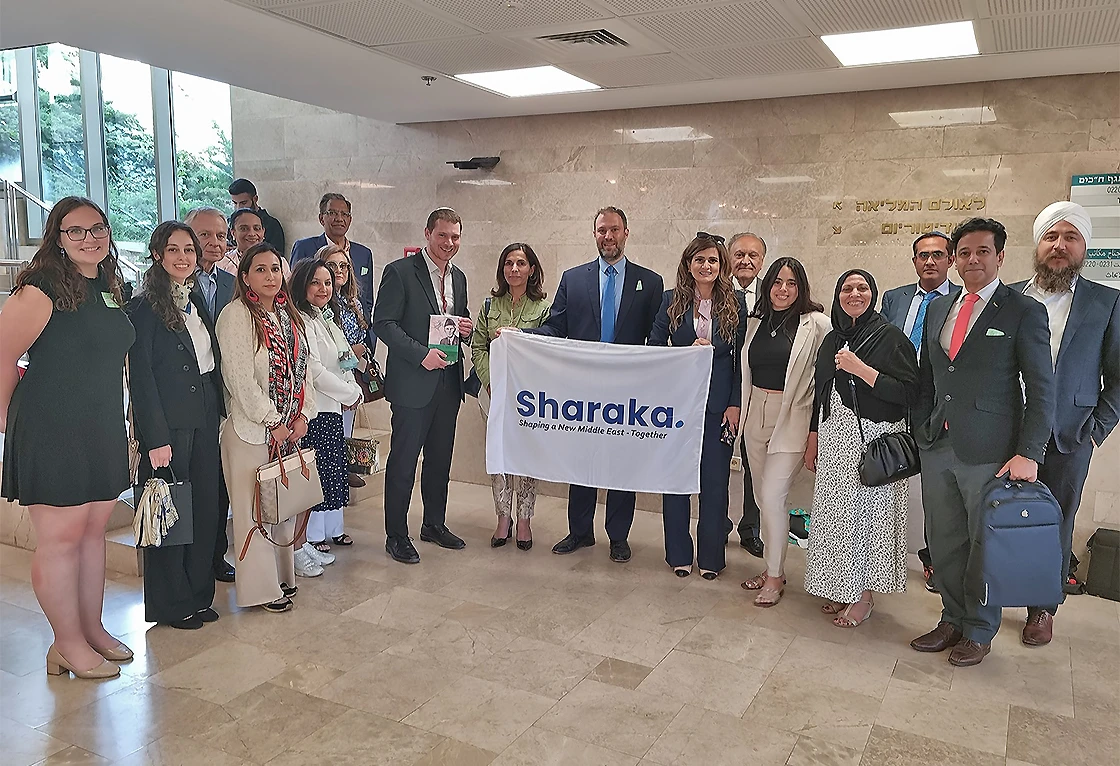
A group poses for a picture during a visit to Israel on May 10, 2022. (@sharakango/Twitter)
Short Url
Updated 30 May 2022
Follow

State TV anchor who visited Israel terminated — Pakistani information minister

  • Controversy stirred after Israeli President Isaac Herzog said he had received delegation of Pakistani-Americans
  • Herzog’s comments raised questions about whether group had visited Israel with official backing of the Pakistani state

ISLAMABAD: A news anchor affiliated with Pakistan Television (PTV) has been sacked from his job for a recent visit to Israel, the information minister said on Monday, reaffirming Islamabad’s “principled stance” on the Palestine conflict.

Pakistan does not recognize Israel and has repeatedly expressed its support for the establishment of an independent State of Palestine with pre-1967 borders in accordance with relevant United Nations and Organization of Islamic Cooperation resolutions.

Israel captured the West Bank and East Jerusalem, the Sinai Peninsula the Gaza Strip and the Golan Heights in the 1967 war. Palestinians want East Jerusalem as the capital of their future free state, a demand Pakistan has supported for decades.

In recent weeks, Israeli President Isaac Herzog’s comments at the World Economic Forum that he had received a delegation of Pakistani-Americans sparked controversy, and raised questions about whether the group had visited Israel in an official capacity. Pictures of the delegation’s visit were also widely shared on social media.

“The PTV anchor involved in the tour has been terminated,” Marriyum Auranzeb was quoted by state news agency APP as saying. “The anchor was on tour in his personal capacity.”

Though the information minister did not name the journalist, it is widely believed she was referring to Ahmed Qureshi, who has hosted a show on state TV and was seen in various pictures of the delegation’s visit.

On Sunday, the foreign office denied reports the delegation had state backing, saying the trip was organized by a foreign non-government organization (NGO) that was not based in Pakistan.

“Pakistan’s position on the Palestinian issue is clear and unambiguous. There is no change whatsoever in our policy on which there is complete national consensus,” a foreign office statement said. “Pakistan steadfastly supports the Palestinian people’s inalienable right to self-determination.” 


Islamabad tree felling sparks debate over Pakistani capital’s green future

Updated 10 sec ago
Follow

Islamabad tree felling sparks debate over Pakistani capital’s green future

  • Authorities say removals target allergy-causing trees under court orders
  • Critics warn development-linked felling is eroding capital’s planned green character

ISLAMABAD: Pakistan’s government is facing growing criticism over a large-scale tree-cutting drive in Islamabad, with residents, environmental experts and lawmakers warning that the removals risk undermining the capital’s carefully planned green character, even as authorities insist the operation is legal and narrowly targeted.

Islamabad, designed in the 1960s by Greek architect Constantinos Doxiadis, was purpose-built to replace Karachi as the federal capital and conceived as a low-density city where green belts and protected natural zones were central to urban planning. The master plan divided the city into sectors separated by open spaces, with surrounding hills and forests intended to act as natural buffers against unchecked expansion.

That vision has come under renewed scrutiny in recent months as thousands of trees have been felled across the capital, including in and around environmentally sensitive areas near the Margalla Hills and Shakarparian, prompting public protests and calls for greater transparency.

Officials from the Capital Development Authority (CDA) acknowledge around 29,000 trees have been cut, but deny that any removals took place in designated green belts. They say replacement plantations exceed the number of trees felled.

Pakistan’s Climate Change Minister Musadik Malik said the bulk of the tree cutting stems from a court order targeting paper mulberry trees, which are blamed for triggering seasonal pollen allergies.

“About three years ago, I guess in 2022 or 2023, the Islamabad High Court made a decision, passed a judgment that all of these paper mulberry trees should be cut, should be culled,” Malik said.

“They are very harmful to people who have asthma,” he added. “So, because of that, according to the plan, the culling of these paper mulberry trees is being carried out.”

CDA officials also reject accusations of illegal felling.

Irfan Niazi, director general environment at the authority, said no development project violates green zoning.

“No development project of CDA is being carried out in the green belt or the green area wherever it was planned in the master plan,” he said. “You will not find a small brown patch on these projects. All of them are purely green and trees in a one-to-10 ratio have been added over there.”

Niazi said Islamabad’s forest cover has more than doubled since it became the capital.

“When Islamabad was announced as the capital at that time it inherited only 18,000 acres of forest … Now, it is 39,130 acres which is a huge area,” he said, adding that more than three million trees were planted in the Margalla Hills National Park last year.

The CDA also pointed to satellite data.

“According to the Normalized Difference Vegetation Index (NDVI) analysis of Islamabad, a comparative assessment between January 2023 and December 2025 shows a net increase of more than 9,000 acres in green cover,” it said in a post on X.

“ERODING GREEN CHARACTER”

Critics say the recent felling has gone far beyond paper mulberry and question whether authorities are respecting the city’s master plan and legal protections for forested areas.

Former CDA planning chief Dr. Ghulam Sarwar Sandhu said development is strictly restricted in forested and protected zones.

“In the master plan of Islamabad three major areas were reserved for forestry,” he said. “One is the Margalla Hills National Park area. It includes Margalla Hills, Shakarparian and two kilometers around Rawal Lake. It has been declared an environmentally sensitive area.”

Sandhu questioned the legality of tree cutting inside protected areas.

“Does the CDA have the power to cut trees from the Margalla Hills National Park area? No. There is no approval from the Islamabad Wildlife Board,” he said. “To me the CDA has no consideration for maintaining the green character of the city as provided in the master plan of Islamabad.”

Environmental groups also dispute the government’s framing, arguing that replacement planting does not compensate for the loss of mature trees or habitat fragmentation.

Muhammad Ibrahim Khan, director forest at WWF, said tree cutting must follow ecological best practices.

“There are ecological rules and regulations, or there is an ecological approach. Do it [cutting] according to the best practice. It is not that the whole of Islamabad should be turned into a plane field first and then tree plantation should be started,” he said.

Khan cited the Margalla Enclave link road, a joint housing project by the CDA and the Defense Housing Authority (DHA), as an example of unchecked development.

“So, for example, on the Margalla Enclave link road that’s being constructed, our team went and assessed it. So far, about 10 to 15 hectares of area has been cleared for the road, and it’s still expanding. It’s a 4-kilometer-long, 12-lane road, so quite a bit of area is being cleared. And it’s not just paper mulberry; there are also some of our native species like shisham and simal that are being cleared as well.”

The controversy has also drawn criticism from within the ruling coalition.

“There has to be a proper plan, even if there is some kind of construction work to be done, it cannot happen at the cost of environment, it cannot happen at the cost of the urban biodiversity, it cannot happen at the cost of clean air, which is most needed,” said Shazia Marri, a member of the National Assembly from the Pakistan Peoples Party, an ally of Prime Minister Shahbaz Sharif’s party.

“Pakistan People’s Party is concerned about this very act of the government where they have cut so many trees. Almost 30,000 trees have been cut in Islamabad. There is no proper justification given. Some say that it is due to pollen allergy but not all trees contribute to pollen allergy. There are all sorts of trees cut. There are very old trees that are being cut, native trees being cut,” she said.

Questions have also been raised about regulatory oversight.

Ali Sakhawat, director of the Islamabad Wildlife Board, said key stakeholders were not informed during recent phases of tree cutting.

“Previously, in the committee that was formed in 2025, our board members were part of it, when there was tree cutting in F9 Park,” he said. “The second phase [of cutting] that they have done, the intimation was not done to the relevant stakeholders. If it was to be done, then no doubt there would have been a public hearing before that.”