Lebanon questions former Nissan boss Carlos Ghosn over Interpol notice

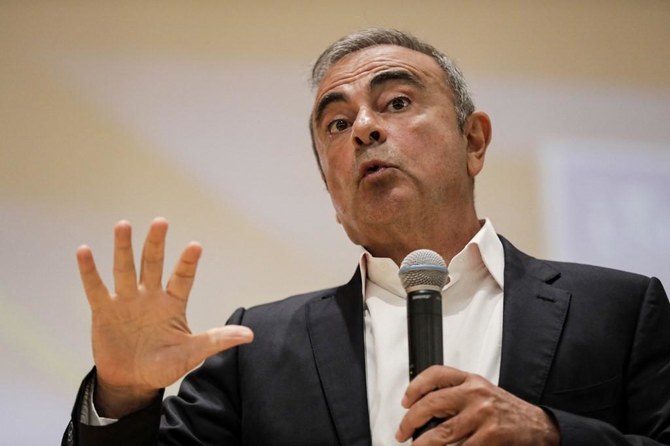
Carlos Ghosn — who holds French, Lebanese and Brazilian citizenships — was initially due to stand trial in Japan following his detention there in 2018, but he jumped bail and fled to Lebanon. (AFP)
Short Url
Updated 30 May 2022
Follow

Lebanon questions former Nissan boss Carlos Ghosn over Interpol notice

  • Questions centered on allegations including ‘money laundering, misuse of power ... squandering company money’
  • Lebanon will send Carlos Ghosn’s responses to French judicial authorities

BEIRUT: Lebanon has questioned ex-Nissan boss Carlos Ghosn after receiving an Interpol red notice for his arrest but did not take new legal measures against him, a court official said Monday.
“Judge Imad Qabalan interrogated Ghosn in the presence of his legal representative over the contents of the red notice,” the official said on condition of anonymity as he is not authorized to speak on the issue.
The questions centered on allegations including “money laundering, misuse of power ... squandering company money” and others, the official said, adding that Ghosn was later released.
Earlier in May, Lebanon received the Interpol red notice, which is not an international arrest warrant, but asks authorities worldwide to provisionally detain people pending possible extradition or other legal actions.
The notice was issued after France sought the arrest of Ghosn in April over suspect payments of some $16.3 million (€15 million) between the Renault-Nissan automaker alliance that Ghosn once headed and its dealer in Oman, Suhail Bahwan Automobiles.
Following the latest questioning session, Lebanon will send Ghosn’s responses to French judicial authorities, the court official said.
Lebanon, which does not extradite its citizens and has banned Ghosn from leaving its territory, asked France to send all evidence it has gathered against the former executive so that the judiciary can determine whether he can be tried in Beirut.
Ghosn — who holds French, Lebanese and Brazilian citizenships — was initially due to stand trial in Japan following his detention there in 2018, but he jumped bail and fled to Lebanon.


Women suicide bombers, new weapons give boost to insurgents in Pakistan

Updated 5 sec ago
Follow

Women suicide bombers, new weapons give boost to insurgents in Pakistan

  • Insurgents put images of women adherents on social media
  • Women recruits ‌fuel group’s propaganda, analysts say
ISLAMABAD: Wearing military fatigues with rifles slung over their shoulders, Yasma Baloch and her husband Waseem smile into the camera for a picture released by Pakistani insurgents after their final mission: detonating suicide bombs.
“They shared a marriage before they shared a final stand,” the Baloch Liberation Army (BLA) said in a statement accompanying the heavily-edited photograph sent to journalists and distributed on social media.
It was among half-a-dozen pictures and biographies that Reuters was unable to immediately verify, but which analysts see as part of a propaganda effort by insurgents in the resource-rich southwestern province to showcase their movement’s appeal.
Insurgent attacks in Pakistan’s largest yet poorest province hit a record last year, fanning risks to huge investments planned in the region, including Chinese and US interests.
Wider ethnic appeal
The growing numbers of women help to boost recruitment, said junior interior minister Talal Chaudhry, in the insurgents’ decades-long battle for greater autonomy and a bigger share of regional resources and critical minerals.
“It gives them popularity and reach, and it impresses on their community that the fight has entered their homes,” Chaudhry told Reuters.
Pakistan has taken up the issue of insurgent recruitment online with numerous social media platforms, ‌he added.
A spokesperson ‌for the BLA did not respond to a request for comment.
Three suicide bombers were among six ‌women ⁠who participated in the ⁠group’s largest wave of attacks in January that killed 58 and nearly brought the province to a standstill, said Hamza Shafaat, a top government official.
Before those attacks, records show a total of five women BLA suicide bombers, including the first such attack in 2022, while three more would-be bombers were captured in counter-terrorism operations in the last some months.
While authorities know of only a small number of women who have joined the ranks of the BLA, analysts say the recruitments point to the group’s widening appeal among ethnic Baloch residents.
“The … insurgency’s broader appeal … has now gone beyond male-dominated tribal and feudal chiefs to include a wider cross-section of society,” said Pearl Pandya, a senior South Asia analyst at conflict monitor ACLED.
‘Most lethal insurgent group’
The participation of women amplifies a ⁠movement that Pakistan’s military says has boosted its firepower with access to a massive cache of US weapons ‌left behind in Afghanistan after Washington pulled out of the neighboring country in 2021.
“In South ‌Asia today, the BLA is the most organized and lethal insurgent group,” said Abdul Basit, a researcher in insurgencies and militancy at Nanyang Technological University in Singapore.
He ‌cited the group’s use of drones to identify troop deployments and vulnerabilities, adding that it used satellite communication during a February 2025 hijack ‌of a train with more than 400 aboard.
Pakistan recovered 272 US made rifles and 33 night vision devices by June last year, its military says, apart from the weapons seized in the most recent Balochistan attacks.
The armed forces “keep on seeing these weapons in the hands of the terrorists operating inside Pakistan,” their spokesperson, Lt. General Ahmed Sharif Chaudhry, told Reuters before January’s attacks.
The Pentagon did not respond to a request for comment.
In reply to a request for comment, White House ‌spokeswoman Anna Kelly said, “As President Trump has said, Joe Biden’s botched Afghanistan withdrawal was the most embarrassing day in our country’s history, which tragically resulted in the deaths of 13 US service members and lost ⁠equipment to the Taliban.”
She added, “We do ⁠not discuss private conversations with foreign governments.”
During more than a dozen coordinated attacks in January, the insurgents stormed hospitals, government buildings, and markets, set off bombs and fired into crowds, killing 58 civilians and security officials.
‘Dangerous evolution in tactics’
Afterwards, from the 216 militants that security forces said were killed in nearly a week of fighting, they seized items ranging from grenade launchers to more than a dozen M16 and M4 rifles.
Reuters was unable to verify whether the sophisticated weapons used in the BLA attacks were made in the United States or came from elsewhere.
Among the $7 billion worth of equipment left in Afghanistan, the US defense department has said, Afghan forces had received more than 300,000 of a total of 427,300 weapons.
That was in addition to more than 42,000 items such as night vision goggles and surveillance devices, it said.
And the insurgents hope propaganda about women recruits will boost their impact.
“They are using women strategically in high-profile attacks for visibility,” Basit added.
The women hail from various socio-economic backgrounds, with some having university education, Pakistan’s counter terrorism department said in a December report seen by Reuters.
“The shift represents a dangerous evolution in terrorist tactics,” it said, about women’s growing participation.
The change was driven by psychological manipulation, online radicalization and strategic exploitation of vulnerable individuals, it added.
“The insurgency’s foot soldiers and leaders both now come from the middle class,” said Pandya, the ACLED analyst.