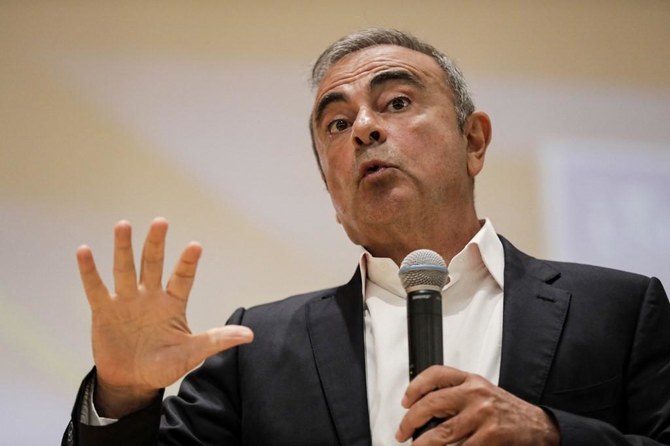
BEIRUT: Lebanon has questioned ex-Nissan boss Carlos Ghosn after receiving an Interpol red notice for his arrest but did not take new legal measures against him, a court official said Monday.
“Judge Imad Qabalan interrogated Ghosn in the presence of his legal representative over the contents of the red notice,” the official said on condition of anonymity as he is not authorized to speak on the issue.
The questions centered on allegations including “money laundering, misuse of power ... squandering company money” and others, the official said, adding that Ghosn was later released.
Earlier in May, Lebanon received the Interpol red notice, which is not an international arrest warrant, but asks authorities worldwide to provisionally detain people pending possible extradition or other legal actions.
The notice was issued after France sought the arrest of Ghosn in April over suspect payments of some $16.3 million (€15 million) between the Renault-Nissan automaker alliance that Ghosn once headed and its dealer in Oman, Suhail Bahwan Automobiles.
Following the latest questioning session, Lebanon will send Ghosn’s responses to French judicial authorities, the court official said.
Lebanon, which does not extradite its citizens and has banned Ghosn from leaving its territory, asked France to send all evidence it has gathered against the former executive so that the judiciary can determine whether he can be tried in Beirut.
Ghosn — who holds French, Lebanese and Brazilian citizenships — was initially due to stand trial in Japan following his detention there in 2018, but he jumped bail and fled to Lebanon.

Lebanon questions former Nissan boss Carlos Ghosn over Interpol notice
https://arab.news/b2at3
Lebanon questions former Nissan boss Carlos Ghosn over Interpol notice
- Questions centered on allegations including ‘money laundering, misuse of power ... squandering company money’
- Lebanon will send Carlos Ghosn’s responses to French judicial authorities
In show of support, Canada, France open consulates in Greenland
- Decisions taken in a strong show of support for Greenland government amid threats by US President Trump to seize the island
COPENHAGEN, Denmark: Canada and France, which both adamantly oppose Donald Trump’s wish to control Greenland, will open consulates in the Danish autonomous territory’s capital on Friday, in a strong show of support for the local government.
Since returning to the White House last year, Trump has repeatedly insisted that Washington needs to control the strategic, mineral-rich Arctic island for security reasons.
The US president last month backed off his threats to seize Greenland after saying he had struck a “framework” deal with NATO chief Mark Rutte to ensure greater American influence.
A US-Denmark-Greenland working group has been established to discuss ways to meet Washington’s security concerns in the Arctic, but the details of the talks have not been made public.
While Denmark and Greenland have said they share Trump’s security concerns, they have insisted that sovereignty and territorial integrity are a “red line” in the discussions.
“In a sense, it’s a victory for Greenlanders to see two allies opening diplomatic representations in Nuuk,” said Jeppe Strandsbjerg, a political scientist at the University of Greenland.
“There is great appreciation for the support against what Trump has said.”
French President Emmanuel Macron announced Paris’s plans to open a consulate during a visit to Nuuk in June, where he expressed Europe’s “solidarity” with Greenland and criticized Trump’s ambitions.
The newly-appointed French consul, Jean-Noel Poirier, has previously served as ambassador to Vietnam.
Canada meanwhile announced in late 2024 that it would open a consulate in Greenland to boost cooperation.
The opening of the consulates is “a way of telling Donald Trump that his aggression against Greenland and Denmark is not a question for Greenland and Denmark alone, it’s also a question for European allies and also for Canada as an ally, as a friend of Greenland and the European allies also,” Ulrik Pram Gad, Arctic expert at the Danish Institute of International Studies, told AFP.
“It’s a small step, part of a strategy where we are making this problem European,” said Christine Nissen, security and defense analyst at the Europa think tank.
“The consequences are obviously not just Danish. It’s European and global.”
Recognition
According to Strandsbjerg, the two consulates — which will be attached to the French and Canadian embassies in Copenhagen — will give Greenland an opportunity to “practice” at being independent, as the island has long dreamt of cutting its ties to Denmark one day.
The decision to open diplomatic missions is also a recognition of Greenland’s growing autonomy, laid out in its 2009 Self-Government Act, Nissen said.
“In terms of their own quest for sovereignty, the Greenlandic people will think to have more direct contact with other European countries,” she said.
That would make it possible to reduce Denmark’s role “by diversifying Greenland’s dependence on the outside world, so that it is not solely dependent on Denmark and can have more ties for its economy, trade, investments, politics and so on,” echoed Pram Gad.
Greenland has had diplomatic ties with the European Union since 1992, with Washington since 2014 and with Iceland since 2017.
Iceland opened its consulate in Nuuk in 2013, while the United States, which had a consulate in the Greenlandic capital from 1940 to 1953, reopened its mission in 2020.
The European Commission opened its office in 2024.


