POKHARA, Nepal: Nepali rescuers pulled 14 bodies on Monday from the mangled wreckage of a passenger plane strewn across a mountainside that went missing in the Himalayas with 22 people on board.
Air traffic control lost contact with the Twin Otter aircraft operated by Nepali carrier Tara Air shortly after taking off from Pokhara in western Nepal on Sunday morning headed for Jomsom, a popular trekking destination.
Helicopters operated by the military and private firms scoured the remote mountainous area all day Sunday, aided by teams on foot, but called off the search when night fell, as bad weather hampered the recovery operation at around 3,800-4,000 meters (12,500-13,000 feet) above sea level.
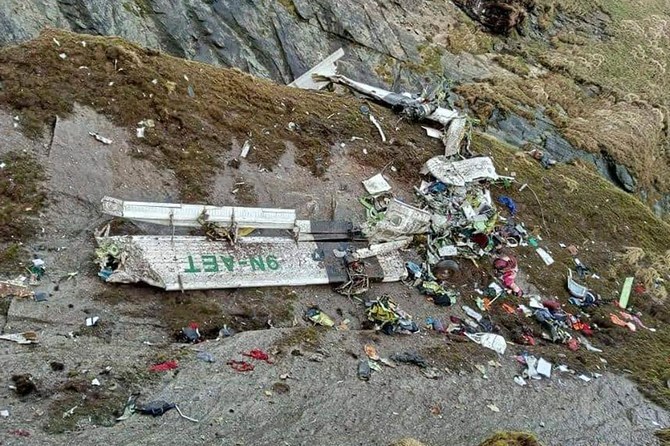
After the search resumed on Monday, the army shared on social media a photo of aircraft parts and other debris littering a sheer mountainside including a wing with the registration number 9N-AET clearly visible.
Four Indians were on board as well as two Germans, with the remainder Nepalis. There was no word on the cause of the crash.
The Civil Aviation Authority confirmed that the plane “met an accident” at 14,500 feet (4,420 meters) in the Sanosware area of Thasang rural municipality in Mustang district.
“Fourteen bodies have been recovered so far, search continues for the remaining. The weather is very bad but we were able to take a team to the crash site. No other flight has been possible,” authority spokesman Deo Chandra Lal Karn told AFP.
Pokhara Airport spokesman Dev Raj Subedi told AFP the rescuers had followed GPS, mobile and satellite signals to narrow down the location.
Pradeep Gauchan, a local official, said that the wreckage was at a height of around 3,800-4,000 meters (12,500-13,000 feet) above sea level.
“It is very difficult to reach there by foot. One team has been dropped close to the area by a helicopter but it is cloudy right now so flights have not been possible,” Gauchan told AFP earlier in the day.
“Helicopters are on standby waiting for the clouds to clear,” he said.
According to the Aviation Safety Network website, the aircraft was made by Canada’s de Havilland and made its first flight more than 40 years ago in 1979.
Tara Air is a subsidiary of Yeti Airlines, a privately owned domestic carrier that services many remote destinations across Nepal.
It suffered its last fatal accident in 2016 on the same route when a plane with 23 on board crashed into a mountainside in Myagdi district.
Nepal’s air industry has boomed in recent years, carrying goods and people between hard-to-reach areas as well as foreign trekkers and climbers.
But it has long been plagued by poor safety due to insufficient training and maintenance.
The European Union has banned all Nepali airlines from its airspace over safety concerns.
The Himalayan country also has some of the world’s most remote and tricky runways, flanked by snow-capped peaks with approaches that pose a challenge even for accomplished pilots.
The weather can also change quickly in the mountains, creating treacherous flying conditions.
In March 2018, a US-Bangla Airlines plane crash-landed near Katmandu’s notoriously difficult international airport, skidded into a football field and burst into flames.
Fifty-one people died and 20 miraculously escaped the burning wreckage but sustained serious injuries.
That accident was Nepal’s deadliest since 1992, when all 167 people aboard a Pakistan International Airlines plane died when it crashed on approach to Katmandu airport.
Just two months earlier a Thai Airways aircraft had crashed near the same airport, killing 113 people.


![]()

Bodies pulled from wreckage of missing Nepal plane carrying 22 passengers
Short Url
https://arab.news/zs35e
Bodies pulled from wreckage of missing Nepal plane carrying 22 passengers
- The plane lost contact with air traffic control soon after the take-off on Sunday
- Nepal’s air industry has recently boomed, though it has been plagued by poor safety
Latest updates


© 2026 SAUDI RESEARCH & PUBLISHING COMPANY, All Rights Reserved And subject to Terms of Use Agreement.