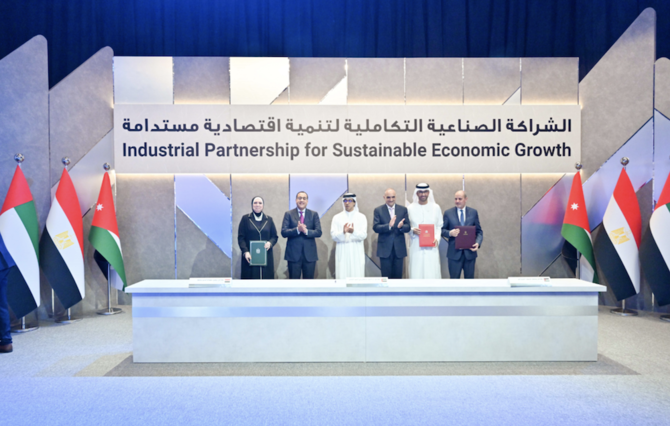

CAIRO: The UAE, Egypt and Jordan officially signed the Industrial Partnership for Sustainable Economic Growth in Abu Dhabi on Sunday, Emirates News Agency (WAM) reported.

UAE Deputy Prime Minister and Minister of Presidential Affairs Sheikh Mansour bin Zayed Al-Nahyan witnessed the signing of the partnership to enhance economic growth across five key sectors: food and agriculture, fertilizers, pharmaceuticals, textiles, minerals, and petrochemicals.
The signing was also attended by Egypt and Jordan’s Prime Ministers Madbouly and Bisher Al-Khasawneh, respectively.
“The partnership embodies the vision of President Sheikh Mohammed bin Zayed to enhance industrial integration with Arab nations and the rest of the world so we can achieve a major leap in the industrial sector and transform its potential as an economic driver,” Sheikh Mansour said. “Industry is the backbone of the world’s largest economies.”
He continued: “Through its capabilities, effective policies and current focus on developing advanced technology and logistics infrastructure, we are confident that the UAE can build a global economic powerhouse by leveraging industrial partnerships across the region.”
Madbouly said that the COVID-19 pandemic and Russian-Ukrainian crises had highlighted the need for deeper integration between Arab countries.
“The projects that have been agreed upon will create added value for the three countries and will have a positive impact on national security, local industry, and supply chain activities,” Madbouly said.
“There will be a continuous follow-up to the implementation of these projects, facilitating procedures, and overcoming obstacles.
“We aim to quickly reap the benefits of these projects, especially as the first phase achieves many gains in terms of enhancing food and drug security, the projects will also attract foreign investment and provide job opportunities for our youth,” he added.
“The continued active interaction and coordination at the leadership level confirms the strength of these relations with the industrial sector at the center of the partnership,” said Al-Khasawneh.
“In Jordan, an attractive investment destination, industry contributes to 24 percent of the GDP, and account for 21 percent of the countries employment.”
Madbouly and Al-Jaber also agreed to set up working groups to formulate renewable energy agreements between Egypt and the UAE.
Madbouly said that “one of the promising areas of Egyptian-Emirati cooperation is the new and renewable energy sector,” explaining that “there are directives from President Abdel Fattah El-Sisi to increase cooperation with brothers in the Emirates in this field, in light of the increasing demand for clean energy and green hydrogen.”
The prime minister touched on two renewable energy projects, the first related to the generation of 10,000 megawatts of wind energy in the Red Sea, and the second related to the generation of 200 gigawatts of solar and wind energy by creating a clean energy corridor, transferring it through a separate network, and then selling it to factories wishing to enter the field of green hydrogen production.
Al-Jaber welcomed the UAE’s cooperation with Egypt on the projects, stressing that the directives of Sheikh Mohamed bin Zayed Al-Nahyan, president of the state, always emphasized cooperation with Egypt.
Al-Jaber said that there was an opportunity to take advantage of the momentum associated with Egypt’s hosting of the COP27 climate conference and to carry out projects related to clean energy.