25 missing after cargo boat sinks in Indonesia

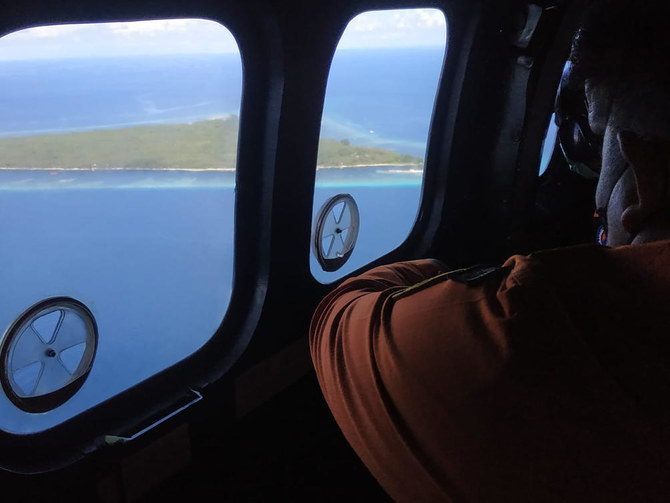
Rescuers look out of the windows of a helicopter during a search flight for a sinking ferry over Makassar Strait, Indonesia on May 29, 2022. (BASARNAS Sulawesi Selatan via AP)
Short Url
Updated 29 May 2022
Follow

25 missing after cargo boat sinks in Indonesia

  • A total of 42 people were on the boat when it sank in bad weather on Thursday morning
  • Ferry tragedies are common in Indonesia, an archipelago of more than 17,000 islands

MAKASSAR, Indonesia: Rescuers in Indonesia were searching for 25 people who were missing after a cargo boat sank in the Makassar Strait in South Sulawesi province, officials said Sunday.
A total of 42 people were on the boat when it sank in bad weather on Thursday morning while traveling from a seaport in Makassar to Kalmas Island in Pangkep Regency, said Djunaidi, the head of the provincial search and rescue agency. Like many Indonesians, Djunaidi goes by only one name.
Seventeen people were later rescued, including some by two tugboats that were at sea at the time of the incident.
Djunaidi said the search and rescue agency received new information about the location of the sunken boat on Saturday and dispatched crews to the area. Two motor boats and a search and rescue boat, along with local fishing boats and Indonesia air force helicopters, are involved in the search for the missing passengers.
The sunken vessel was initially said to be a passenger ferry, but Djunaidi later clarified that it was a cargo boat carrying construction materials. Thirty-six passengers had asked for a ride on the boat and there were six crew members.
Ferry tragedies are common in Indonesia, an archipelago of more than 17,000 islands, where ferries are often used as transport and safety regulations can lapse.
In 2018, an overcrowded ferry with about 200 people on board sank in a deep volcanic crater lake in North Sumatra province, killing 167 people.
In one of the country’s worst recorded disasters, an overcrowded passenger ship sank in February 1999 with 332 people aboard. There were only 20 survivors.


Britain needs to step up defense spending faster, says Starmer

Britain's Prime Minister Keir Starmer takes part in a panel discussion in Munich, Germany. (AP file photo)
Updated 5 sec ago
Follow

Britain needs to step up defense spending faster, says Starmer

  • Britain’s budget watchdog, the Office for Budget Responsibility, said last year that raising defense spending to 3 percent of the GDP would cost an additional £17.3 billion a year ($24 billion) in 2029-30

LONDON: Britain should step up and accelerate its ​defense spending, Prime Minister Keir Starmer said on Monday, following a report that the government was considering bringing forward its target to spend 3 percent of economic output on defense.
Britain, which has warned of the risks posed by Russia, said in February 2025 that it would lift annual defense spending to 2.5 percent of the GDP by 2027 and aim for 3 percent in the next Parliament, which is expected to begin after an ‌election due in ‌2029.
The BBC reported that the government was ​now ‌exploring ways to ​reach the 3 percent target by 2029. It said no decision had been taken but the government recognized current plans would not cover rising defense costs.

HIGHLIGHT

The BBC reported that the government is ​now ‌exploring ways to ​reach the 3 percent target by 2029.

Asked whether he would bring the target forward to 2029, Starmer echoed comments he made at the Munich Security Conference, where he said Europe had united to support Ukraine with the supply of weapons and munitions and to strengthen military readiness.
“We need to step up. That means on ‌defense spending, we need to go faster,” ‌Starmer told reporters on Monday. “We’ve obviously made commitments ​already in relation to that, but ‌it goes beyond just how much you spend.”
Latest NATO estimates show ‌that Britain spent 2.3 percent of the GDP on defense in 2024, above the alliance’s 2 percent guideline. But like other European countries, it has faced US pressure to spend more to protect the continent. Struggling with high debt and spending commitments, the government last ‌year cut its international aid budget to fund the hike in defense spending to 2.5 percent of GDP but is yet to publish an investment plan with spending priorities, something that has frustrated the defense industry.
Britain’s budget watchdog, the Office for Budget Responsibility, said last year that raising defense spending to 3 percent of the GDP would cost an additional £17.3 billion a year ($24 billion) in 2029-30.
Finance Minister Rachel Reeves has struggled to stay on track with her plans to repair the public finances. The BBC said the Finance Ministry was believed to be cautious about the new defense spending proposals.
A government spokesperson said Britain was “delivering ​the largest sustained increase in defense ​spending since the Cold War.”