

UN Security Council in renewed call for Abu Akleh’s killers to be brought to justice

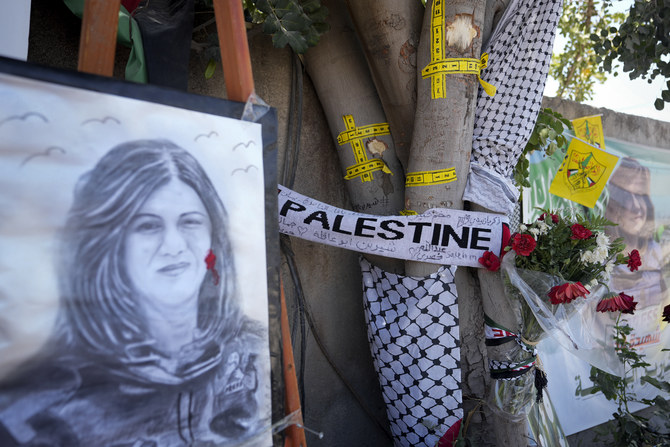
Makeshift memorial at the site where journalist Shireen Abu Akleh was shot and killed in the West Bank city of Jenin. (AP)
Short Url
Updated 26 May 2022
Follow

UN Security Council in renewed call for Abu Akleh’s killers to be brought to justice

  • Council members condemn Israeli violence at slain journalist’s funeral and repeat demands for independent investigation into her death
  • Israel again called on to halt settlement expansion, and rescind Palestinian property demolition and eviction orders

NEW YORK: The killing of Palestinian-American journalist Shireen Abu Akleh in Jenin in the West Bank and the subsequent excessive use of force by Israeli police against mourners at her funeral were again a key focus of a UN Security Council meeting held on Thursday to discuss the latest report on the situation in the Palestinian territories.

Council members condemned Abu Akleh’s killing, and reiterated their calls for an independent and transparent investigation into her death, while Tor Wennesland, the UN special coordinator for the Middle East peace process, said that “those responsible must be held accountable.”

US permanent representative to the UN Linda Thomas-Greenfield described Abu Akleh’s “heart-wrenching killing” as a “tragic loss and an affront to press freedoms everywhere.”

She strongly condemned the killing, and called for “an immediate, thorough, transparent and impartial investigation,” adding: “And upon the conclusion of an investigation, we expect full accountability for those found responsible.”

Thomas-Greenfield said that Abu Akleh’s death was compounded by the violence at her funeral procession.

“We have directly shared our concern with Israel regarding the troubling footage of Israeli police intruding on the procession,” she said.

The US envoy called on all parties to honor Abu Akleh by “redoubling” peace efforts.

Former and current European members of the Security Council also reiterated their call for an investigation into Abu Akleh’s killing and expressed shock at “the violence exercised by the Israeli police toward mourners at her funeral.”

In a joint statement issued after the Security Council meeting, EU members France, Ireland and Estonia, joined by Albania, deplored the decision by the Israeli Higher Planning Council on May 12 to advance plans for the construction of more than 4,000 housing units in the occupied West Bank.

The statement urged Israel to rescind that decision, as well as abandon planned demolitions and evictions, especially in Masafer Yatta area, which alone could result in the forced transfer of 1,200 people.

Condemning all attacks against journalists, Wennesland said that Abu Akleh’s death “brought Palestinians and countless others around the world together in grief and anger, while serving as another reminder of the devastating human cost of this conflict.”

The special coordinator also lamented “the familiar pattern of daily violence, including armed clashes, settlement expansion, evictions, demolitions and seizures of Palestinian structures, as well as a deadly terrorist attack in Israel.”

The daily violence has left 10 Palestinians, including a woman and three children, dead and 346 Palestinians, including 24 children, injured.

Those deaths and injuries at the hands of Israeli security forces occurred during demonstrations, clashes, and search-and-arrest operations, said Wennesland.

He said that Israeli settlers and other civilians have carried out 57 attacks against Palestinians, resulting in one Palestinian child being killed, 24 injuries and damage to Palestinian property.

Meanwhile, four Israeli civilians and one Israeli security personnel were killed and 22 civilians and 20 security personnel injured by Palestinians in shooting and stabbing attacks or clashes involving the throwing of stones or homemade incendiary devices.

Wennesland also called for urgent attention to the Palestinian Authority’s “dire” financial situation, “compounded by the constraints of the occupation, the absence of serious Palestinian reforms and unclear prospects for donor support.”

He said: “Without meaningful policy steps on the part of Israel, bold reforms on the part of the PA and increased donor support, these economic challenges will continue.”


Israel orders Gaza families to move in first forced evacuation since ceasefire

Updated 58 min 21 sec ago
Follow

Israel orders Gaza families to move in first forced evacuation since ceasefire

  • Residents of Bani Suhaila, east of Khan Younis, said the leaflets were dropped on Monday on families living in tent encampments in the Al-Reqeb neighborhood

CAIRO: Israeli forces have ordered dozens of Palestinian families in the southern Gaza Strip to leave their homes in the first forced evacuation since October’s ceasefire, as residents and Hamas said on Tuesday the military was ​expanding the area under its control.
Residents of Bani Suhaila, east of Khan Younis, said the leaflets were dropped on Monday on families living in tent encampments in the Al-Reqeb neighborhood.
“Urgent message. The area is under IDF control. You must evacuate immediately,” said the leaflets, written in Arabic, Hebrew, and English, which the army dropped over the Al-Reqeb neighborhood in the town of Bani Suhaila.
In the two-year war before the US brokered ceasefire was signed in October, Israel dropped leaflets over areas that were subsequently raided or bombarded, forcing some families to move several times.
Residents and a source from the Hamas militant group said this was the first time they had been ‌dropped since then. ‌The Israeli military did not immediately respond to a request for comment.

SIDES FAR ‌APART ⁠ON ​NEXT PHASES
The ‌ceasefire has not progressed beyond its first phase, under which major fighting has stopped, Israel withdrew from less than half of Gaza, and Hamas released hostages in return for Palestinian detainees and prisoners.
Virtually the entire population of more than 2 million people are confined to around a third of Gaza’s territory, mostly in makeshift tents and damaged buildings, where life has resumed under control of an administration led by Hamas.
Israel and Hamas have accused each other of major breaches of the ceasefire and remain far apart on the more difficult steps planned for the next phase.
Mahmoud, a resident from the ⁠Bani Suhaila area, who asked not to give his family name, said the evacuation orders impacted at least 70 families, living in tents and homes, ‌some of which were partially damaged, in the area.
“We have fled ‍the area and relocated westward. It is maybe the ‍fourth or fifth time the occupation expanded the yellow line since last month,” he told Reuters by phone ‍from Khan Younis, referring to the line behind which Israel has withdrawn.
“Each time they move it around 120 to 150 meters (yards) inside the Palestinian-controlled territory, swallowing more land,” the father-of-three said.

HAMAS CITES STATE OF HUMANITARIAN DISRUPTION
Ismail Al-Thawabta, director of the Hamas-run Gaza government media office, said the Israeli military had expanded the area under its control in eastern Khan Younis five times since ​the ceasefire, forcing the displacement of at least 9,000 people.
“On Monday, 19 January 2026, the Israeli occupation forces dropped warning leaflets demanding the forced evacuation of the Bani Suhaila area in eastern ⁠Khan Younis Governorate, in a measure that falls within a policy of intimidation and pressure on civilians,” Thawabta told Reuters.
He said the new evacuation orders affected approximately 3,000 people.
“The move created a state of humanitarian disruption, increased pressure on the already limited shelter areas, and further deepened the internal displacement crisis in the governorate,” Thawabta added.
Israel’s military has previously said it has opened fire after identifying what it called “terrorists” crossing the yellow line and approaching its troops, posing an immediate threat to them.
It has continued to conduct air strikes and targeted operations across Gaza. The Israeli military has said it views “with utmost severity” any attempts by militant groups in Gaza to attack Israel.
Under future phases of the ceasefire that have yet to be hammered out, US President Donald Trump’s plan envisages Hamas disarming, Israel pulling out further, and an internationally backed administration rebuilding Gaza.
More than 460 Palestinians and three Israeli soldiers have been reported killed since the ceasefire took ‌effect.
Israel launched its operations in Gaza in the wake of an attack by Hamas-led fighters in October 2023 which killed 1,200 people, according to Israeli tallies. Israel’s assault has killed 71,000 people, according to health authorities in the enclave.