

Pakistan central bank raises key interest rate by 1.5% to 13.75% as inflation outlook deteriorates

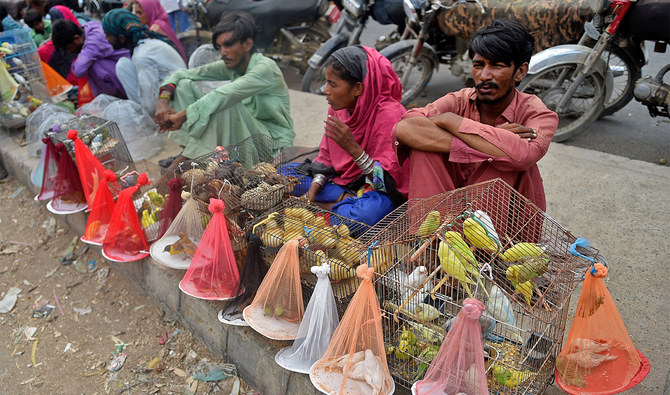
Vendors selling birds wait for customers at a weekly birds and animals market in Karachi on May 22, 2022. (AFP)
Short Url
Updated 23 May 2022
Follow

Pakistan central bank raises key interest rate by 1.5% to 13.75% as inflation outlook deteriorates

  • Rupee hit all-time low at Rs200.93 against USD on Monday amid continued demand for import payments, increase in inflation
  • Pakistan and IMF are currently negotiating country’s seventh review under $6 billion loan facility, with $3 disbursed so far

KARACHI: Pakistan’s central bank on Monday raised the key policy rate by 150 basis points to 13.75 percent as the inflation outlook deteriorated due to home-grown and international factors, the State Bank of Pakistan said. 
The central bank announcement comes at a time when the country’s national currency hit an all time low at Rs200.93 against the United States Dollar on Monday, amid continued demand for import payments and as inflation increased by 13.4 percent in the month of April 2022. 

The central bank said provisional estimates suggest growth in the current fiscal year had been much stronger than expected but a recent fuel subsidy had compounded pressure on the exchange rate. 

Previously, the central bank had hiked the key interest rates by 250 basis points to 12.25 percent in an emergency meeting on April 7, 2022, citing deterioration in the inflation outlook and rising risks to external stability due to domestic political uncertainty and the Russia-Ukraine war.

“External pressures remain elevated and the inflation outlook has deteriorated due to both home-grown and international factors,” the monetary policy statement said. “Domestically, an expansionary fiscal stance this year, exacerbated by the recent energy subsidy package, has fueled demand and lingering policy uncertainty has compounded pressures on the exchange rate.” 

Globally, inflation has intensified due to the Russia-Ukraine conflict and renewed supply disruptions caused by a new COVID-19 wave in China. As a result, almost all central banks across the world are suddenly confronting multi-year high inflation and a challenging outlook, the Pakistani state bank said.

“This action, together with much needed fiscal consolidation, should help moderate demand to a more sustainable pace while keeping inflation expectations anchored and containing risks to external stability,” the statement added. 

The central bank said the country’s economy was estimated to grow by around 6 percent this year. 

“After contracting by 0.9 percent in FY20 in the wake of COVID, the economy has rebounded much more strongly than anticipated, growing by 5.7 percent last year and accelerating to 5.97 percent this year, as per provisional estimates,” the central bank said.

At 13.4 percent, headline inflation unexpectedly rose to a two-year high in April and has now been in double digits for six consecutive months. 

Inflation momentum was also elevated, at 1.6 percent on a monthly basis, and core inflation rose further to 10.9 and 9.1 percent in rural and urban areas, respectively. On the external front, notwithstanding some encouraging moderation in the current account deficit during April, the rupee depreciated further due to both domestic uncertainty as well as the recent strengthening of the US dollar in international markets following the tightening by the Federal Reserve. 

“The baseline outlook assumes continued engagement with the IMF (International Monetary Fund), as well as reversal of fuel and electricity subsidies together with normalization of the petroleum development levy (PDL) and General Sales Tax on fuel during FY23,” the central bank said.
 
Pakistan and the IMF are currently negotiating the country’s seventh review under a $6 billion Extended Fund Facility (EFF), with $3 billion disbursed so far. Islamabad is expected to receive another $1 billion after the completion of the review, which has been stalled since the previous government announced in February an around $1.7 billion relief package in energy prices.


UN torture expert decries Pakistan ex-PM Khan’s detention

Updated 12 December 2025
Follow

UN torture expert decries Pakistan ex-PM Khan’s detention

  • Khan’s party alleges government is holding him in solitary confinement, barring prison visits
  • Pakistan’s government rejects allegations former premier is being denied basic rights in prison

GENEVA: Pakistan’s former prime minister Imran Khan is being held in conditions that could amount to torture and other inhuman or degrading treatment, the United Nations’ special rapporteur on torture warned Friday.

Alice Jill Edwards urged Pakistan to take immediate and effective action to address reports of the 73-year-old’s inhumane and undignified detention conditions.

“I call on Pakistani authorities to ensure that Khan’s conditions of detention fully comply with international norms and standards,” Edwards said in a statement.

“Since his transfer to Adiala Jail in Rawalpindi on September 26, 2023, Imran Khan has reportedly been held for excessive periods in solitary confinement, confined for 23 hours a day in his cell, and with highly restricted access to the outside world,” she said.

“His cell is reportedly under constant camera surveillance.”

Khan an all-rounder who captained Pakistan to victory in the 1992 Cricket World Cup, upended Pakistani politics by becoming the prime minister in 2018.

Edwards said prolonged or indefinite solitary confinement is prohibited under international human rights law and constitutes a form of psychological torture when it lasts longer than 15 days.

“Khan’s solitary confinement should be lifted without delay. Not only is it an unlawful measure, extended isolation can bring about very harmful consequences for his physical and mental health,” she said.

UN special rapporteurs are independent experts mandated by the Human Rights Council. They do not, therefore, speak for the United Nations itself.

Initially a strong backer of the country’s powerful military leadership, Khan was ousted in a no-confidence vote in 2022, and has since been jailed on a slew of corruption charges that he denies.

He has accused the military of orchestrating his downfall and pursuing his Tehreek-e-Insaf (PTI) party and its allies.

Khan’s supporters say he is being denied prison visits from lawyers and family after a fiery social media post this month accusing army leader Field Marshal Asim Munir of persecuting him.

According to information Edwards has received, visits from Khan’s lawyers and relatives are frequently interrupted or ended prematurely, while he is held in a small cell lacking natural light and adequate ventilation.

“Anyone deprived of liberty must be treated with humanity and dignity,” the UN expert said.

“Detention conditions must reflect the individual’s age and health situation, including appropriate sleeping arrangements, climatic protection, adequate space, lighting, heating, and ventilation.”

Edwards has raised Khan’s situation with the Pakistani government.