Saudis are natural-born storytellers, says Saudi Film Commission CEO

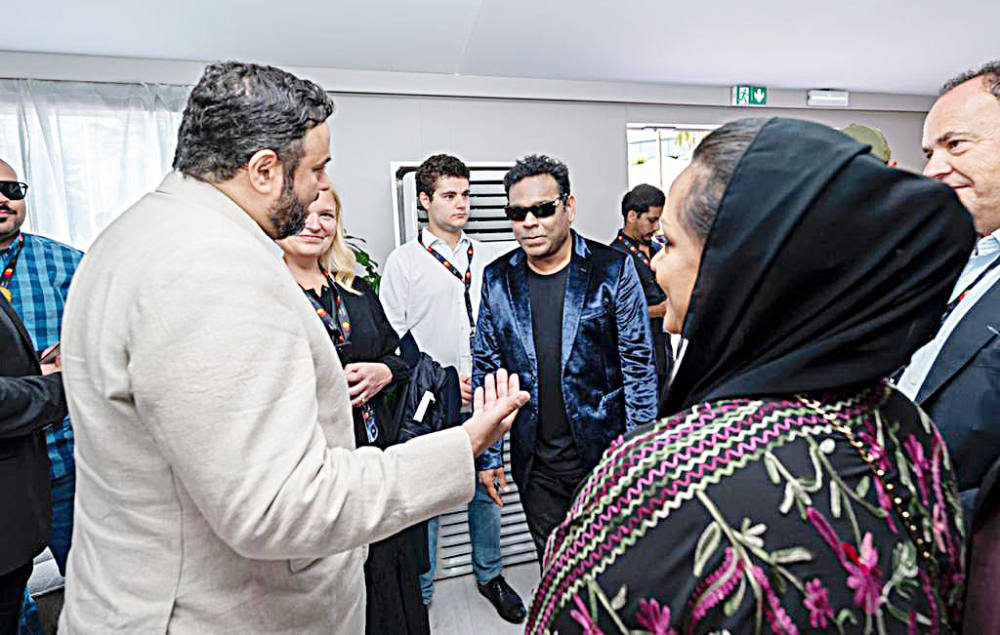
Saudi Film Commission CEO Abdullah Al-Eyaf held several discussions with international industry professionals during the 75th Cannes Film Festival. (Supplied)
Short Url
Updated 22 May 2022
Follow

Saudis are natural-born storytellers, says Saudi Film Commission CEO

  • Abdullah Al-Eyaf discusses the importance of Saudi talent during the 75th Cannes Film Festival

CANNES: Abdullah Al-Eyaf, the CEO of the Saudi Film Commission, aims to drive the Saudi film industry by fostering an environment for young Saudi filmmakers to develop their passions and talents.

During a panel discussion hosted on Sunday in the March du Film pavilion in Cannes, Al-Eyaf expressed his vision for Saudi youth filmmakers and the important role they play in the industry.

“We in the commission strongly believe in the filmmakers in Saudi, actually they are the reason behind all that we do,” Al-Eyaf said.
The Kingdom’s film industry is bursting with talent and passion from Saudi filmmakers, writers, and artisans. What is needed now is the strong support from an entity to facilitate that growth. This is where the Saudi Film Commission plans to come into play.

The Saudi Film Commission, under the Ministry of Culture, has conducted numerous outreach and education programs to help Saudi filmmakers in the industry through masterclasses, workshops and training.

According to the CEO, Saudis play a pivotal role in the industry’s growth on a global and local level.

“These young filmmakers started before the commission was established and they will continue with or without the film commission that’s why we think the industry will not be built in Saudi without these filmmakers,” Al-Eyaf said.

HIGHLIGHT

With many blockbusters films showing an interest in shooting in the Kingdom, doors are opening for Saudi production teams, special effects artists, actors and many more talents to contribute to the industry.

Therefore the commission is striving to establish a wider creative opportunity for Saudi talent through partnerships and representation in global film festivals such as the Cannes festival.

Through the organizations and initiatives of the Saudi Film Commission, the Saudi presence during the Cannes Film Festival has only grown stronger since the 74th Cannes film festival held in 2021.

It is known that Saudi Arabia has a wealth of locations through its 13 diverse provinces. During the initial days of the festival, this is what attracted many producers and filmmakers to the Saudi pavilion to learn more.

With many blockbusters films showing an interest in shooting in the Kingdom, doors are opening for Saudi production teams, special effects artists, actors and many more talents to contribute to the industry.

Al-Eyaf said that Saudis are natural-born storytellers; what is needed now is to support and empower them throughout the film sector.

“We really appreciate what they are doing and our only role is to support them and to have Saudi Arabia as a friendly environment for filmmakers to create their films and tell their stories to the world and to Saudi,” Al-Eyaf said.

The Saudi Film Commission aims to expand and strengthen the Saudi film industry on a local and global level through partnerships, investment and educational empowerment.

During the 75th Cannes Film Festival, the Saudi pavilion welcomed some of the biggest global names in the film industry — producers, directors and actors — to partner on Saudi film projects.

The commission’s role isn’t only to support Saudi talents but it’s also to foster a community where directors explore collaborative initiatives from filming in Saudi to creating films with some of the many Saudi talents in the sector.

In January the commission launched the third phase of the “Film Makers” program that took students through sets of comprehensive training workshops that were spread throughout the Kingdom.

“We have already contacted hundreds (of Saudi filmmakers) via either training programs, grants or the fund that we launched a couple of years ago,” the CEO said.

The commission has developed an incentive package for local and international filmmakers to establish the Kingdom as a global hub for film, creative production and industry talent.


Meet Abu Hajar, who collects perfume bottles

Updated 05 December 2025
Follow

Meet Abu Hajar, who collects perfume bottles

JEDDAH: Most people have several fragrances on rotation, adding a new scent every month or year. But collectors like Mohammed Abu Hajar, who acquire hundreds of blends, take their love of fragrance to another level.

Arab News spoke to Abu Hajar, one of Saudi Arabia’s renowned niche perfume experts, critics, and collectors.

He is known for his collaborations with established perfume houses to create specific fragrances and for his extensive knowledge shared as an influencer and a private museum owner.

With a collection of more than 6,000 perfume bottles in his home, he has earned a reputation not only for searching for rare and iconic fragrances but also for his deep understanding of the stories, craftsmanship, and heritage behind them.

Abu Hajar’s passion for perfumery began in Paris, where he was studying for a bachelor’s degree and has since evolved into an extraordinary personal journey marked by dedication.

He said: “I’ve spent years exploring the world of fragrances — reading, experiencing, collecting, and connecting with experts and creators. I am not only a collector, but I truly appreciate the stories behind each fragrance.”

When asked what sparked his passion for perfumes, Abu Hajar replied: “It all began in 1990 when I went to Paris to continue my college education and I witnessed how perfume’s deeply ingrained in the French culture. The other thing which really made me fall in love with perfumes was my mother’s favorite perfume, which I took with me just to remember her. I used to spray it in every spot of my apartment, especially my bed.”

After finishing his studies in Paris, Abu Hajar held a number of jobs in Jeddah before beginning his social media career, including working as a public relations manager and a manager for local celebrities. 

The perfume critic and expert has a large following on social media platforms (Snapchat, Instagram, X, YouTube), where he shares reviews, insights, and recommendations on niche perfumes and the world of fragrances.

Abu Hajar has a private perfume museum, displaying his passion for and collection of various perfumes.

“This museum showcases my personal collection of rare perfumes, ouds, ambers, and incense that you will not find in the market anymore, collected over 15 years. The collection is not for sale and is available for visits only by prior appointment.

“This museum is an experiment and an invitation for my followers to discover the history of scents with their noses,” he added.

He said that he offers his followers a different experience when they come to visit his museum.

Today, Abu Hajar’s collection includes more than 6,000 perfumes. Each piece holds a story, whether it is a rare vintage, a limited edition, or a scent that simply captured a moment in time. 

For him, it is not just about quantity or the perfume itself, but about the memory behind every bottle. 

“Every bottle holds a story, a memory, a piece of identity,” he said.

“My collection is a reflection of years of passion, exploration, and a deep appreciation for the world of perfumery. Each perfume bottle and the memories associated with them are precious to me,” he added.

The collection includes historical and modern perfumes that have been worn by royalty and presidents. “Also, you will find scents from Italy, France, Romania, Germany, Morocco, Turkey, India, UAE, Oman, and USA,” he said.

“I have been buying perfume bottles to capture my experiences in each country. It’s my style to capture and relive my experiences in those scents.”

He revealed that he has perfumes and ouds worn by great personalities such as Crown Prince Mohammed bin Salman, King Abdullah bin Abdulaziz, the late Iraqi president Sadam Hussain, the Sultan of the Ottoman Empire, Suleiman, the special oud of the black stone in Makkah, and many others. 

Asked what to wear every day, he said: “The bottles are in my living room, so I see them when I wake up. I shift the bottles around according to my mood, and according to the occasions I am going to. The ones I’m not wearing at present I put in the back, while my current favorites reside in the front,” he said.

To stay updated with the latest launches, Abu Hajar travels around the world.

“I have to attend international events and niche forums to meet experts and representatives of top brands to exchange opinions and sometimes witness the steps of production,” he said.

He is also a global food critic, world traveler, and lifestyle influencer, using his platform to cover a range of luxury experiences.

“In the back of our mind, we always know food and scents are closely connected. Perfumers discovered a long time ago that certain food smells can be used in fragrance production.”

Abu Hajar told Arab News that once he reaches 10,000 bottles, he will apply to be recognized by Guinness World Records.