Four killed as Jordanian army thwarts drug smuggling attempt from Syria

1 / 2
Jordanian soldiers patrolling along the border with Syria to prevent trafficking, on February 17, 2022. (AFP)
2 / 2
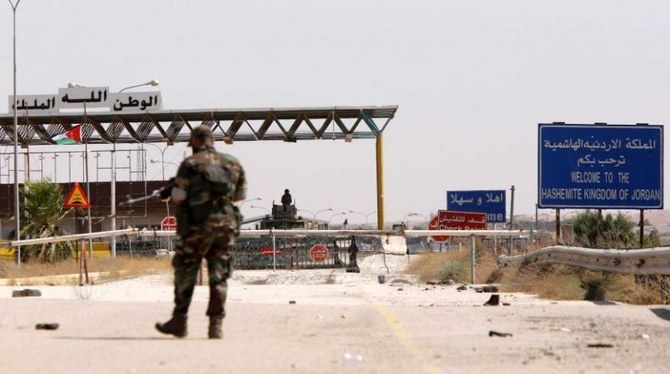
Nasib border crossing on the border with Jordan, Daraa, Syria (File photo: Reuters)
Short Url
Updated 23 May 2022
Follow

Four killed as Jordanian army thwarts drug smuggling attempt from Syria

  • Hezbollah resorting to narcotics trade to secure funding after US sanctions hit Iran

AMMAN: The Jordanian army announced it had killed four people who attempted to smuggle “large amounts” of drugs into the country from Syria.

A source from the Jordanian Armed Forces said that troops on Jordan’s eastern borders with Syria opened fire on people who attempted to infiltrate the kingdom, killing four of them and injuring others.

The source said that the infiltrators were forced to retreat into Syrian territory.

“After inspecting the area, 181 palm-sized sheets of hashish, 637,000 Captagon narcotic pills, and 39,600 tramadol pills were found and handed over to the concerned authorities,” the source told Arab News.

The Syrian Observatory for Human Rights in London said that six people were injured in the operation with some of them in a critical condition.

It said that one of those killed by the Jordanian army was the leader of a group that works in the narcotics industry in southern Syria and had “strong” ties with Lebanon’s Shiite Hezbollah.

The operation on Sunday was the latest since Jordan announced a crackdown on drug smuggling from Syria and a change in rules of engagement to curb what it described as a “dramatic increase” in drug trafficking from its neighbor.

Jordan has warned that Syria was becoming a narco-state, posing cross-border threats to Jordan, the region, and the rest of the world.

The JAF has recently said that a total of 361 smuggling attempts from Syria were foiled in 2021, leading to the seizure of about 15.5 million pills of narcotics of different types.

It foiled more than 130 smuggling attempts from Syria in 2020 and seized about 132 million Captagon pills and more than 15,000 sheets of hashish.

Describing the figures as “dramatically high,” a military source, who requested anonymity, told Arab News that “Illicit drug cultivation and manufacture has become a growing industry in Syria.”

According to the Syrian news website Enab Baladi, drug smuggling operations are most active in the southern regions of Daraa and Al-Suwayda.

Most of the smuggling routes are controlled by armed Bedouin tribes that have affiliations inside Jordan, the news website quoted sources as saying.

Experts say the strong presence of the militant organization Hezbollah in Syria and the expansion of its drug trafficking operations are the main reasons for the war-torn country becoming a narco-state and for the increase of drug smuggling into Jordan, Arab Gulf states, and Europe.

In recent remarks to Arab News, Fayez Dweiri, a retired major general and military analyst, said Hezbollah had resorted to the narcotics trade to secure funding after the US sanctions on Iran.

“There is an established illicit drugs industry for Hezbollah in Beirut’s Dahieh Al-Janubiya and in the Shiite stronghold of Baalbek,” he said.

Hezbollah “has relocated some of its drug factories to Aleppo and other Syrian regime-controlled regions,” Dweiri said.

“The US sanctions on Iran have hit Hezbollah hard, obliging Tehran’s most funded proxy to look for other sources of revenues,” he said.

According to a report by the Washington Institute for Near East Policy, Hezbollah has significantly expanded and institutionalized its drug trafficking enterprises, which now generate more money than its other funding streams.

The think tank said that Hezbollah’s global narcotics industry began in Lebanon’s Bekaa Valley in the 1970s, using well-established smuggling routes across the Israel-Lebanon border.

Rewilding Arabia
Return of the leopard is at the heart of plans to conserve and regenerate Saudi Arabia’s landscapes and wildlife

Enter


keywords


Palestinian VP meets diplomat expected to serve on Trump’s Gaza peace board

Updated 11 sec ago
Follow

Palestinian VP meets diplomat expected to serve on Trump’s Gaza peace board

  • Media reports say he is expected to serve as the representative on the ground in Gaza for the Board of Peace
  • Sheikh said that during his meeting with Mladenov, “an in-depth discussion took place on all political and field developments in the Palestinian territories“

RAMALLAH, Palestinian Territories: Palestinian vice president Hussein Al-Sheikh met on Friday with former UN Middle East envoy Nickolay Mladenov, who is expected to head the US-backed Board of Peace in Gaza.
The meeting in the occupied West Bank city of Ramallah comes a day after Mladenov held talks with Israeli Prime Minister Benjamin Netanyahu and met with President Isaac Herzog.
Bulgarian diplomat Mladenov served as the United Nations envoy for the Middle East peace process from early 2015 until the end of 2020.
Media reports say he is expected to serve as the representative on the ground in Gaza for the Board of Peace — a transitional body for the war-battered Palestinian territory which US President Donald Trump would theoretically chair.
In a statement on X, Sheikh said that during his meeting with Mladenov, “an in-depth discussion took place on all political and field developments in the Palestinian territories.”
He added there was “a focus on the situation in the Gaza Strip, means of transitioning to the second phase (of the ceasefire), mechanisms for implementing the US President Donald Trump’s plan, and UN Security Council Resolution 2803.”
That UN Security Council resolution endorsed the Trump plan in November.
Under Trump’s 20-point plan, Gaza will be governed by a temporary transitional technocratic, apolitical Palestinian committee, under the oversight and supervision of the Board of Peace.
Under the second stage of the fragile ceasefire that came into effect in October, Israel is supposed to gradually withdraw from its positions in Gaza, while Hamas is supposed to lay down its weapons.
An international stabilization force is also to be deployed.
But talks to bring about the second phase stalled after Israel accused Hamas of delaying the return of the last hostage in its custody.
Netanyahu met with Mladenov in Jerusalem on Thursday and “reiterated that Hamas must be disarmed and the Gaza Strip must be demilitarised,” the prime minister’s office said in a statement.
It said that Mladenov “is set to become the Director of the Gaza Strip Board of Peace.”
Herzog also met with Mladenov on Thursday, a spokesman from his office said, without providing details.
US media outlet Axios has reported that Trump is expected to announce the Board of Peace next week and that it would include around 15 world leaders.
“Among the countries expected to join the board are the UK, Germany, France, Italy, Saudi Arabia, Qatar, Egypt and Turkiye,” Axios reported.
Some White House officials fear both Israel and Hamas are slow-walking the second stage of the ceasefire, with each side alleging frequent ceasefire violations.