

After divisive presidential campaign, Marcos Jr faces challenge of uniting Philippines

1 / 2
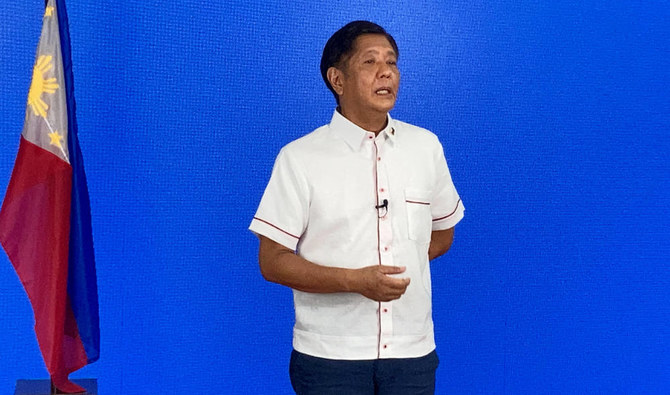
In this photo taken May 9, 2022, Presidential candidate Ferdinand Marcos Jr., son of the late dictator Ferdinand Marcos Sr., speaks to the members of the media, at his party heaquarters in Manila. (AFP)
2 / 2
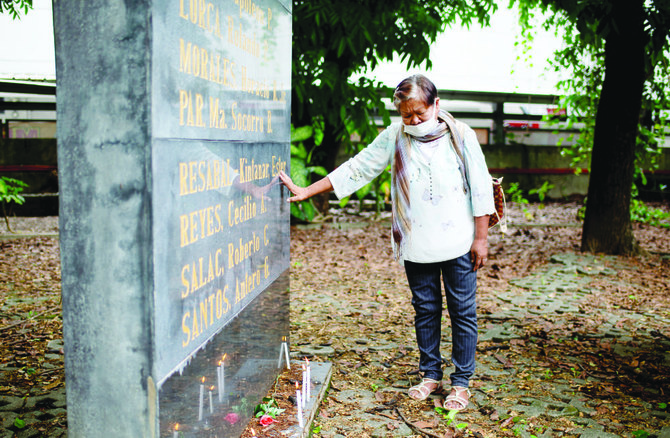
A woman visits a memorial honoring victims of martial law under late dictator Ferdinand Marcos in Metro Manila, Philippines, on Saturday. (Reuters)
Short Url
Updated 22 May 2022
Follow

After divisive presidential campaign, Marcos Jr faces challenge of uniting Philippines

  • ‘Candidate for change’ has promised unity to voters weary of years of political polarization and pandemic hardship
  • With initial count largely complete, Marcos has more than 31 million votes, more than double that of his closest rival

MANILA: Days after clinching a landslide victory in one of the most divisive presidential elections in the history of the Philippines, Ferdinand Marcos now faces the challenge of fulfilling his campaign promise to unite the country.

Marcos, the son and namesake of the late dictator, is set to take over from President Rodrigo Duterte as the country’s leader for the next six years.   

While the election results are still unofficial, over 98 percent of an initial count has been completed, with Marcos having more than 31 million votes, more than double that of his closest rival, the outgoing Vice President Leni Robredo.   

Just stabilize the economy, curb inflation and do not kill us.

Jarrah Brillantes, Community development worker

Other contestants included boxing legend Manny Pacquaio, who is now a senator; Isko Moreno, a former actor and current Manila mayor; and Panfilo Lacson, a senator and former police chief.

Marcos’ running mate, Sara Duterte-Carpio, the daughter of the incumbent president, is also leading in the vice-presidential race with more than triple the votes of Senator Francis Pangilinan, who ran in support of Robredo. They are expected to take office on June 30.

During his election campaign, Marcos, who is widely known by his childhood nickname “Bongbong,” has portrayed himself as the candidate for change, promising unity to voters weary of years of political polarization and pandemic hardship.

“He promised unity. I hope he can do that,” Eccleo Gregorio, a taxi driver in Manila who voted for Marcos, told Arab News. “I also expect him to give Filipinos a better life by bringing down the prices of commodities, gasoline, electricity, and making sure to raise workers’ wages.”

Allan Bergonia, a reporter, expects Marcos’ incoming administration to “show us the real change.”

“As they promised, together, we Filipinos will rise again,” Bergonia said, adding that the victory proved that Filipinos wanted a return to “the old style of Marcos system of government.”

In the months leading up to the election, an online campaign portrayed the Marcos regime as a “golden age” in the country’s history.

Yet for other Filipinos, Marcos’ family name remains a painful reminder of two decades of widespread corruption and human rights abuses committed by his father, who was ousted in a popular uprising 36 years ago.

Jarrah Brillantes, a community development worker, told Arab News that she believed Robredo could solve the country’s woes, not the president-elect of whom she had few expectations.

“Just stabilize the economy, curb inflation and do not kill us,” she said.

Angie, a writer who gave only her first name, said that she was uncertain about what the future would offer under a new Marcos regime.

“I am hoping and praying that the new leadership will be able to bring about their promised peace and unity by digging deep and working hard across political colors to overcome pandemic challenges for the sake of all Filipinos,” she said.

With Marcos promising voters that he will continue Duterte’s policies, Jude, a supporter who works for the current administration, said that he expected the future leader to “sustain the projects and programs” launched by his predecessor.

“The majority of Filipinos have spoken, which should be respected,” he said, requesting that his last name not be revealed. “They want a genuine government, pro-poor, pro-people, that can sustain and further improve what the present administration has implemented.”

Ramon Casiple, executive director of the Institute for Political and Electoral Reform, said that he will reserve his comments until the final count is made public.

But he said that if Marcos takes office, a rapid return of his father’s loyalists is likely.

“The immediate thing that will happen is there will be redeployment of political forces,” Casiple told Arab News.

“But if he does reach out to his political opponents, which is very doubtful, then he might be able to achieve his unifying battle cry … All political forces would have to adjust their strategies vis-a-vis the new Marcos regime.”


Trump says Australia will grant asylum to Iran women footballers

Team Iran listens to the national anthem before the AFC Women’s Asian Cup Australia 2026 football match.
Updated 57 min 43 sec ago
Follow

Trump says Australia will grant asylum to Iran women footballers

  • Presenter on Iranian state TV had branded the players “wartime traitors” after they stood motionless during the anthem

MIAMI: US President Donald Trump said Monday that Australia had agreed to grant asylum to some of Iran’s visiting women’s football team, amid fears they could face retaliation back home for not singing the national anthem before a match.
The gesture ahead of the team’s Asian Cup match against South Korea last week was seen by many as an act of defiance against the Islamic republic just two days after the United States and Israel attacked it.
“I just spoke to Prime Minister Anthony Albanese, of Australia, concerning the Iranian National Women’s Soccer Team. He’s on it! Five have already been taken care of,” Trump said Monday on his Truth Social network, less than two hours after an initial post urging Australia to take them in.
Trump added that “some, however, feel they must go back because they are worried about the safety of their families, including threats to those family members if they don’t return.”
There was no immediate comment from the Australian government, which has so far declined to say whether it could offer the players asylum.
Asked about their case on Sunday, Foreign Minister Penny Wong said Australia “stands in solidarity” with the people of Iran.
The son of Iran’s late shah, US-based Reza Pahlavi, warned on Monday that the refusal to sing the anthem could have “dire consequences,” and urged Australia to offer the team protection.
Trump then weighed in, pressing Albanese to “give ASYLUM” to the team and adding: “The US will take them if you won’t.”
“Australia is making a terrible humanitarian mistake by allowing the Iran National Woman’s Soccer team to be forced back to Iran, where they will most likely be killed,” the US leader said on Truth Social.
Pahlavi, who has not returned to Iran since before the 1979 Islamic revolution that ousted the monarchy, has billed himself as the man to lead a democratic transition to a secular Iran as the theocratic regime fights to survive.
Politicians, human rights activists and even “Harry Potter” author J.K. Rowling have also called for the team to be offered official protection.
“Please, protect these young women,” Rowling said in a post on social media.

‘Save our girls’ 

A presenter on Iranian state TV had branded the players “wartime traitors” after they stood motionless during the anthem before their match against South Korea.
In subsequent games, the players saluted and sang.
Crowds gathered outside the Gold Coast stadium where the side played their last match over the weekend, banging drums and shouting “regime change for Iran.”
They then surrounded the Iranian team bus, chanting “let them go” and “save our girls.”
On Monday, an AFP journalist saw members of the team speaking on phones from their balcony of their hotel.
Asked about the possibility of granted asylum, a spokesperson for Australia’s Home Affairs department told AFP earlier it “cannot comment on the circumstances of individuals.”
Amnesty International campaigner Zaki Haidari said they faced persecution, or worse, if they were sent home.
“Some of these team members probably have had their families already threatened,” Haidari told AFP.
“Them going back... who knows what sort of punishment they will receive?“
Despite being heavily monitored, the side would have a “small window of opportunity” to seek asylum at the airport, he said.
Iran’s embassy in Australia did not respond to a request for comment.