

‘We called her Roger Federer’: How Ons Jabeur made her mark in Tunisia

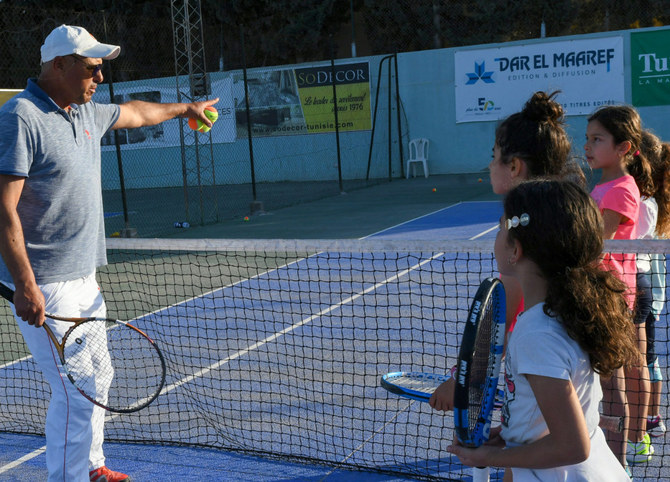
Tunisian tennis coach Nabil Mlika, who trained a young Ons Jabeur for 10 years, teaches students at the Hammam Sousse tennis club in the Mediterranean port city of Sousse on May 13, 2022.  (AFP)
Short Url
Updated 21 May 2022
Follow

‘We called her Roger Federer’: How Ons Jabeur made her mark in Tunisia

  • Jabeur, who hopes to win a maiden Grand Slam title at the French Open which starts in Paris on Sunday, started playing on courts belonging to local hotels
  • She has gone on to rise to sixth place in the global Women’s Tennis Association’s women’s singles rankings — the first Arab woman ever to reach the world top 10

HAMMAM SOUSSE, Tunisia: Fifteen years before Tunisia’s Ons Jabeur became the first Arab or African woman to win a top-flight tennis title, her adolescent sparring partner could see she was destined for glory even if he suffered a broken arm in the process.

Omar Laabidi remembers being repeatedly beaten by a 12-year-old Jabeur, who this month surged to victory at the Madrid Open at the age of 27 — the first WTA 1000 trophy of her career.

“We used to call her Roger Federer,” he said.

Laabidi was talking at the tennis club where it all began, in the North African country’s coastal town of Hammam Sousse.

“One time during a training match she hit a drop shot that I tried so hard to return that I broke my arm,” he said.

Jabeur, who hopes to win a maiden Grand Slam title at the French Open which starts in Paris on Sunday, started playing on courts belonging to local hotels.
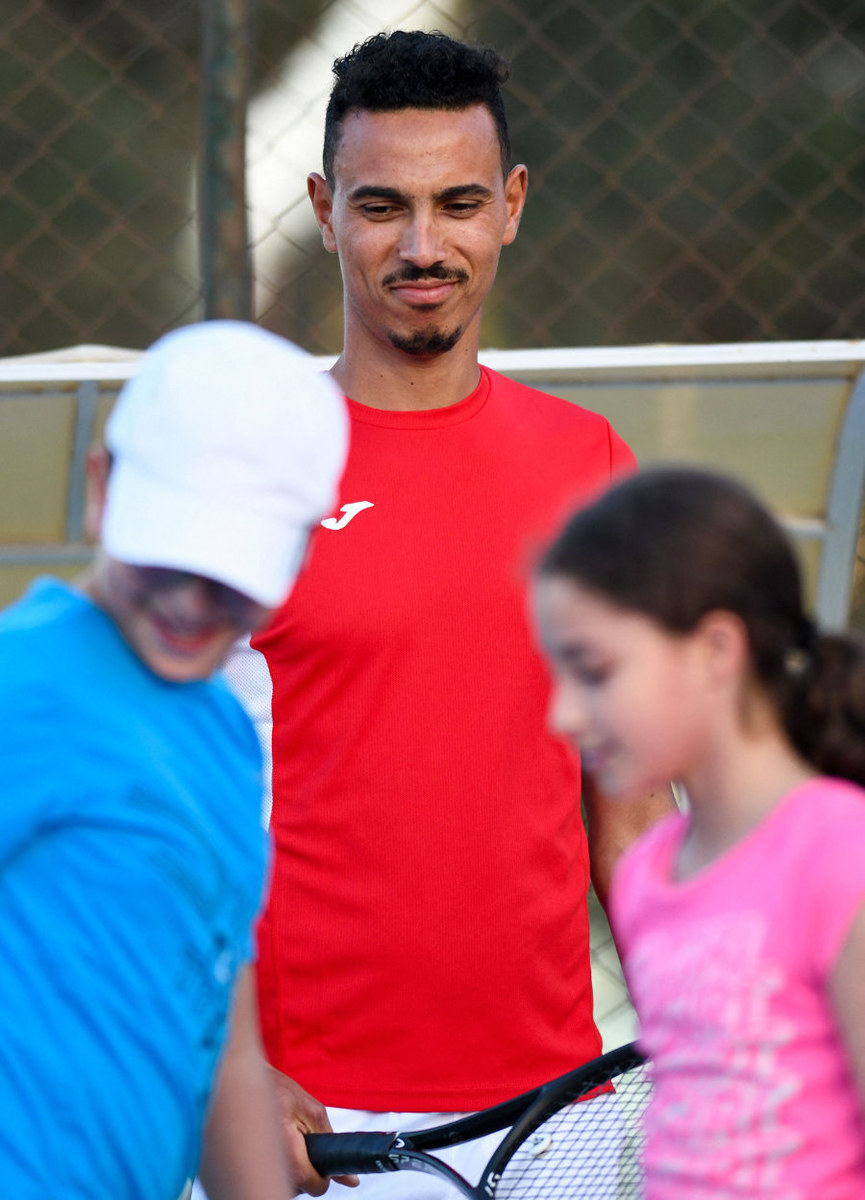


Omar Laabidi, the adolescent sparring partner of Ons Jabeur, teaches students at the Hammam Sousse tennis club in the Mediterranean port city of Sousse on May 13, 2022.  (AFP)

But she soon joined the Hammam Sousse Club, which now bears a huge portrait of its most famous graduate.

It was there that Nabil Mlika first trained a talented girl “determined to stand out” against both female and male peers.

But Mlika, who trained a young Jabeur for 10 years, said there was a moment where she almost quit the sport.

“She had great ball control, to the point where other coaches tried to attract her to handball,” said the 55-year-old.

“Ons thought seriously about switching sport — but decided to stick to tennis.”

She has gone on to rise to sixth place in the global Women’s Tennis Association’s women’s singles rankings — the first Arab woman ever to reach the world top 10.

She also reached the final of the Italian Open in mid-May, eventually won by world No. 1 Iga Swiatek.

Jabeur, known to many Tunisians as “the minister for happiness,” was born in the southern coastal town of Ksar Hellal, one of four siblings.

She moved to the capital Tunis at the age of 12 to train at a prestigious state-backed sports club.

She has been married to her physical trainer and former fencer, Karim Kammoun, since 2015.

The right-hander is known for her stamina and for constantly changing the pace of the match.

“She hates playing at one pace. She’s always trying to create a spectacle by switching up the game with shots that surprise her opponents, especially with drop shots,” said Mlika.

“She’s really the queen of the drop shot.”

Jabeur made her first entry to the global scene in 2011, winning the girls’ singles finals at the French Open at the age of 16.

Laabidi also moved to Tunis around the same time as the adolescent Jabeur and joined the same academy, where they continued sparring.

“She was always fun and quickly got to know strangers,” he said.

“But she was always provocative and competitively debating on all subjects.”

Those who knew her as a teenager say she has changed little despite her growing fame.

“She still runs around gathering up all the balls during training, which she’s been doing since she started playing,” said Mlika.

Unsurprisingly, as her fame has spiralled since 2018, subscriptions have skyrocketed at her home club from 320 to more than 700 students today.

For Yousra Koubaa, the mother of eight-year-old student Yasmine, Jabeur is “an example of hope, one we’re always showing to our children.”

Mlika says he uses photos of a young Jabeur to inspire his students today.

“She was a spark of enthusiasm, always moving and wanting to show that she was the best,” he said.

“She always put me in a difficult position because I had to balance between taking the training up a level, or waiting for her peers to catch up with her level and her pace.”


How Saudi football scored in the runup to 2026 FIFA World Cup

Updated 03 January 2026
Follow

How Saudi football scored in the runup to 2026 FIFA World Cup

  • Saudi Pro League asserted global dominance with star-studded lineups and record-breaking performances from Asia’s elite top-tier clubs
  • Domestic leagues reached new heights, yet the national team faces mounting pressure ahead of a high-stakes global tournament

DUBAI: FIFA President Gianni Infantino seemed full of optimism on Dec. 21 when he said Saudi Arabia had become a major hub on the global football stage and that the Saudi Pro League was on track to become one of the top three in the world.

With players like Cristiano Ronaldo and Karim Benzema and a nation crazy about the great game, this endorsement perhaps comes as little surprise.

Infantino also predicted a successful World Cup in 2034 when the tournament will be hosted by Saudi Arabia. With infrastructure being built and upgraded, the Expo 2030 venue under construction, and reforms underway, the World Cup seems destined to be a success.

At the 2026 World Cup, Saudi Arabia will face Uruguay, European champions Spain, and Cape Verde in their three Group H matches, taking place in Miami, Atlanta, and Houston respectively. (Reuters/File)

The FIFA boss also praised the progress made not only at the senior national team level and across youth categories, but also in the women’s game, thanks to the backing of football authorities in recent years.

While this paints a positive picture of the game in the Kingdom, it follows the national team’s 1-0 loss to Jordan in the semi-finals of the 2025 Arab Cup. Many supporters will need far more convincing of the team’s prospects going into the New Year.

Although the return of Herve Renard as coach of the Green Falcons following Roberto Mancini’s disappointing stint has resulted in a second consecutive World Cup qualification (and seventh overall), failure to win the Arab Cup in Qatar and some less than inspiring performances means the jury is still out on the Frenchman.

At the 2026 World Cup, Saudi Arabia will face Uruguay, European champions Spain, and Cape Verde in their three Group H matches, taking place in Miami, Atlanta, and Houston respectively.

Saudi fans sharing Infantino’s positive outlook will hope Renard’s men can emulate the historic win over Argentina on that memorable night at Lusail Stadium in 2022. But that is far easier said than done, and many remain unconvinced.

Cristiano Ronaldo celebrates after scoring a goal during the Saudi Pro League. (AFP/File)

For a start, just as Poland and Mexico were alerted to Saudi Arabia’s potential following that humbling of Lionel Messi and co in Qatar, their opponents in the US will likewise be on their guard this time around.

Worryingly for Saudi fans, the team has rarely, if at all, hit the same highs since Saleh Al-Shehri’s equalizer and Salem Al-Dawsari’s stunning strike brought about arguably the most famous win in the Green Falcons’ history.

The 2023 AFC Asian Cup, played in early 2024 and only months after Mancini’s arrival, saw Saudi Arabia eliminated by South Korea on penalties in the round of 16.

World Cup qualification was eventually secured but not before the team needed to negotiate a fourth round group that included Iraq and Indonesia in October.

The semi-final exit at the Arab Cups prompted rumors — immediately denied by the Saudi Arabian Football Federation — that Renard’s job was under threat. Still, it was hardly a ringing endorsement of the way things had turned out on his second stint as national team coach. 

Al-Ahli's Roberto Firmino lifts the trophy as he celebrates with teammates after winning the Asian Champions League. (Reuters/File)

Outspoken Saudi-based football pundit Battal Algoos has been scathing in his criticism of Renard and his employers, and in particular of the excuses for the Arab Cup disappointment.

“It seems to be a contagion that has affected the Saudi camp,” he said on the football show “Filmarma” on Al Arabiya.

“Everyone justifies (their position) through others’ failures. We brought you to win a championship, not to say ‘those before me didn’t win championships, I’m no worse than them’.

“It seems to be contagious, from (SAFF President) Yasser Al-Misehal to Renard. Or their thinking is one and the same.”

Paul Williams, Australian journalist and founder and presenter of “The Asian Game” podcast, was at Lusail Stadium the day Saudi Arabia beat the eventual world champions, but believes urgent fixes are needed by Renard this time round.

New Murabba Stadium. (Supplied)

“There are a multitude of areas that Saudi Arabia need to improve,” he told Arab News. “The obvious is in the final third, where there are still issues finding a reliable avenue to goal, an issue that blighted most of their qualification campaign.

“But they also haven’t yet found a capable replacement in midfield for Salman Al-Faraj, and the entire narrative around Saudi football has changed since before 2022.

“There has always been pressure and expectation from the fans, but that is even more intense now and it feels like that sits heavily on the squad, who are yet to prove they are capable of delivering under that burden of expectation.”

The team’s main concern remains, as it was four years ago in Qatar, its lack of fire power up front and an over-reliance on Al-Dawsari for goals and inspiration. In that sense, at least the 34-year-old talisman can still be relied on.

Al-Ittihad's Karim Benzema celebrates. (Reuters/File)

The Al-Hilal and Saudi Arabia captain provided one of the highlights of 2025 when he was named AFC Player of the Year at the awards ceremony in Riyadh. Al-Dawsari is the only Saudi to have won the Asian award twice.

On an individual level, he enjoyed a stellar 2024-25 season with his club, although Al-Hilal lost out on the Saudi Pro League title to a Benzema-inspired Al-Ittihad.

Al-Dawsari and Al-Hilal came back strongly in the summer to reach the quarter-finals of the 2025 FIFA Club World Cup in the US, along the way drawing 1-1 with Real Madrid in the group stage and brilliantly beating Manchester City 4-3 in the round of 16.

Domestically, however, it is their local rivals that have stolen all the headlines, with their lead at the top of the SPL delighting millions of fans around the world and perhaps in the process reinforcing Infantino’s estimation of the league.

Al-Nassr, now managed by former Al-Hilal boss Jorge Jesus and inspired by the relentlessly enduring Ronaldo, look near invincible at the top of the table, having won all nine matches during this campaign.

The coronation that their fans and the Portuguese legend’s army of global followers had envisioned since he landed in Riyadh three years ago is looking increasingly likely to happen in May. Their end of year report card is glowing 9 out of 10.

Cristiano Ronaldo scores a goal in the Saudi Pro League. (Reuters/File)

Al-Hilal, the self-styled Real Madrid of Asia, can never be counted out however, and the title race in 2026 could be one of the most exciting and close in recent years.

Reigning champions Al-Ittihad, on the other hand, have put up a dismal defense of their title resulting in the sacking of Laurent Blanc, who was succeeded by Sergio Conceicao. Their card will read “must do better.”

Al-Ahli provided further evidence of the SPL’s continental dominance by claiming the 2025 AFC Champions League Elite after beating Japan’s Kawasaki Frontale 2-0 in Jeddah last May. 

Elsewhere, Aramco-owned Al-Qadsiah and newly promoted NEOM provide intriguing plot lines as they sit in fifth and eighth respectively, while Al-Taawoun continue to punch above their weight in third.

One of the standout personalities of the season has been US investor Ben Harburg who — through Harburg Group — acquired 100 percent of Al-Kholood in July, making it the first Saudi club wholly owned by a foreign entity. The purchase opens up new possibilities for the SPL.

Al-Hilal's Salem Al-Dawsari poses with the trophy and the President of the Asian Football Confederation Salman bin Ibrahim Al Khalifa after winning the AFC Player of the Year. (Reuters/File)

There is little debate now that the SPL is the most powerful and entertaining in Asia and could in future years, if Infantino is right, become one of the world’s best. The national team’s standing however, until the 2026 World Cup at least, remains up in the air.