Saudi tourism ministry signs deals to boost localization program

1 / 2
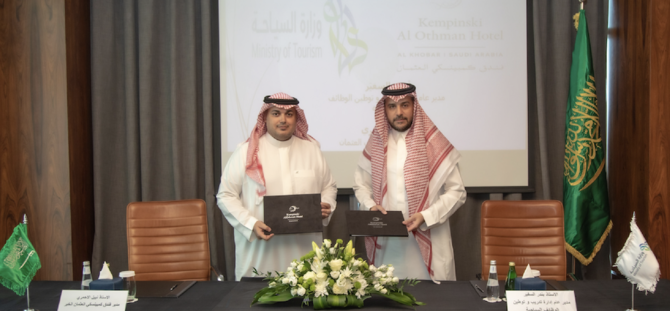
Saudi Arabia’s Ministry of Tourism signs two agreements. (Twitter/@Saudi_MT)
2 / 2
Saudi Arabia’s Ministry of Tourism signs two agreements. (Twitter/@Saudi_MT)
Short Url
Updated 20 May 2022
Follow

Saudi tourism ministry signs deals to boost localization program

RIYADH: Saudi Arabia’s Ministry of Tourism has signed two agreements to enhance joint cooperation and support training and localization programs to qualify those wishing to work in the hospitality sector.
The move, which aims to support workers in the food, beverage and accommodation sectors, in support of achieving the Kingdom’s’ tourism human capacity development strategy.
Bandar bin Mohammed Al-Safir, director general of training and localization at the ministry, stressed that these two agreements aim to develop human resources in the tourism sector through quality training programs that will contribute to developing localized skills in the tourism sector.
Under the two agreements, which were signed with Kempinski Al-Othman Hotel and Carlton Al-Moaibed Hotel, the ministry will support dualifying Saudi nationals in the tourism sector within the “Your Future has Arrived” initiative.


US allows countries to buy Russian oil stranded at sea for 30 days

Updated 13 March 2026
Follow

US allows countries to buy Russian oil stranded at sea for 30 days

  • US issues 30-day license for stranded Russian oil purchases
  • Measure the latest by Trump administration to calm energy markets jolted by Iran war

The United States issued ​a 30-day license for countries to buy Russian oil and petroleum products currently stranded at sea in what Treasury Secretary Scott Bessent said was a step to stabilize global energy markets roiled by the Iran war.
The announcement comes a day after the US Energy Department said that the US would be releasing 172 million barrels of oil from the strategic petroleum reserve in an effort to curb sky-rocketing oil prices in the wake of the war in Iran. That release was part of a broader commitment by the 32-nation International Energy Agency to release 400 million barrels of oil. The agency said earlier on Thursday that he war in the Middle East ‌was creating the ‌biggest oil supply disruption in history. Bessent, in a statement on X ​released ‌hours ⁠after benchmark ​oil prices ⁠shot above $100 a barrel, said the measure was “narrowly tailored” and “short-term” and would not provide significant financial benefit to the Russian government.
“The temporary increase in oil prices is a short-term and temporary disruption that will result in a massive benefit to our nation and economy in the long-term,” Bessent said in the statement, echoing President Donald Trump.
Thursday’s license, which authorizes the delivery and sale of Russian crude oil and petroleum products loaded on vessels as of March 12, will remain valid through midnight Washington time on April 11, according to the text of the license posted on ⁠the Treasury Department’s website. The US Treasury previously issued a 30-day waiver on March ‌5 specifically for India, allowing New Delhi to buy Russian oil stuck ‌at sea. Among other measures to tame energy prices, Trump has already ordered ​the US International Development Finance Corporation to provide political ‌risk insurance and financial guarantees for maritime trade in the Gulf and said the US Navy ‌could escort ships in the region. In another attempt to control prices, the Trump administration is considering temporarily waiving a shipping rule known as the Jones Act to ensure energy and agricultural products can move freely between US ports, the White House said. Waiving the rule would allow foreign ships to carry fuel between US ports, potentially lowering costs and speeding deliveries.
“The president ‌is taking every action he can to lower prices ... unsanctioned oil that’s at sea to get that into the market, continuing to push our own ⁠producers to drill and ⁠expand production as fast and as far as they can, providing regulatory relief, and you’re going to see more and more in the days to come,” White House Deputy Chief of Staff Stephen Miller told Fox News’ “Primetime” program on Thursday.
There were about 124 million barrels of Russian-origin oil on water across 30 different locations globally as of Thursday, Fox News reported, adding that the US license would provide around five to six days of supply when taking into account the daily loss of oil from the Strait. Trump said earlier on Thursday the United States stood to make significant money from oil prices driven higher by the war, prompting criticism from some lawmakers who accused him of caring only about rich people.
US and Israeli strikes on Iran and the subsequent response by Tehran have widened regional tensions and paralyzed shipping through the Strait of Hormuz, disrupting vital ​Middle East oil and gas flows and sending energy ​prices higher.
Raising the stakes for the global economy, Iran’s Islamic Revolutionary Guard Corps says it will block oil shipments from the Gulf unless the US and Israeli attacks cease.