

Pakistan top court bans transfers of investigating officers in ‘high-profile’ criminal cases

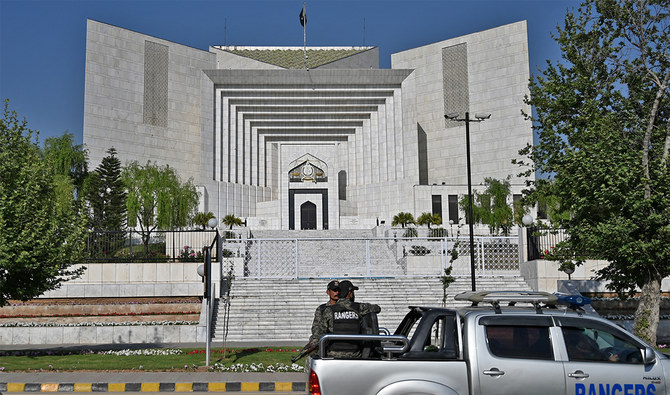
Rangers patrol along a street past Pakistan's Supreme Court in Islamabad, Pakistan, on April 5, 2022. (AFP/File)
Short Url
Updated 19 May 2022
Follow

Pakistan top court bans transfers of investigating officers in ‘high-profile’ criminal cases

  • The supreme court bars all investigating agencies from withdrawing high-profile cases pending before trial courts
  • The court expresses apprehension the country’s criminal justice system may be undermined by those in positions of authority

ISLAMABAD: Pakistan’s top court on Thursday stopped authorities from transferring officials involved in “high-profile” cases in different investigating agencies while seeking record of any new appointments and transfers made in the last six weeks.

The development took place only a day after the Supreme Court took suo motu notice on apprehensions that criminal justice system may be undermined by people in positions of authority.

According to news reports based on court documents, the Federal Investigation Agency (FIA) said last week it did not want to pursue a Rs16 billion money laundering case against Prime Minister Shehbaz Sharif and his two sons three days before a special court in Lahore was scheduled to frame charges against them.

The FIA denied, however, it was withdrawing the case against the prime minister in a statement subsequently released to the media.

“We want to ensure the sanctity and integrity of the criminal justice system and rule of law,” Chief Justice of Pakistan Umar Ata Bandial remarked while chairing a five-member larger bench to hear the case.

The court barred the authorities from withdrawing any high-profile cases while seeking a response from the government on transfers and appointments recently made in the FIA.

Attorney General of Pakistan Ashtar Ausaf tried to defend the transfers and postings, saying there might be “genuine reasons” behind them.

The court also issued notices to the National Accountability Bureau, director general FIA, secretary interior and others to explain their respective positions over the issue.

It directed the attorney general to ensure all record and evidence in high-profile cases were preserved and protected from any tampering.

“We hope the federal government will help us by explaining all these matters,” the chief justice said.

“We have been seeing such news for the last one month,” he continued. “We want to know about these matters because they are impacting the rule of law.”

The chief justice pointed out that an investigation officer, Dr. Rizwan, who was probing cases against Prime Minister Sharif and his son Hamza, was transferred and later died of heart attack.

“Why were the officers investigating the case against Hamza Shehbaz removed,” the chief justice asked. “We have to ensure independent and transparent working of the prosecution branch.”

The chief justice clarified the court proceedings were not meant to embarrass or hold anyone responsible, but “to uphold the rule of law.”
The court adjourned the case until May 27.


Police in Pakistan’s Karachi say 71 of 75 extortion cases traced as businesses complain of threats

Updated 6 sec ago
Follow

Police in Pakistan’s Karachi say 71 of 75 extortion cases traced as businesses complain of threats

  • Builders told provincial authorities this week extortion calls were traced to numbers operating from abroad
  • Police say 128 suspects were identified, with 91 arrested and six killed in encounters during investigations

ISLAMABAD: Police in Karachi said on Saturday they traced 71 of 75 confirmed extortion cases this year, arresting 91 suspects and killing six in encounters, amid complaints from businesses about rising threats in Pakistan’s commercial hub.

The disclosure follows recent complaints by builders and developers who told provincial authorities that extortion demands had increased in Karachi, with some calls traced to numbers operating from abroad, prompting assurances of tougher enforcement by the Sindh government.

“In 2025, a total of 171 extortion cases were registered, of which 75 were confirmed as genuine extortion,” police said in a statement. “Of these 75 cases, 71 were traced, representing a 95 percent trace rate.”

According to the report released by the Special Investigation Unit (SIU) of the Crime Investigation Agency (CIA) Karachi, the remaining 96 cases initially registered as extortion were later found to be linked to financial disputes, land and plot conflicts, personal matters, fights and other non-extortion-related disagreements.

Police said 128 suspects were identified in the confirmed extortion cases. Of these, six were killed in encounters with the SIU, while 14 others were arrested in injured condition during operations.

A total of 91 suspects were arrested over the course of the year, the statement said, adding that crackdowns against extortion would continue.

Karachi, Pakistan’s largest and most populous city, is the country’s financial and commercial capital, accounting for a significant share of national revenue, trade and industrial activity.

The city has long struggled with crime, political violence and organized criminal networks, with members of the business community repeatedly warning that extortion poses a persistent threat to investment and economic stability.