

Illustrator Nourie Flayhan pays tribute to reporter Shireen Abu Akleh with digital drawing

Nourie Flayhan is a Lebanese illustrator. (Instagram)
Short Url
Updated 19 May 2022
Follow

Illustrator Nourie Flayhan pays tribute to reporter Shireen Abu Akleh with digital drawing

DUBAI: The Lebanese illustrator discusses her latest digital drawing, which pays tribute to Palestinian-American reporter Shireen Abu Akleh, who was killed in Jenin earlier this month. 

When I heard the news of Shireen Abu Akleh’s death, I was in Portugal with my parents on a three-day vacation. I saw a couple of posts on social media, but it wasn’t very clear what was happening, so I went on Google Search and read a couple of very short reports, as the news was breaking. I went back on social media and my Palestinian friends were posting more and more about it. 

It was actually very shocking. I felt like I had to go back to the hotel and draw a tribute to her. Seeing her on the floor was really intense and I was deeply disturbed for a while. It took me some time to process what was happening. I feel like she’s done so much for everyone; the way she’s been reporting for so many years and has been a voice for the people — risking her life almost every day. 
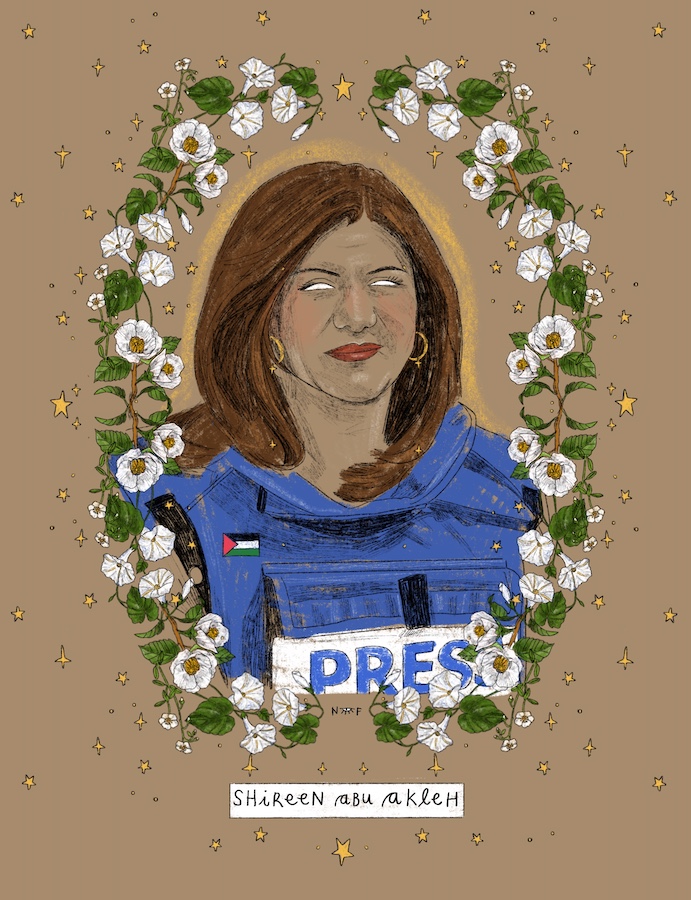


‘Honoring Shireen.’ (Supplied) 

Illustration is how I can communicate my thoughts and feelings more clearly. Most of my work is digital illustrations and I use an iPad. My fingers were moving so fast, almost in rage, but I had to stop myself and give a softer emotion to it. I had to pour out appreciation and admiration of who she was. I wanted that to translate into the piece, rather than it being an angry piece. 

She was a very soft and kind person and I think that contributes to the halo around her head. At first, I wanted the flowers to be colorful, but then I wanted them to be kind of muted out and be white and very peaceful. She had an angelic face and was graceful till the end and I wanted that to be highlighted in the illustration. 

She was wearing a press vest when she got shot and part of me wanted to remind people not just about the job that she carried out until her last breath, but also that she was wronged and that hurt a lot people. 

The white, blank eyes may be disturbing to others, but to me they’re calming. It’s to remind people that, yes, there’s a human being behind that person, but there’s also a soul. 


Riyadh exhibition to trace the origins of Saudi modern art

Updated 07 January 2026
Follow

Riyadh exhibition to trace the origins of Saudi modern art

  • Features painting, sculpture and archival documents
  • Open from Jan. 27-April 11 at Saudi national museum

DUBAI: A new exhibition in Riyadh is focusing on the origins of Saudi Arabia’s modern art scene, examining how a generation of artists helped shape the Kingdom’s visual culture during a period of rapid change.

The “Bedayat: Beginnings of Saudi Art Movement” show reportedly traces the emergence of creative practices in Saudi Arabia from the 1960s to the 1980s, an era that laid the groundwork for today’s art ecosystem.

On view from Jan. 27 until April 11 at the National Museum of Saudi Arabia, it includes works and archival material that document the early years of modern and abstract art in the Kingdom, according to the organizers.

It will examine how artists responded to shifting social, cultural and economic realities, often working with limited infrastructure but a strong sense of purpose and experimentation.

The exhibition is the result of extensive research led by the Visual Arts Commission, which included dozens of site visits and interviews with artists and figures active during the period.

These firsthand accounts have helped to reconstruct a time when formal exhibition spaces were scarce, art education was still developing, and artists relied heavily on personal initiative to build communities and platforms for their work.

Curated by Qaswra Hafez, “Bedayat” will feature painting, sculpture, works on paper and archival documents, many of which will be shown publicly for the first time.

The works will reveal how Saudi artists engaged with international modernist movements while grounding their practice in local heritage, developing visual languages that spoke to both global influences and lived experience.

The exhibition will have three sections, beginning with the foundations of the modern art movement, and followed by a broader look at the artistic concerns of the time.

It will conclude with a focus on four key figures: Mohammed Al-Saleem, Safeya Binzagr, Mounirah Mosly and Abdulhalim Radwi.

A publication, documentary film and public program of talks and workshops will accompany the exhibition, offering further insight into a pivotal chapter of Saudi art history and the artists who helped define it.