

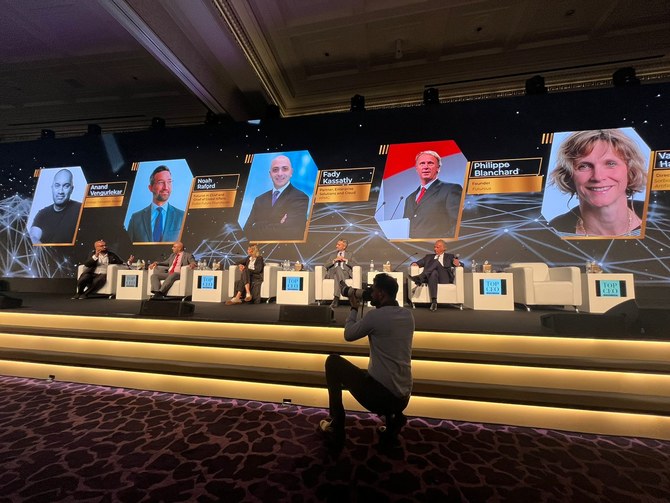
Investing in video games is more rewarding at the moment than Metaverse: Futurist-in-Chief at Dubai Future Foundation

Noah Raford was speaking at the Top CEO Forum
Short Url
Updated 19 May 2022
Follow

Investing in video games is more rewarding at the moment than Metaverse: Futurist-in-Chief at Dubai Future Foundation

DUBAI: As the business world is increasingly fascinated by the Metaverse, Noah Raford, futurist-in-chief and chief of Global Affairs at Dubai Future Foundation, claimed that investing in this advanced technology is just a waste of time. 

While speaking at the Top CEO Forum, Raford argued that people should invest in video games, as it is the only successful digital economy so far. 

However, Fady Kassatly, partner of Enterprise Solutions and Cloud, KPMG, said the Metaverse is nothing but the next evolution, which will make people live differently. 

He also added the Metaverse is going to evolve quickly in different directions, and this is just the beginning of the journey. 

On his part, Philippe Blanchard, founder of Futurous, stated the Metaverse will change the relationship between humans and nature. 

Predicting an inevitable Metaverse future, Valerie Hawley, Director of Sorbonne Center for Artificial Intelligence, said every business will look at the Metaverse space and consider using it in the coming years. 

She also added the Metaverse is a projection of the world that humans would like to live in. 


Saudi Arabia set to lead $500bn wave of GCC debt maturities: Kamco Invest 

Updated 6 sec ago
Follow

Saudi Arabia set to lead $500bn wave of GCC debt maturities: Kamco Invest 

RIYADH: The Gulf Cooperation Council region is expected to see elevated levels of fixed-income maturities over the next five years, driven primarily by Saudi Arabia and the UAE, a new analysis showed. 

In its latest report, Kamco Invest said fixed-income maturities in Saudi Arabia are projected to total $174.5 billion between 2026 and 2030, closely followed by the UAE at $171.8 billion.  

Saudi Arabia’s debt market has recorded robust growth in recent years, attracting strong investor interest in fixed-income instruments amid a global environment of elevated interest rates. 

In October, Kuwait Financial Center — also known as Markaz — said Saudi Arabia dominated the GCC’s primary debt market in the third quarter, raising $20.32 billion through 36 issuances, a 62.7 percent year-on-year increase in value. 

“The bulk of the maturities in Saudi Arabia are for bonds and sukuk issued by the government at $106.4 billion, while in the case of the UAE, the lion’s share of maturities are for instruments issued by corporates at $136.2 billion,” said Kamco Invest. 

Over the next five years, fixed-income maturities in Qatar are expected to reach $85.6 billion, while Kuwait, Bahrain and Oman are each projected to record maturities of around $25 billion. 

Citing Bloomberg data, the report showed that GCC sovereign maturities stand at $244.8 billion over the 2026–2030 period, while corporate maturities are higher at $263.3 billion. 
 
“Both bond and sukuk maturities are expected to remain elevated starting from 2026 until 2030 and then gradually taper for the rest of the tenor. The higher maturities during the next five years reflects deficit financing issuances from GCC governments as well as investment and refinancing related issuances from the corporates,” said Kamco Invest. 

The report added that the majority of maturities are denominated in US dollars, accounting for 64.7 percent, followed by local-currency issuances in Saudi riyals and Qatari riyals at 10.6 percent and 6.3 percent, respectively. 

Owing to the strong credit profiles of GCC governments, most maturities fall within the high investment-grade category. A-rated instruments account for $208.7 billion, while total investment-grade maturities stand at $239.1 billion. 

In terms of instruments, conventional bonds dominate, with maturities of $317.6 billion over the next five years, compared with $190.5 billion for sukuk. Corporate bond maturities, at $173.4 billion, exceed government bond maturities of $144.2 billion. 
 
By sector, banks and other financial services firms account for $210.4 billion in maturities through 2030, representing 79.9 percent of total corporate maturities and 41.4 percent of overall GCC maturities. The energy sector follows with $21.8 billion, or 8.3 percent, of corporate maturities, while utilities and industrials account for $13.6 billion and $5.4 billion, respectively. 

Real estate maturities are concentrated mainly in the UAE and Saudi Arabia, at $11.2 billion and $4.3 billion, respectively, through 2030. 
 
Issuances in 2025 

Aggregate bond and sukuk issuances in the GCC reached $206.6 billion through the third week of December 2025, broadly unchanged from $206.8 billion in the same period a year earlier.

However, issuance patterns shifted markedly. Government issuances declined sharply to $77.9 billion in 2025, from $98.6 billion in 2024, while corporate issuances rose to a record $128.6 billion, up from $108.2 billion. 

In terms of type of issuances, sukuk issuances witnessed a sharp decline during 2025, whereas bond issuances showed a healthy growth. 

“Aggregate GCC bond issuances stood at $125.2 billion in 2025, the highest on record, compared to $106.2 billion during 2024, whereas sukuk issuances declined by 19.1 percent to reach $81.4 billion this year as compared to issuances of $100.6 Bn during 2024,” said Kamco Invest. 

Despite an 18.3 percent decline, Saudi Arabia remained the region’s largest fixed-income issuer, with total issuance of $82.0 billion in 2025, down from $100.3 billion the previous year. 

Issuances from Qatar fell 21.7 percent to $22.1 billion, while the UAE recorded modest growth, with total issuance rising to $64.9 billion from $63.4 billion. Kuwait posted the sharpest increase, with issuance surging to $20.5 billion from $2.6 billion in 2024 following the approval of its debt law. 
 
Green issuances 

Green-instrument issuance in the GCC rose sharply in 2025, though it remained below the record levels seen in 2023. Total green issuance reached $12.5 billion, up from $4.6 billion in 2024 but below $17.3 billion recorded in 2023. 

The UAE led the region with $5.6 billion in green issuance, compared with $3.8 billion a year earlier. Saudi Arabia followed with $5.1 billion, after recording no green issuances in 2024. 

Green sukuk are Shariah-compliant instruments designed to finance environmentally sustainable projects, including renewable energy, clean transportation and climate-resilient infrastructure. 
 
Outlook 

Kamco Invest expects higher issuance levels in 2026, particularly among GCC countries facing fiscal deficits. The UAE and Qatar are also projected to see elevated corporate issuance. 

A potential decline in interest rates could further support issuance activity, especially early in the year, as borrowers seek to lock in lower funding costs. 

“Maturity refinancing is expected to result in approximately $85.4 billion in issuances during the year, while government deficit financing led by lower average oil prices would also contribute to the overall trend during the rest of the year,” the report said.  

Based on IMF forecasts, deficit financing could result in issuance of close to $60 billion in 2026, it added.