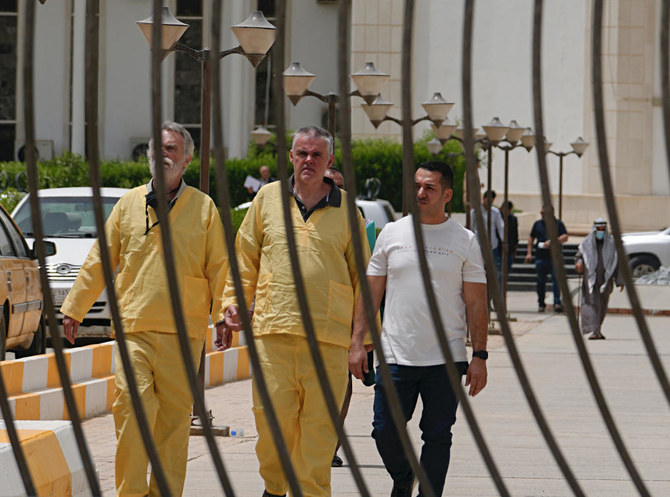
BAGHDAD: A British and a German tourist accused of smuggling ancient shards out of Iraq appeared in a Baghdad court in yellow detainees’ uniforms Sunday, telling judges they had not acted with criminal intent and had no idea they might have broken local laws.
The trial of Jim Fitton, 66, is grabbing international attention at a time when Iraq seeks to open up its nascent tourism sector. The session also revealed first details about a second defendant, identified as Volker Waldmann of Germany.
The three-judge panel in Baghdad’s felony court scheduled the next hearing for May 22. The court must determine whether the defendants had sought to profit by taking the 12 items, which were found in their possession as they attempted to fly out of Baghdad airport on March 20.
Fitton and Waldmann appeared in court in detainees’ yellow and were asked to explain their actions.
Waldmann said the two items found in his possession were not his and instead had been given to him by Fitton to carry. “But did you put them in your bag?” asked head judge Jaber Abdel Jabir. “Didn’t you know these were Iraqi antiquities?”
Waldmann said he didn’t pick up the items from the site, only agreed to carry them for Fitton.
Fitton said he “suspected” the items he collected were ancient fragments, but that “at the time I didn’t know about Iraqi laws,” or that taking the shards was not permitted. Fitton said as geologist he was in the habit of collecting such fragments as a hobby and had no intention to sell them.
He said it was not clear to him at the time that picking them up from the site was a criminal offense. “There were fences, no guards or signage,” at the sites he told the court.
“These places, in name and by definition, are ancient sites,” Jabir responded. “One doesn’t have to say it is forbidden.”
When Fitton said some of the shards were “no larger than my fingernail” , Jabir said this was not relevant. “Size doesn’t matter,” he told him.
Based on the law both men could face the death penalty, an outcome that legal experts said was unlikely. British and German embassy officials were present at the court but have not issued detailed public statements about the case in order not to jeopardize the proceedings, they said.
The defense plans to submit more evidence to clear the men, Fitton’s defense lawyer Thair Soud told The Associated Press. This includes testimony from government officials present at the site where the fragments were collected, he said.
“(Their testimony) is pending approval from their official directorates,” he said.


![]()

Briton, German deny smuggling antiquities in Iraq court
Short Url
https://arab.news/6fybx
Briton, German deny smuggling antiquities in Iraq court
- Waldmann said the two items found in his possession were not his and instead had been given to him by Fitton to carry
- Based on the law both men could face the death penalty, an outcome that legal experts said was unlikely


Latest updates


Recommended


© 2026 SAUDI RESEARCH & PUBLISHING COMPANY, All Rights Reserved And subject to Terms of Use Agreement.