

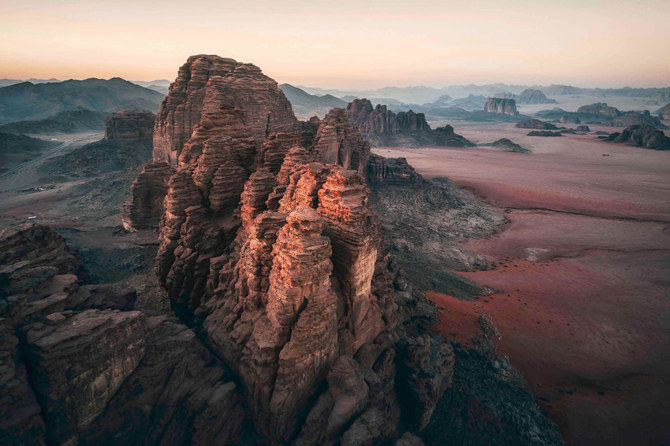
NEOM seeks to regenerate the area, offer ‘guilt-free’ vacations

Saudi Arabia’s $500-billion giga-project, NEOM, intends to regenerate the area by planting 100 million trees, bringing back ibex, oryx, ostriches, and cheetahs, and stopping hunting, fishing and logging. (Supplied)
Short Url
Updated 12 May 2022
Follow

NEOM seeks to regenerate the area, offer ‘guilt-free’ vacations

  • The Line is a 170-km city with no streets or cars, and is one of the three big projects NEOM has announced, said McEvoy

DUBAI: Saudi Arabia’s $500-billion giga-project, NEOM, intends to regenerate the area by planting 100 million trees, bringing back ibex, oryx, ostriches, and cheetahs, and stopping hunting, fishing and logging.

Visitors to the city will have a guilt-free vacation and the city seeks to make holidays environmentally friendly, Andrew McEvoy, managing director tourism at NEOM, told Arab News on the sidelines of the Arabian Travel Market.

The net-zero city — to be powered by 100 percent clean energy — will seek to seamlessly integrate nature with technology with a blueprint for the future of work, living and sustainability. 

“NEOM is very much built around sustainability,” said McEvoy. 
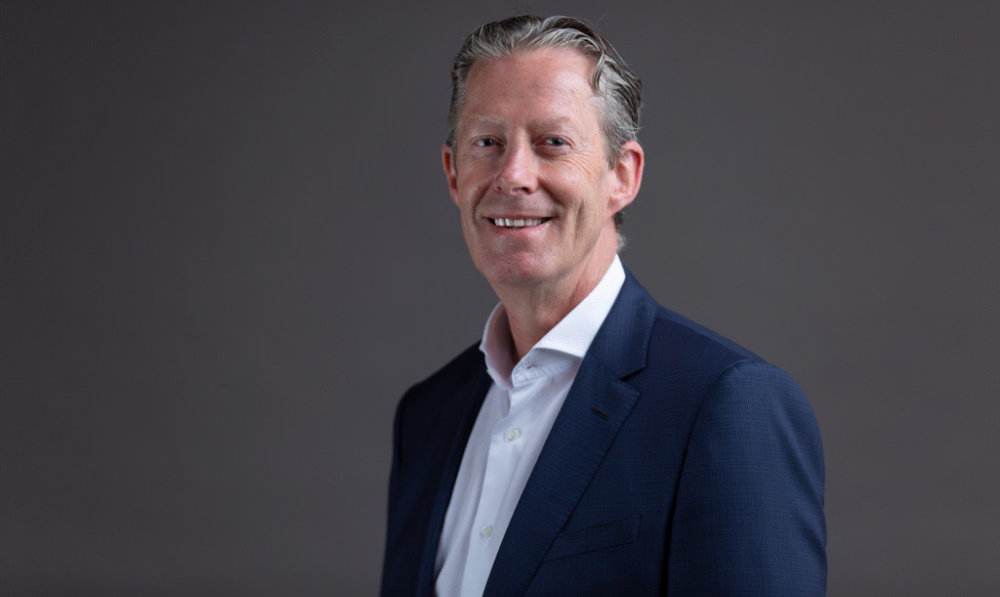


Andrew McEvoy, managing director of tourism at NEOM

McEvoy told Arab News NEOM’s The Line establishes a regenerative receipt that will make going on holiday more environmentally friendly than staying at home.

The Line is a 170-km city with no streets or cars, and is one of the three big projects NEOM has announced, said McEvoy.

“When you come as a visitor to NEOM, we want to give you what we call a regenerative receipt. We want to tell you that we offset all of your emissions,” the official said.

McEvoy said that visitors will not only offset all their emissions, but will also contribute to the local economy. “You’ve helped employ locals as guides, rangers, and tourism professionals,” he added.

According to McEvoy, tourists visiting The Line will have a guilt-free vacation because they have created no emissions, and added value financially, socially, and sustainably.

NEOM is also currently developing OXAGON, the world’s largest flood control structure, a port that will include cruise terminals, as well as TROJENA, a ski resort in Saudi Arabia where tourists can enjoy natural snow on Jabal Al-Lawz (a mountain), said McEvoy.

McEvoy said that NEOM is beyond sustainability as it aims to be a regenerative tourism destination.

“This is about leaving the destination better than the way we found it, which is super exciting,” McEvoy said.

Asked about NEOM’s targets for 2022, the NEOM official said for this year, the company's targets are business-to-business.

NEOM’s goal for 2022 is to build assets, McEvoy said. Visitors will be able to visit in 2024, he added.

“We have 10,000 construction workers living and working in NEOM now,” McEvoy said.

However, he added that by the end of 2022, the number will increase to 30,000 construction workers.

According to McEvoy, ATM is about building commercial partnerships to better sell NEOM once it opens.


First EU–Saudi roundtable on critical raw materials reflects shared policy commitment

Updated 16 January 2026
Follow

First EU–Saudi roundtable on critical raw materials reflects shared policy commitment

RIYADH: The EU–Saudi Arabia Business and Investment Dialogue on Advancing Critical Raw Materials Value Chains, held in Riyadh as part of the Future Minerals Forum, brought together senior policymakers, industry leaders, and investors to advance strategic cooperation across critical raw materials value chains.

Organized under a Team Europe approach by the EU–GCC Cooperation on Green Transition Project, in coordination with the EU Delegation to Saudi Arabia, the European Chamber of Commerce in the Kingdom and in close cooperation with FMF, the dialogue provided a high-level platform to explore European actions under the EU Critical Raw Materials Act and ResourceEU alongside the Kingdom’s aspirations for minerals, industrial, and investment priorities.

This is in line with Saudi Vision 2030 and broader regional ambitions across the GCC, MENA, and Africa.

ResourceEU is the EU’s new strategic action plan, launched in late 2025, to secure a reliable supply of critical raw materials like lithium, rare earths, and cobalt, reducing dependency on single suppliers, such as China, by boosting domestic extraction, processing, recycling, stockpiling, and strategic partnerships with resource-rich nations.

The first ever EU–Saudi roundtable on critical raw materials was opened by the bloc’s Ambassador to the Kingdom, Christophe Farnaud, together with Saudi Deputy Minister for Mining Development Turki Al-Babtain, turning policy alignment into concrete cooperation.

Farnaud underlined the central role of international cooperation in the implementation of the EU’s critical raw materials policy framework.

“As the European Union advances the implementation of its Critical Raw Materials policy, international cooperation is indispensable to building secure, diversified, and sustainable value chains. Saudi Arabia is a key partner in this effort. This dialogue reflects our shared commitment to translate policy alignment into concrete business and investment cooperation that supports the green and digital transitions,” said the ambassador.

Discussions focused on strengthening resilient, diversified, and responsible CRM supply chains that are essential to the green and digital transitions.

Participants explored concrete opportunities for EU–Saudi cooperation across the full value chain, including exploration, mining, and processing and refining, as well as recycling, downstream manufacturing, and the mobilization of private investment and sustainable finance, underpinned by high environmental, social, and governance standards.

From the Saudi side, the dialogue was framed as a key contribution to the Kingdom’s industrial transformation and long-term economic diversification agenda under Vision 2030, with a strong focus on responsible resource development and global market integration.

“Developing globally competitive mineral hubs and sustainable value chains is a central pillar of Saudi Vision 2030 and the Kingdom’s industrial transformation. Our engagement with the European Union through this dialogue to strengthen upstream and downstream integration, attract high-quality investment, and advance responsible mining and processing. Enhanced cooperation with the EU, capitalizing on the demand dynamics of the EU Critical Raw Materials Act, will be key to delivering long-term value for both sides,” said Al-Babtain.

Valere Moutarlier, deputy director-general for European industry decarbonization, and directorate-general for the internal market, industry, entrepreneurship and SMEs at European Commission, said the EU Critical Raw Materials Act and ResourceEU provided a clear framework to strengthen Europe’s resilience while deepening its cooperation with international partners.

“Cooperation with Saudi Arabia is essential to advancing secure, sustainable, and diversified critical raw materials value chains. Dialogues such as this play a key role in translating policy ambitions into concrete industrial and investment cooperation,” she added.