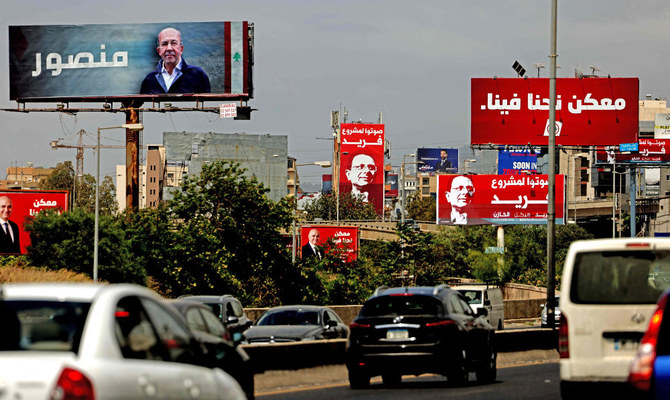

BEIRUT: With Lebanon’s crucial parliamentary elections on Sunday expected to go down to the wire, candidates and party supporters have been accused of trying to buy their way to victory by offering cash bribes to undecided voters.
A Shiite voter in Beirut’s second constituency told Arab News that he had been offered $300 if he and his family agreed to vote for a particular businessman.
The man, who asked to be identified only as Mohammed, said: “Supporters campaigning for their parties call me every day to ask who I will be voting for. I have no idea how they got my number. Some offer ration cards, others money, to either vote for them, or even boycott the elections or cast a blank ballot.”
Mohammed, who has no links with the Amal Movement or Hezbollah, said he is unlikely to vote. “All the parties in power had the opportunity to fulfill their promises, but they have left their people mired in their misery. We will not re-elect them.”
Electoral bribery has long been a problem in Lebanon, despite laws banning the practice, but has become more widespread and visible with the collapse of the national currency and decline in living conditions.
Now, if rumors from the money exchange black market are to be believed, the exchange rate will drop ahead of the elections as parties attempt to buy votes using US currency.
One money changer, who declined to be named, told Arab News: “Electoral spending is expected to rise during the next few days as parties attempt to buy the largest number of votes, through direct bribes.”
People in Beirut have reported that money changers have been stopping passers-by in the street to ask if they want to exchange their dollars.
Many believe the election result will depend on undecided voters or those desperate for money, who will end up voting for the highest bidder.
Lebanese electoral law states: “During the period of the electoral campaign, the provision of services or the payment of funds including the obligations and expenses of candidates shall be prohibited.”
Nadim Abdelmalak, head of Lebanon’s supervisory commission for elections, said recently: “The commission has not received any complaint from any party regarding electoral bribery.”
However, according to the Lebanese Association for Democratic Elections, rapidly worsening living conditions are reinforcing the presence of bribery, especially with about 80 percent of the population facing poverty as a result of the country’s economic crisis.
The unemployment rate is also approaching 40 percent amid a record collapse of the national currency against the dollar, while a freeze on bank withdrawals and the withholding of depositors’ funds are also threatening household budgets.
Ihab, a cab driver and voter in the Beirut’s second district, said that “he doesn’t mind receiving help from any electoral list.”
Many electoral lists offered gas and food vouchers. “They even offered to pay the generator bills and they are now offering to rent my car to transport voters for payment in dollars. I agreed, but I will not vote for anyone.”
LADE said that it had evidence of candidates distributing baby milk in the north of Lebanon, while others have donated solar panels to light roads.
Samer, a voter in the Zahle district, said that “as the electoral battle in the region heats up, the bribes will double and this will manifest on the election day. Those voting in the morning will be less bribed than those voting in the afternoon.”
Bribery appears commonplace in the electoral districts where competition is fierce, especially Beirut I, Beirut II, Zahle, Keserwan, Jbeil, Batroun, Koura, Bsharri, Zgharta and Chouf Aley.
However, the contest seems less heated in regions controlled by Hezbollah and the Amal Movement.
Mayssa, from the Baalbek–Hermel district, said: “A group from Hezbollah visited our home in the southern suburbs of Beirut and asked about the number of voters in the family. They assured us that transport will be available from Beirut to the district. They didn’t offer anything else.”
With fuel prices at crippling levels, most parties are offering voters in remote areas gas vouchers to cover their driving costs to polling stations.
The cost of refueling a car often exceeds 500,000 Lebanese pounds ($300), which means voters in isolated villages can face a $600 bill to drive back and forth to vote.
Salam, who works in a Beirut hotel, said: “Hezbollah is confident that they will win the elections. That is why they are not urging us to vote for them, although I am reluctant to vote because I no longer believe in anyone.”