

Sunni preachers in ‘vote to save Lebanon’ plea

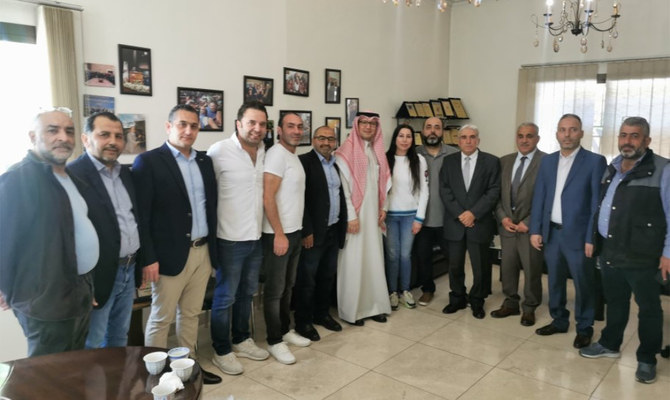
The Saudi ambassador to Lebanon during his visit. (AN photo)
Short Url
Updated 10 May 2022
Follow

Sunni preachers in ‘vote to save Lebanon’ plea

  • Sermons to warn against ‘dangerous’ voter boycott in Sunday’s poll

BEIRUT: Lebanon’s Sunni preachers have been told to issue a call in their Friday sermons for people to take part in the country’s parliamentary elections on May 15.

Grand Mufti Sheikh Abdel Latif Derian, the Sunnis’ supreme religious authority, instructed preachers to urge Lebanese to head to the polling stations on Sunday, and elect those who would “preserve Lebanon, and the future of its children, its Arab identity and its legitimate institutions.”

Many Sunnis have said they will boycott the elections following a decision by the head of the Future Movement, former prime minister Saad Hariri, to step down from politics and not contest the poll.

Some say that the many electoral lists and numerous candidates in Beirut, Tripoli and Akkar make it difficult to choose Sunni MPs, with most voting only for the Future Movement in previous elections.

Derian has previously declared that “election is a duty and a necessity,” and warned of the “extremely dangerous” effects of a voter boycott on the representation of Sunnis in parliament.

Meanwhile, Saudi Ambassador to Lebanon Walid Bukhari visited several election hopefuls on Tuesday, including the Sunni candidate on the Zahle Sovereignty list, Bilal Hoshaimy. This electoral list includes activists who took part in the Oct. 17 protests.

Bukhari also visited current MP and candidate Michel Daher, who is running with the Independent Sovereigns list, which includes nonpartisan figures.

The incoming parliament will elect a new president to succeed Michel Aoun.

For the second day, Hezbollah Secretary-General Hassan Nasrallah addressed party supporters in the southern suburb of Beirut and singled out voters “who support the resistance, but do not want to vote because of the living crisis.”

Nasrallah described the upcoming election as a “political July war” — a reference to the July 2006 conflict with Israel — and said: “You must get out of your homes to exercise political resistance in order for us to have armed military resistance; if the resistance abandons its weapons, who will protect Lebanon?”

Parliament Speaker Nabih Berri also urged his supporters to vote on Sunday. Before Berri’s speech, the Amal Movement candidate Qabalan Qabalan criticized the “clamor, chaos and madness” that accompanies election campaigns.

Qabalan said that his party hopes to renew political life and constitutional institutions in Lebanon in order to get the country out of the “deep pit” it is in.

“There is no need to raise the ceiling in political discourse, nor to provoke sectarian and political fanaticism in the hope of a vote or a seat or a majority here or there. We must admit that the country does not function by a system wherein a majority rules over a minority. A majority cannot subjugate a minority, no matter how powerful it is, because the foundations of this country are based on understanding among all its components and groups,” Qabalan said.

Samir Geagea, head of the Lebanese Forces party — which is engaged in a fierce battle against the Free Patriotic Movement — addressed supporters during an electoral meeting in which he criticized Aoun, saying that the presidency has become “a title for undermining Lebanon’s sovereignty, destroying its institutions and eroding the state; a title of hunger, poverty, humiliation and power cuts.”

The FPM is a Lebanese Christian group founded by Aoun in 2005.

Geagea said that Lebanon witnessed “the biggest lies and fraud undertaken by the FPM. Its goal was only to reach power, and when it achieved that, it forgot its promises.”


Israel’s ‘deliberate intention of preventing births among Palestinians’ meets ‘legal criteria of Genocide Convention’: Reports

Updated 10 sec ago
Follow

Israel’s ‘deliberate intention of preventing births among Palestinians’ meets ‘legal criteria of Genocide Convention’: Reports

  • Births in Gaza fell by 41% during conflict as maternal deaths, miscarriages surged
  • ‘The destruction of maternal care in Gaza reflects the deliberate infliction of conditions of life calculated to bring about the destruction of the Palestinian people, in whole or in part’

LONDON: Births in Gaza fell by 41 percent due to Israel’s war on the territory, with the conflict resulting in catastrophic numbers of maternal deaths, miscarriages and birth complications, two reports have found.

The data on pregnant women, babies and maternity care in the war-torn Palestinian enclave also revealed a surge in newborn mortality and premature births, The Guardian reported on Wednesday.

Dangerous wartime conditions and Israel’s systematic destruction of Gaza’s health systems were blamed for the alarming statistics.

The two reports were conducted by Physicians for Human Rights, in collaboration with the University of Chicago Law School’s Global Human Rights Clinic and Physicians for Human Rights — Israel.

Researchers highlighted Israel’s “deliberate intention of preventing births among Palestinians, meeting the legal criteria of the Genocide Convention.”

The reports build on earlier findings by PHR’s Israel branch. They place the testimonies of pregnant women and new mothers within the context of health data and field reports, which recorded “2,600 miscarriages, 220 pregnancy-related deaths, 1,460 premature births, over 1,700 underweight newborns, and over 2,500 infants requiring neonatal intensive care” between January and June 2025.

PHRI’s Lama Bakri, a psychologist and project manager, said: “These figures represent a shocking deterioration from pre-war ‘normalcy,’ and are the direct result of war trauma, starvation, displacement and the collapse of maternal healthcare.

“These conditions endanger both mothers and their unborn babies, newborns, and breastfed infants, and will have consequences for generations, permanently altering families.”

She added: “Beyond the numbers, what emerges in this report are the women themselves, their voices, choices and lived realities, confronting impossible dilemmas that statistics alone cannot fully capture.”

Maternal and newborn care in Gaza has been damaged by Israel’s destruction of health infrastructure, as well as fuel shortages, blocked medical supplies, mass displacement and relentless bombardment.

As a result, survival in Gaza’s overcrowded tent encampments has become the sole option for pregnant women and new mothers.

During the first six months of Israel’s war on the territory, more than 6,000 mothers were killed, at an average of two every hour, according to UN Women estimates.

It is also believed that about 150,000 pregnant women and new mothers have been forcibly displaced by the conflict.

In the first months of last year, just 17,000 births were recorded in Gaza, a 41 percent fall compared to the same period in 2022.

The researchers examined Israel’s apparent strategy to undermine Palestinian births, highlighting a targeted strike in December 2023 on the Al-Basma IVF clinic.

The attack on Gaza’s largest fertility center destroyed about 5,000 reproductive specimens and ended a pattern of 70-100 IVF procedures each month.

The strike was deliberately designed to target the reproductive potential of Palestinians, the Independent International Commission of Inquiry later found.

“Reproductive violence constitutes a violation under international law; when carried out systematically and with them intent to destroy, it falls within the definition of genocide of the Genocide Convention,” the reports said.

“The destruction of maternal care in Gaza reflects the deliberate infliction of conditions of life calculated to bring about the destruction of the Palestinian people, in whole or in part.”