

China In-Focus — Tesla denies halting production at Shanghai plant; Geely buys stake in Renault Korea

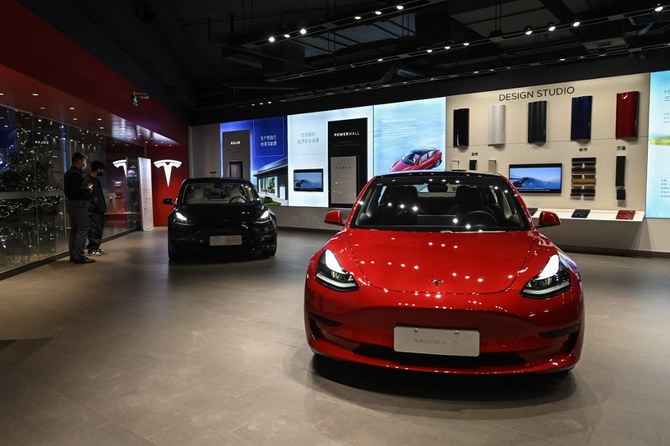
Tesla had planned as late as last week to increase output to pre-lockdown levels by next week. (AFP)
Short Url
Updated 10 May 2022
Follow

China In-Focus — Tesla denies halting production at Shanghai plant; Geely buys stake in Renault Korea

BEIJING: Electric vehicle maker Tesla has denied halting production at its Shanghai plant, despite reports it had ceased most activities due to problems in securing parts.

Reuters reported that according to an internal memo seen by the news agency, the plant plans to manufacture less than 200 vehicles Tuesday — far less than the roughly 1,200 units it has been building each day since shortly after it reopened on April 19 following a 22-day closure.

Two sources familiar with the matter had earlier said supply issues had forced the factory to halt production Monday.

The company has refuted the report, saying that it hasn’t halted output at the site, although a spokesperson for the US carmaker acknowledged that it is experiencing some disruption to logistics amid the city’s long-running Covid-19 lockdown.

Shanghai is in its sixth week of an intensifying COVID-19 lockdown that has tested the ability of manufacturers to operate amid hard restrictions on the movement of people and materials.

Tesla had planned as late as last week to increase output to pre-lockdown levels by next week.

It was not immediately clear when the current supply issues could be resolved, said the people, who asked not to be identified because the production plans are private.

China's Geely buys stake in Renault Korea

China’s Geely Automobile will buy just over a third of Renault’s Korea unit for roughly $200 million, potentially helping it boost US exports, and freeing up funds for the French automaker to invest in its electric business.

Renault, which can assemble 300,000 vehicles a year in its factory in Busan, South Korea, is in the middle of a turnaround aimed at increasing margins and separating its electric vehicle business to catch up with rivals such as Tesla.

The French firm’s move to sell the stake to Geely — which owns Volvo Cars and a 9.7 percent stake in Daimler AG — follows an announcement by the two companies in January to develop hybrid vehicles for South Korea and abroad, produced at the Busan plant.

For Geely, which has typically grown its business through global partnerships, the deal goes beyond selling cars in South Korea and is a way for the Chinese automaker to export cars made in South Korea to America, a person close to the company said.

“It is an open door into the US,” said the person who declined to be named because the plans are confidential.

(With input from Reuters) 


Qatar’s foreign reserves rise to $71.9bn in January

Updated 8 sec ago
Follow

Qatar’s foreign reserves rise to $71.9bn in January

RIYADH: Qatar’s foreign reserves saw a slight increase in January, reaching $71.95 billion, according to recent data from the Qatar Central Bank.

The figures, released at the end of last month, show a steady rise in the country’s international reserves and foreign currency liquidity.

One notable highlight from the report is a significant 12.8 percent month-on-month rise in Qatar’s gold investments, which now stand at $18.13 billion — marking the highest level ever recorded.

This growth in reserves underscores Qatar’s increasingly robust financial position, which is expected to be mirrored in the December data of other Gulf Cooperation Council countries.

The GCC nations, whose currencies are pegged to the US dollar, typically align their monetary policies with that of the Federal Reserve. Accumulating foreign reserves is crucial for maintaining the stability of these currency pegs, managing liquidity, and safeguarding exchange rates, especially during periods of global financial uncertainty.

However, the report also revealed a decline in investments in foreign treasury bonds and bills, which fell by 9 percent month on month to approximately $30.1 billion — the lowest level in five years. In contrast, the total balances held with foreign banks saw an 18.7 percent increase, reaching $5.92 billion, the highest figure in 10 months.

QCB’s international reserves and foreign currency liquidity also showed a year-on-year increase of 2.65 percent in December, reaching $71.7 billion, as reported by the Qatar News Agency.

This trend of rising foreign reserves is not unique to Qatar. In November, Saudi Arabia’s foreign reserve assets saw a notable 5 percent increase, reaching $463.6 billion, suggesting a regional trend of accumulating financial buffers.

In addition, Qatar’s economic resilience continues to be recognized globally. In March, Fitch Ratings reaffirmed the country’s “AA” credit rating, citing its expanding liquefied natural gas production capacity and high per capita income. The rating reflects Qatar’s strong fiscal position, with one of the highest GDPs per capita globally and a flexible public finance framework that bolsters its economic stability.

An “AA” rating signals very low credit risk and a strong ability to meet financial obligations, even amid potential economic challenges. This rating aligns with a broader regional shift, as Middle Eastern countries diversify their economies to reduce dependence on oil revenues.