IATA’s head optimistic about airlines recovery as early as next year

1 / 2
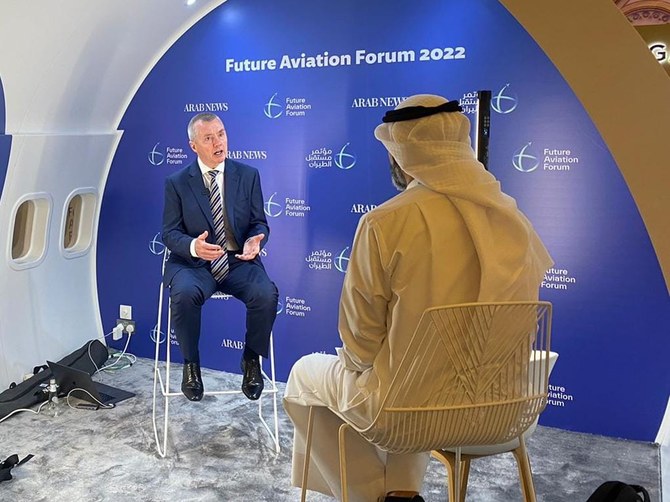
Willie Walsh - Director General, International Air Transport Association (IATA) speaking to Arab News. (AN photo)
2 / 2
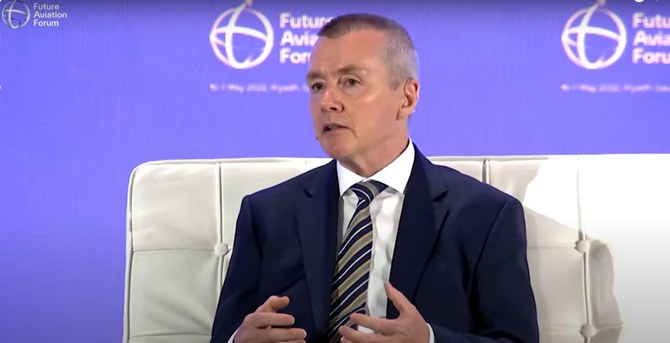
International Air Transport Association director general, Willie Walsh speaking at FAF event in Riyadh. (AN photo)
Short Url
Updated 14 May 2022
Follow

IATA’s head optimistic about airlines recovery as early as next year

RIYADH: The aviation sector is poised to see a full recovery to the pre-pandemic levels as early as next year, according to International Air Transport Association director general, Willie Walsh. 

The recovery in the travel market is ongoing and it may take another year or two to see it fully back to where it was in 2019, he told Arab News in an interview on the sidelines of Future Aviation Forum in Riyadh.

Walsh believed that policies — such as the one Saudi Arabia proposed at the forum — aimed at facilitating movement of people and harmonizing the different health policies in different countries will play a big role in accelerating the recovery.

Talking on the impact of high oil prices on the recovery, Walsh said that this is not the first time the industry faced such a challenge and that demand for traveling wasn't affected in the past due to the high cost of fuel.

Airlines always know how to find a way to operate and make profit in any cost environment, he added.

Walsh noted that soaring energy prices are one of the most difficult challenges the aviation sector is facing, as it tries to come out of the economic slump caused by the pandemic — with consumers paying higher ticket prices. 

The IATA director general revealed that the airline industry is committed to achieving net-zero by 2050, despite the challenges this involves. 

Sounding a cautionary note, he made it clear that these initiatives would cost a lot of money, and would need greater commitment from the financial community to allocate funding to help achieve this target.

Earlier in the forum, He said the aviation sector has slowed due to China’s zero-Covid policy, which is impossible to achieve.

Walsh made the remarks while speaking at the Future Aviation Forum in Riyadh on May 9. 

While the use of hydrogen as aviation fuel has been much talked about in recent months, Walsh indicated that a complex process was involved to achieve this.

He said countries should initially develop aircraft engines that can use this energy source.


Argentina eyes deeper Saudi ties as multilateral trade landscape shifts, says minister  

Updated 9 sec ago
Follow

Argentina eyes deeper Saudi ties as multilateral trade landscape shifts, says minister  

ALULA: Shifting global trade patterns are creating new opportunities for bilateral cooperation between Argentina and Saudi Arabia, particularly in the energy sector, said Federico Sturzenegger, Argentina’s minister of deregulation and state transformation. 

Speaking to Arab News on the sidelines of the AlUla Conference for Emerging Market Economies, Sturzenegger expanded on his goals at the event, Argentina’s growing economic relationship with the Kingdom, and the country’s position as a third-party player amid geopolitical tensions. 

He said the forum provides a strong platform for collaboration because of the diversity of participants gathered in AlUla. Sturzenegger pointed to Argentina’s bilateral relationship with Saudi Arabia as an example of the type of cooperation the conference can facilitate, particularly in energy: 

“Definitely we could see some of the knowledge, experience, capital, know-how of this country to exploit those resources. It’s always an opportunity to talk and learn about those things and see how things are going in each country,” the minister told Arab News. 

Elaborating on the sector, he added: “I mean energy definitely, I mean this country is absolutely top tier, it’s a leader in the world. It has the engineers, it has the knowledge, it has the capital; Argentina is a potentially relevant hub in the world in this, in a very isolated place, and a very safe place from a geopolitical point of view.” 

After speaking on Paper Session 1: Resetting Global Trade — which also featured Faisal Alibrahim, Saudi minister of economy and planning; Eyob Tekalign, governor of the Ethiopian National Bank; and Pol Antras, professor of economics at Harvard University — Sturzenegger outlined the effects of geopolitical tensions on trade agreements and the role of third-party countries. 

He referred to a major trade deal recently signed between the US and Argentina as an example of how fragmentation in multilateralism has paradoxically created alternative avenues for cooperation, especially as such agreements historically took decades to finalize. 

Building on that example, he raised the question of whether the rupture of multilateralism might in some cases lead to more trade rather than less — a view that Antras challenged during the session. 

Geopolitical positioning remained a central theme in his remarks, particularly when discussing the importance of third-party countries during periods of tension. 

“Until three years ago we had this kind of multilateralism; it was very well established, everything was contained within that framework. Of course, the US had a prominent role in that framework. Now things are a little bit more uncertain, and that has led to the proliferation of many bilateral agreements,” he said. 

Despite that shift, Sturzenegger said the new environment is creating room for agreements that previously struggled to advance. 

“I’m seeing some opportunities for trade which perhaps were not explored before,” the minister added. 

He also referred to an increase in trade in Africa, emphasizing that there are different opportunities throughout the world that were previously unexplored under the contained sphere of earlier multilateralism. 

On Saudi-Argentine ties, he maintained an optimistic outlook, again emphasizing energy as a priority. 

“I know that Saudi companies have been visiting Argentina this year, and again, as I mentioned, you have the expertise, you have the know-how, it’s a business that you know, you have the global network of trade, so just adding an additional source of supply makes that network even more powerful, profitable, and resilient,” the minister said. 

As the Emerging Market Economies Conference wraps up its first day, it is evident that while discussions on implementation and the strengthening of long-term economic planning are at the forefront, relationships with the Kingdom continue to develop and support bilateral ties.