ISLAMABAD: China’s confidence in Pakistan’s ability to provide security to its nationals has been “seriously shaken” after a recent suicide bombing in Karachi that claimed the lives of four people, said a local newspaper on Sunday while quoting the top official of the Senate Defense Committee.
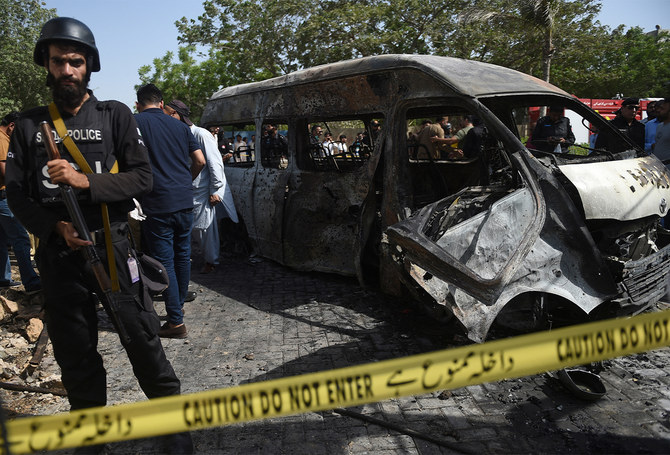
Three Chinese citizens and their Pakistani driver were killed last month when a female suicide bomber detonated herself near a Chinese language learning center at the University of Karachi.
The attack was claimed by the separatist Baloch Liberation Army, as security forces said the attacker had specifically targeted the Chinese workers.
“The Chinese confidence in Pakistan’s security system’s ability to protect their citizens and their projects is seriously shaken,” Senator Mushahid Hussain, who led a delegation of lawmakers to the Chinese embassy soon after the bombing, told Dawn newspaper.
“It has caused serious concern and understandable indignation in China. More so, the pattern of attacks is so recurring and it’s clear that Pakistani promises of ‘foolproof security’ are mere words, not matched by countermeasures on the ground,” he added.
Chinese workers in Pakistan have also been targeted by militant groups in the past.
In July 2021, 10 Chinese nationals were killed after an explosion on their bus in Khyber-Pakhtunkhwa province.
Chinese nationals have also been attacked by separatists in Balochistan, where Beijing is involved in huge infrastructure projects as part of its Belt and Road Initiative.
“If such attacks continue, not just Chinese but other foreign investors will be forced to review their role in Pakistan,” Hussain said.
While Chinese officials have condemned attacks against its nationals and urged Pakistani authorities to bring their perpetrators to justice, they have also acknowledged that Pakistanis from all walks of life have criticized such incidents.
“Pakistani people from all sectors also condemned the terrorist attack and mourned for the victims,” China’s Foreign Ministry Spokesperson Zhao Lijian said on Friday. “This further demonstrates that the China-Pakistan all-weather friendship is deeply rooted in the hearts of the people and is the consensus of the ruling party as well as the opposition.”
Prime Minister Shehbaz Sharif and Foreign Minister Bilawal Bhutto-Zardari also visited the Chinese embassy in Pakistan following the attack in Karachi to express their condolences.


![]()

Pakistan’s top Senate Defense Committee official says Chinese confidence ‘shaken’ after Karachi attack
Short Url
https://arab.news/p5tyx
Pakistan’s top Senate Defense Committee official says Chinese confidence ‘shaken’ after Karachi attack
- Senator Mushahid Hussain says China skeptical of security arrangements for its nationals in Pakistan
- Hussain maintains such attacks can also force other foreign investors to review their role in the country
Latest updates


© 2026 SAUDI RESEARCH & PUBLISHING COMPANY, All Rights Reserved And subject to Terms of Use Agreement.