

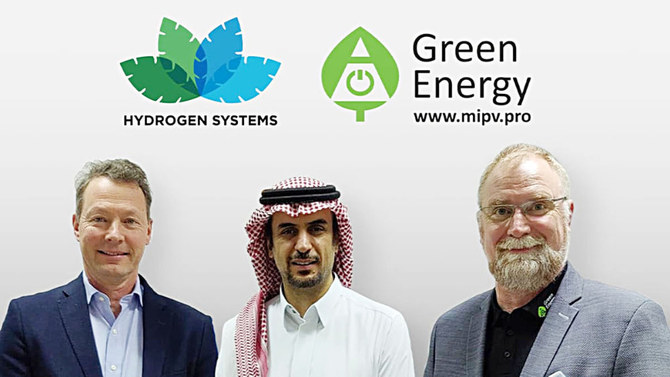
Green Energy signs contract with Hydrogen Systems

From left, H.P. Michelet, COB of Green Energy A/S; Sattam Al-Suwailem, CEO of Hydrogen Systems Inc.; and Karl Andreassen, CEO of Green Energy A/S.
Short Url
Updated 03 May 2022
Follow

Green Energy signs contract with Hydrogen Systems

Denmark-based Green Energy A/S, a leader in mobile integrated photovoltaic solutions for commercial vehicles, has announced an exclusive long-term contract with Hydrogen Systems Inc., a Saudi Arabian company, providing integrated hydrogen solutions and value-added support to industrial, hydrogen energy and decarbonization markets throughout the Kingdom and the Middle East.

The agreement provides exclusive rights to Green Energy’s total portfolio of mobile solar solutions across a wide range of applications such as buses, trucks, vans and lightweight steel and container roofing. The agreement allows for future manufacturing of key components of the system in Saudi Arabia.

Sattam Alsuwailem, founder and CEO of Hydrogen Systems Inc., said: “The agreement represents an important step toward our goal of emission reductions as Green Energy’s mobile solar solutions allow the transition from motor-driven to battery-driven electricity generation. There is an urgent need to expand the renewable energy matrix and green energy will be key in decentralizing renewable energy. We are looking forward to the technology transfer, localization, and integration of this technology into conventional vehicles as well as electric and hydrogen fuel cell vehicles.”

“We believe our product configurations offer Hydrogen Systems Inc. the immediate benefit of positioning it as the region’s leading provider of mobile off-grid electricity products,” a statement from Green Energy A/S said.

The heart of the Green Energy System is CIGS solar cell technology. After eight years of intense R and D efforts, the solutions are currently being commercially launched in 27 countries throughout Europe and across more than 13 different industrial verticals.


World Defense Show 2026: KPMG highlights human capital as strategic defense asset

Updated 03 February 2026
Follow

World Defense Show 2026: KPMG highlights human capital as strategic defense asset

KPMG published a series of four white papers as official knowledge partner for the World Defense Show 2026, reinforcing its commitment to supporting Saudi Arabia’s Vision 2030 and the Kingdom’s ambition to build a sovereign, future-ready defense ecosystem grounded in integrated capability development, localization, and digital readiness.

As global defense priorities evolve from procurement-led models toward capability-driven ecosystems, one of the papers in the defense integration series highlights a clear inflection point for the sector. According to KPMG analysis, defense localization in Saudi Arabia has increased from around 4 percent in 2018 to 24.9 percent in 2024, with the Kingdom targeting 50 percent localization by 2030. At the same time, local content across the defense sector has reached 40.7 percent, up from 38.4 percent in 2023, reflecting deeper integration across procurement, industrial participation, technology adoption, and workforce development.

KPMG’s findings emphasize that modern defense power is no longer defined by platforms and equipment alone, but by the ability to design, operate, integrate, and sustain advanced systems at scale. While technology, infrastructure, and capital investment remain critical enablers, the firm’s WDS position paper highlights that defense transformation has a significant human-capital focus, recognizing that skills, data literacy, and local expertise are essential to maximizing the performance, resilience, and sovereignty of advanced defense capabilities.

Christopher Moore, head of defense and security, said: “Saudi Arabia’s defense transformation has a significant human-capital focus, alongside major investments in technology, equipment, and industrial capacity. The progress we are seeing in localization and local content demonstrates that the Kingdom is not only acquiring advanced systems, but also building the skills, institutions, and operating models required to sustain them. Through our partnership with the World Defense Show, KPMG is proud to contribute insight and frameworks that help translate Vision 2030 ambition into operational readiness.”

This human-capital perspective forms part of a broader KPMG defense thought-leadership series developed for WDS 2026, which examines defense transformation through multiple, interconnected pillars. These include accelerating sovereign defense ecosystems, integrating business and technology infrastructure, financing future deterrence through public-private partnerships, strengthening industrial and technological autonomy, and building a future-ready defense workforce — reflecting KPMG’s holistic view of defense as an integrated national ecosystem.

KPMG’s research also situates Saudi Arabia’s progress within a global economic context. International benchmarks cited in the firm’s WDS analysis show that every $1 billion in defense manufacturing output in the US supports approximately 5,700 jobs, while the UK defense sector contributes around £25 billion ($34.2 billion) to GDP and sustains 260,000 skilled jobs. Across the EU, defense industries employ more than 1.6 million people and generate approximately 70 billion euros ($82.9 billion) in annual value. KPMG notes that similar dynamics are beginning to emerge in Saudi Arabia as localization accelerates and private-sector participation expands.

To support measurable progress, KPMG has proposed a Defense Workforce Capability Index — a framework that links workforce outcomes directly to operational readiness. The index tracks localization rates, technical qualification levels in advanced and digital systems, and the share of maintenance and sustainment conducted domestically, aligning human-capital metrics with broader defense performance objectives.

Taking place in Riyadh from Feb. 8 to 12, the World Defense Show will bring together senior government leaders, defense manufacturers, and technology innovators from around the world. The other three papers in the defense integration series focus on sovereignty, financing and technology.