

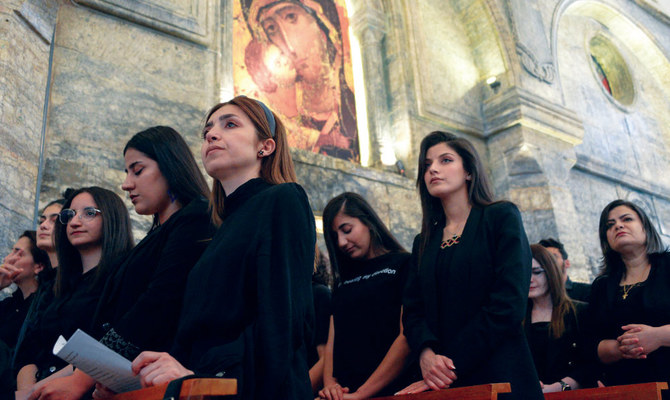

MOSUL, Fallujah: Dozens of faithful celebrated Mass on Saturday at a Mosul church in northern Iraq for the first time since it was restored after its ransacking by Daesh terrorists.
Daesh swept into Mosul and proclaimed it their “capital” in 2014, in an onslaught that forced hundreds of thousands of Christians in the northern Nineveh province to flee, some to Iraq’s nearby Kurdistan region.
The Iraqi army drove out the jihadists three years later after months of grueling street fighting that devastated the city.
The Mar Tuma Syriac Catholic church, which dates back to the 19th century, was used by the jihadists as a prison or a court.
Restoration work is ongoing and its marble floor has been dismantled to be completely redone.
In September 2021, a new bell was inaugurated at the church during a ceremony attended by dozens of worshippers.
The 285-kg bell cast in Lebanon rang out on Saturday to cries of joy before the Mass got underway.
The service began with worshippers who packed the church chanting hymns as an organist played.
“This is the most beautiful church in Iraq,” said Father Pios Affas, 82, the delighted parish priest.
Affas also paid tribute to those behind the restoration work which, he said, had “brought the church back to its past glory, like the way it was 160 years ago.”
Inside the church, ochre and grey marble shone in the nave, where the altar and colonnaded arches were restored and new stained glass installed.
Jihadists had destroyed all Christian symbols, including the holy cross, and parts of the church were damaged by fire and shelling.
Artisans worked diligently to “clean the scorched marble” and restore it, Fraternity in Iraq, a French NGO that aids religious minorities, which helped fund the restoration work said earlier this year.
Outbuildings and rooms on the first floor, where windows have been broken and Daesh graffiti can be seen, are still due to be repaired.
Mosul and the surrounding plains of Nineveh were once home to one of the region’s oldest Christian communities.
Iraq’s Christian population has shrunk to fewer than 400,000 from around 1.5 million before the US-led invasion of 2003 that toppled dictator Saddam Hussein.
Nineveh province was left in ruins after three years of jihadist occupation which ended in 2017 when Iraqi forces backed by US-led coalition airstrikes pushed them out. Several monasteries and churches are being renovated but reconstruction is slow, and the Christian population that has fled has not returned.
Meanwhile, two rockets targeting a base in western Iraq hosting US-led coalition troops on Saturday crashed near the complex without causing casualties or damage, security sources said.
“Two rockets fell outside the Iraqi base of Ain Al-Asad,” a security forces statement said, adding there were no “losses.”
The base, controlled by Iraq, is located in the desert in the western Anbar province and hosts foreign troops from the coalition fighting the Daesh group.
A coalition official said there was “no impact on the installation reported” and “no coalition personnel injuries reported.”
A previously unknown group calling itself “International Resistance” claimed the attack on a pro-Iran channel of messaging app Telegram.
Rockets and drones frequently target the Ain Al-Asad base.


