Egypt’s Coptic Church mourns death of former patriarch

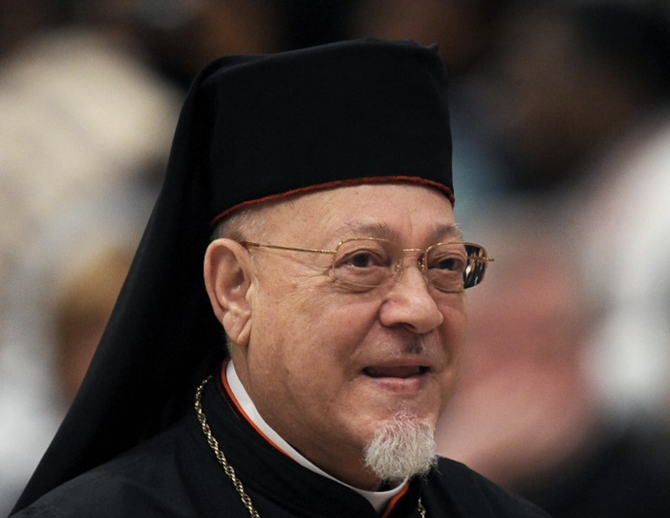
Former patriarch Cardinal Antonios Naguib died on March 28, aged 87. (File/AFP)
Short Url
Updated 29 March 2022
Follow

Egypt’s Coptic Church mourns death of former patriarch

  • Cardinal Antonios Naguib, who has died aged 87, praised as “a scholar who served spirit and truth”
  • He leaves a legacy of social activities, and writings in Arabic and English, including “The Gospel of Bliss”

CAIRO: The Coptic Catholic Church in Egypt is mourning the death of former patriarch Cardinal Antonios Naguib, who died on March 28, aged 87.

Naguib, a leading figure in the 250,000-strong Catholic Coptic community, was fluent in English, French, Italian and German.

He was born on March 18, 1935 in Samalut, Minya governorate, Upper Egypt.

Naguib was unanimously elected as patriarch on March 30, 2006 after his predecessor, Cardinal Stephen II, submitted his resignation due to health conditions.

In 2010, Pope Benedict XVI promoted Naguib to cardinal. Three years later, however, ill health forced Naguib to step down as patriarch.

He leaves a legacy of social activities, and writings in Arabic and English, including “The Gospel of Bliss,” in which he explained the beatitudes of Christ in the famous sermon. 

Naguib opened the House of Peter the Apostle to handle publishing and translation work for the church in Egypt, and also set up a number of economic projects, such as Al-Amal Hospital in Al-Fakrya, Mazraat Shusha, and the Second Good Shepherd School in Shalaby in Minya.

Pope Tawadros II, leader of the Coptic Orthodox Church of Alexandria, sent a telegram to Anba Ibrahim Ishaq, the Coptic Catholic patriarch, offering condolences on the death of Naguib.

The pope described Naguib as “a dignified personality serving spirit and truth, and a scholar of knowledge and biblical studies who gained the love and respect of many.”

Episcopal Church Archbishop of Alexandria Sami Fawzy also praised Naguib’s church service.

Apostolic Vicar Claudio Lurati, his deputy Monsignor Antoine Tawfik and the archdiocese Shoura Council offered condolences.


The West Bank soccer field slated for demolition by Israel

Updated 13 sec ago
Follow

The West Bank soccer field slated for demolition by Israel

  • The move is likely to eliminate one of the few ​spaces where Palestinian children are able to run and play
BETHLEHEM: Israeli authorities have ordered the demolition of a soccer field in a crowded refugee camp in the occupied West Bank, eliminating one of the few ​spaces where Palestinian children are able to run and play.
“If the field gets demolished, this will destroy our dreams and our future. We cannot play any other place but this field, the camp does not have spaces,” said Rital Sarhan, 13, who plays on a girls’ soccer team in the Aida refugee camp near Bethlehem.
The Israeli military ‌issued a demolition ‌order for the soccer field on ‌December ⁠31, ​saying ‌it was built illegally in an area that abuts the concrete barrier wall that Israel built in the West Bank.
“Along the security fence, a seizure order and a construction prohibition order are in effect; therefore, the construction in the area was carried out unlawfully,” the Israeli military said in a statement.
Mohammad Abu ⁠Srour, an administrator at Aida Youth Center, which manages the field, said the ‌military gave them seven days to demolish ‍the field.
The Israeli military ‍often orders Palestinians to carry out demolitions themselves. If they ‍do not act, the military steps in to destroy the structure in question and then sends the Palestinians a bill for the costs.
According to Abu Srour, Israel’s military told residents when delivering ​the demolition order that the soccer field represented a threat to the separation wall and to Israelis.
“I ⁠do not know how this is possible,” he said.
Israeli demolitions have drawn widespread international criticism and coincide with heightened fears among Palestinians of an organized effort by Israel to formally annex the West Bank, the area seized by Israel in the 1967 Middle East war. Israel accelerated demolitions in Palestinian refugee camps in early 2025, leading to the displacement of 32,000 residents of camps in the central and northern West Bank. Human Rights Watch has called the demolitions a war crime. ‌Israel has said they are intended to disrupt militant activity.