

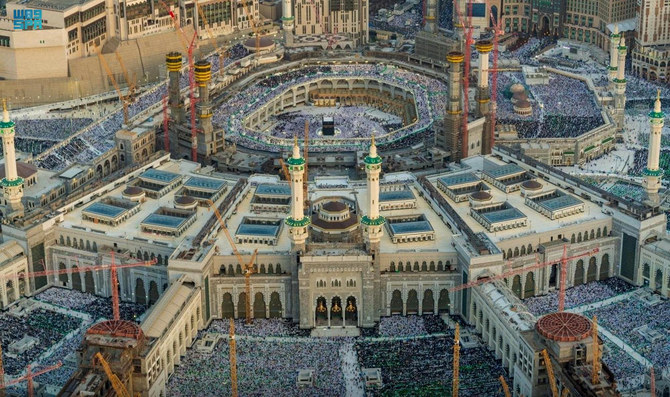

JEDDAH: Almost 19 million people worshipped in the third expansion of the Grand Mosque in Makkah during Ramadan, the Saudi Press Agency reported.
The director of the General Administration of the Third Saudi Expansion at the Grand Mosque, Walid Al-Masoudi, said the expansion had received more than 500,000 worshippers per hour at a rate of 250,000 inside the expansion and more than 250,000 in the squares.
He stressed that these efforts came under the directives of the General Presidency for the Affairs of the Two Holy Mosques in fulfillment of the aspirations of the Saudi leadership.
At the start of Ramadan, 80 new prayer halls that form part of the third phase of expansion opened to worshippers for the first time.
Al-Masoudi said worshippers were divided throughout the days of the holy month on all floors of the expansion building, on the ground floor, first floor, first mezzanine, second floor, second mezzanine, the balconies, and the surrounding northern and western squares.
When King Abdulaziz united the country and founded Saudi Arabia, he made the Two Holy Mosques a top priority and ensured they received special attention.
HIGHLIGHT
Worshippers were divided throughout the days of the holy month on all floors of the expansion building, on the ground floor, first floor, first mezzanine, second floor, second mezzanine, the balconies, and the surrounding northern and western squares.
In 1926, he ordered a complete renovation to the Grand Mosque, including a directive to cover the entire floor with marble. A year later, according to the general presidency, he ordered marquees to be erected at the Mataf (circumambulation space) to protect worshippers from the sun’s heat. He also ordered that the Masa, the area between Safa and Marwah where pilgrims walk in what is known as Saee, be paved with stone.
When his son King Saud became monarch, the Grand Mosque covered approximately 28,000 square meters. In 1955, he launched a long-term expansion project that continued for nearly 10 years. The size of the Masa was increased, and an underground area and another floor were added.
Saud’s successor, King Faisal, continued the expansion and development work. The building surrounding the Maqam Ibrahim was removed to provide more space for worshippers while circumambulating the Kaaba.
After King Khalid took over in 1975, the Mataf area was expanded and the stone pavement of the Masa was replaced with Greek, heat-resistant marble so that worshippers could circle the Kaaba more comfortably, especially at noon.
On Sept. 14, 1988, King Fahd laid the foundation stone for the largest expansion of the Grand Mosque in 14 centuries. The project increased its size to 356,000 square meters, enough space for up to 1.5 million worshippers to comfortably perform their rituals. Two minarets were added to the existing seven.
The sixth Saudi leader, King Abdullah, who took the throne in 2005, initiated another major expansion project. It included architectural, technical, and security improvements. The capacity of the Mataf area was increased from about 50,000 people an hour to more than 130,000 to cope with the growing numbers of Hajj and Umrah pilgrims.
The total space covered by the Grand Mosque and its open areas and facilities increased to 750,000 square meters, at a total cost of more than SR80 billion ($21.3 billion).
In 2015, King Salman launched five major projects designed to allow the mosque to accommodate nearly 2 million worshippers on a 1.5-million-square-meter site.


