


BEIRUT: Lebanon has once again voiced its concerns about Syrian refugees, stating that the country can no longer tolerate some of their actions.
Lebanese Minister of Labor Mustafa Bayram said: “Lebanon is no longer able to play policeman for other countries.”
Prime Minister Najib Mikati chaired a meeting of the ministerial committee in charge of discussing the issue of Syrian refugees in Lebanon, during which Bayram said: “The Lebanese state is no longer able to handle this matter.”
Bayram also stressed after the meeting that Lebanon is left alone, and the state cannot stand to cost.
“We no longer have diesel boats to monitor the sea, and the UN and UNHCR must step up and bear their responsibilities. The Lebanese are queuing at banks and ATMs, while others receive direct aid in dollars. They share our water, electricity and resources while we do not get anything. Many institutions, international organizations and countries are concluding agreements with Lebanese NGOs and paying them in dollars without going through the state, and frankly, this uncontrolled situation is no longer acceptable,” he said.
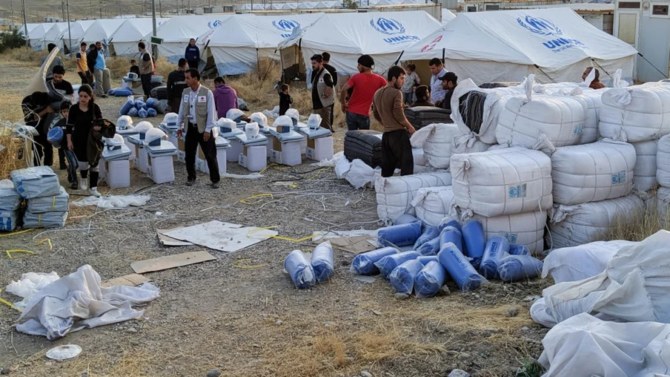
Hector Hajjar, minister of social affairs, met Ayaki Ito, representative of the UNHCR office in Lebanon, and conveyed the Lebanese government’s official position regarding Syrian refugees.
Hajjar’s office said he informed Ito that the Lebanese state is committed to the principle of not forcing refugees to return to their country of origin, but the situation is no longer tolerable and the state is no longer able to bear the cost of maintaining security in the refugee camps and the areas in which refugees have settled.
Hajjar said: “The Lebanese state has always received less aid than the needs declared annually, despite the fact that 35 percent of the population is made up of displaced persons and refugees. According to reports, 82 percent of the Lebanese suffer from multidimensional poverty. The Lebanese state has incurred huge losses over the years, due to the displaced people benefiting from the state’s subsidies on basic commodities such as medicine, bread, and fuel, in addition to prison overcrowding and the resulting burdens, not to mention the security chaos and competition in the labor market.”
Following the ministerial committee meeting, Hajjar talked about the high crime rate, to which Syrians have contributed.
The Internal Security Forces announced that they had arrested two Syrians who tried to kill a shop owner in Hermel on Friday by hitting him with a sharp object on the head as they attempted to rob him.
Bayram warned that Lebanon will implement the laws deporting criminals back to their country. “This is what all countries do.”
“The social situation is also no longer tolerable. The non-Lebanese are admitted to hospitals, while the Lebanese can no longer be hospitalized. Others receive education, rent, and heating allowance, and the Lebanese get nothing,” Hajjar said.
The Supreme Defense Council convened on Friday, headed by Lebanese President Michel Aoun, to discuss the security measures that will accompany the parliamentary elections on May 15. Aoun repeated his demand that Syrian refugees return to their country and talked about the burden on Lebanon, which is suffering from a severe economic crisis.
Officials in Lebanon frequently hold Syrian refugees responsible for the deteriorating economic situation. Aoun raised this issue with UN Secretary-General Antonio Guterres when he visited Lebanon in 2021.


