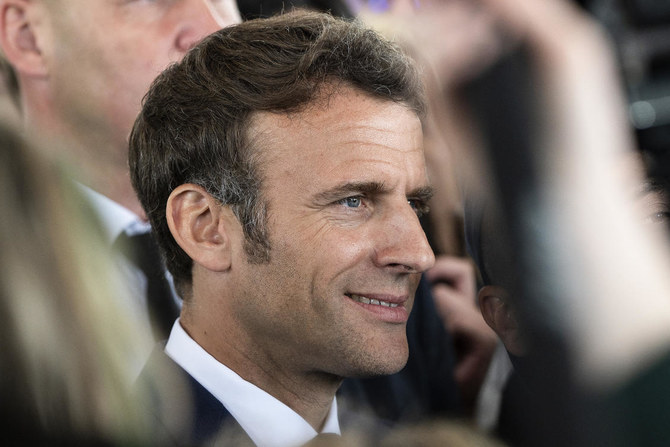
France gears up for May Day protests, in first test for newly reelected Macron

The CGT will call on workers to keep pressure on Macron in the streets and with strikes after the May Day rallies as well. (File/AFP)
Short Url
Updated 30 April 2022
Follow

France gears up for May Day protests, in first test for newly reelected Macron

  • His current government put together price caps on gas and electricity price increases and he has promised further steps
  • Many backed Macron both times not because they agreed with his platform but to block far-right candidate Marine Le Pen from being elected

PARIS: Like quite a few on the left, 60-year-old nurse assistant Isabelle-Touria Boumhi says backing either Emmanuel Macron or Marine Le Pen in France’s presidential runoff last Sunday would have been choosing “between the plague and cholera.”
She did not vote. Instead, she is preparing to take part in May Day protests this coming Sunday.
And, in what could foreshadow what a newly re-elected Macron may expect when he presses ahead with pro-business reforms, including a plan to push back retirement age, Boumhi says she will take to the streets as often as needed to block this.
“It’s the only path we have left to obtain something,” said the single mother, who, with a gross salary of just under 2,000 euros ($2,107) that she needs to house and feed her and her 22-year-old daughter, who is a student, must count every cent.
“I used to allow myself something extra once in a while, but now, once I’ve paid the electricity bill, the rent ... I would struggle to go on holidays.”
The cost of living was the main theme in the presidential election campaign and looks set to be equally prominent ahead of June legislative elections that Macron’s party and its allies must win if he is to be able to implement his policies.
His current government put together price caps on gas and electricity price increases and he has promised further steps, including increasing pensions, to try and protect consumers’ purchasing power amid a steep rise in prices.
But inflation reached a new high of 5.4 percent in April, while growth stalled in the first quarter, giving fodder to opponents and to street protests.

‘ANGER’
Boumhi last year started to receive a 228 euros monthly bonus on top of her salary, as part of government steps to improve the fate of health care workers, but she says that has not quelled her anger nor been enough to allow her to live more comfortably.
She will march on Sunday for salary increases and to push Macron to drop plans to raise the retirement age to 65 from 62. “If we don’t obtain anything, things could escalate,” she said. “There is a lot of built-up anger.”
Philippe Martinez, the head of the hard-line CGT union, will also be in the May Day rallies on Sunday.
And he has quite a few messages for the government.
“The government has got to deal with the purchasing power problem by raising wages,” Martinez told Reuters in an interview.
Macron “cannot repeat what he did in 2017, when he considered that all those who had voted for him agreed with his program,” said Martinez, stressing that many backed Macron both times not because they agreed with his platform but to block far-right candidate Marine Le Pen from being elected.
The CGT will call on workers to keep pressure on Macron in the streets and with strikes after the May Day rallies as well, he said, stressing that “if there is no pressure on the president, he will consider he has free reins to carry on anti-social reforms.”
And even the more moderate Laurent Berger, from the CFDT union, urged Macron in a tribune in Le Monde to listen to workers’ demands or face tough street protests. ($1 = 0.9492 euros)


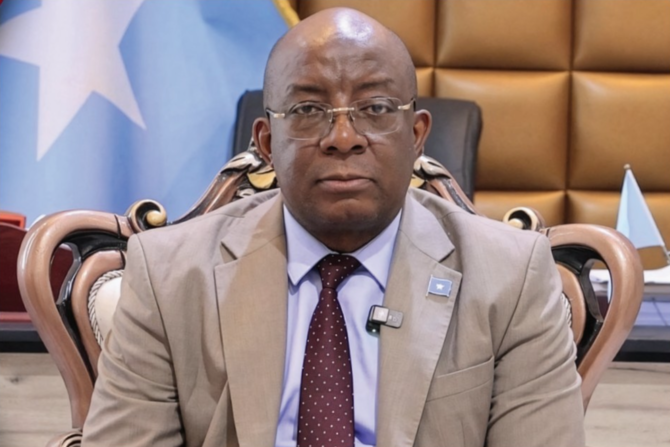
Israel is risking global security, warns Somali Information Minister

Updated 6 sec ago
Follow

Israel is risking global security, warns Somali Information Minister

  • Tel Aviv’s actions boost terror groups he tells Arab News in exclusive interview
  • Jama accuses Tel Aviv of wanting to relocate Palestinians from Gaza to region

RIYADH: Israel’s recognition of Somaliland and its presence in the region risks inflaming the situation there, allowing terrorist groups to undermine regional security and stability, according to Somali Information, Culture and Tourism Minister Daud Aweis Jama.

In a special interview with Arab News, Jama insisted that Israel’s unprecedented Dec. 26 move to recognize Somaliland as a sovereign state represents a major setback for Mogadishu’s fight against terrorist organizations like Al-Shabab and Daesh.

“The presence of Israel will be used by the terrorist groups to expand their operations in the region. (They will) have a pretext to spread their ideologies in the region,” he said.

“That is another factor that is also risking global security and regional stability, because we have been in the last stage of overcoming the challenges of the terrorist groups Al-Shabab and ISIS,” he added, using another term for Daesh.

Jama added: “We have been putting all our resources and all our time into making sure that we finalize the final stages of the fight against Al-Shabab. So, if something else interrupts us, that means that we are not going to focus fully on the operations against Al-Shabab. And that means we are giving more opportunities to Al-Shabab or other organizations.”

The consequences of this hit to Somalia’s ability to fight terror will not be restricted to the country’s borders, according to Jama, but will spread across the region and beyond.

“This might invite other, external terrorist groups to the region, because they will take advantage of this crisis and will make sure that they take over all the areas that have been defeated before,” the minister said.

“We believe this has come at a time that is going to affect our security as a Somali government, the security of the Horn of Africa, the security of the Gulf of Aden, the security of the Red Sea, the security of the Middle East and global stability. This is a very important location that holds the trade of the world.”

The minister underlined that Israel’s recognition and larger presence in the region are leading to more challenges, “putting more fuel on the ongoing challenges that exist in the region, especially in Somalia.” He added: “And at this time, it is not only limited to Somalia, but it’s going to be a challenge that is going to spread like a fire all over the region and all over the world.”

Jama told Arab News that Israel has other strategic motives for its recognition of Somaliland — including the forced resettlement of Palestinians from Gaza.

“According to reliable sources that our intelligence gathered, one of the conditions that Israel put forward (for recognizing Somaliland) was to have a place that they can settle the people from Gaza,” he said.

“We find that it is a violation also of the people of Palestine, because we believe that the people of Palestine have the right to self-determination. The two-state solution that has been the call of the international community has to be adhered to and implemented.”

Israel’s coalition government, the most right-wing ‌and religiously conservative in its history, includes far-right politicians who advocate the ‍annexation of both Gaza and the West ‍Bank and encouraging Palestinians to leave their homeland.

Somalia’s UN Ambassador Abukar Dahir Osman said ‍Security Council members Algeria, Guyana, Sierra Leone and Somalia “unequivocally reject any steps aimed at advancing this objective, including any attempt by Israel to relocate the Palestinian population from Gaza to the northwestern region of Somalia.”

Israel last month became the first country to recognize Somaliland as an independent nation. In the three-plus decades since its self-declaration of independence in 1991, no state had recognized the northwestern territory as being separate from Somalia.

Mogadishu immediately rejected the Israeli move, alongside countries all over the world.

Saudi Arabia affirmed its rejection of any attempts to impose parallel entities that conflict with the unity of Somalia. It also affirmed its support for the legitimate institutions of the Somali state and its keenness to preserve the stability of Somalia and its people.

A group of foreign ministers from Arab and Islamic countries, alongside the Organization of Islamic Cooperation, also firmly rejected Israel’s announcement. In a joint statement, the ministers warned that the move carries “serious repercussions for peace and security in the Horn of Africa and the Red Sea region” and undermines international peace and security.

The 22-member Arab League rejected “any measures arising from this illegitimate recognition aimed at facilitating forced displacement of the Palestinian people or exploiting northern Somali ports to establish military bases,” the organization’s UN Ambassador Maged Abdelfattah Abdelaziz told the UN Security Council.

In the most recent development in Israel-Somaliland relations, less than two weeks after Tel Aviv’s recognition, Israeli Foreign Minister Gideon Saar visited the region on Tuesday to publicly formalize diplomatic relations.

“It was a blatant violation of Somalia’s sovereignty that Israel recognized a region within the Somali Federal Republic as an independent state,” Jama underlined. “That was a total violation of international laws. It was a violation of the territorial integrity and sovereignty of Somalia.

“From the beginning, our path was to follow diplomatic efforts. And we kind of started with a successful UN Security Council meeting that supported Somalia’s territorial integrity and sovereignty. (This was) followed by other international actors like the Arab League, the Organization of Islamic Cooperation, the African Union and regional bodies like the East African Community and IGAD.

“Also, the Peace and Security Council of the African Union has reiterated the importance of supporting Somali sovereignty and territorial integrity.”