


DUBAI: The brand value of Twitter increased by 85 percent to $5.7 billion this year, before Elon Musk bought the platform, according to Brand Finance’s latest Media 50 report, which ranks the global media industry’s top 50 most valuable and strongest brands.
This year, Twitter improved its ranking amongst the world’s most valuable media brands, jumping ten places from 36 to 26 in the global rankings.
“In the past, many people think of brands as being focused on the consumer,” Richard Haigh, managing director of Brand Finance, told Arab News.
“Developments like this show that brands are incredibly important for investors as well. Good brand management needs to consider all the stakeholders: Customers, suppliers, investors, regulators and other partners.”
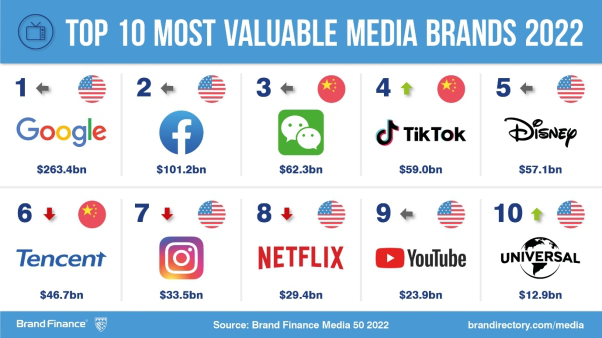
This year, Google continued its reign as the most valuable media brand, seeing an increase of 37.8 percent to reach $263 billion.
Google relies heavily on advertising for most of its revenue and was hurt at the start of the coronavirus disease pandemic as advertising spending dropped. However, as the world adjusted, budgets went back up and Google’s business rebounded, resulting in a healthy uplift in brand value.
Brand Finance’s ranking found Chinese social media giant WeChat to be the strongest media brand in the world.
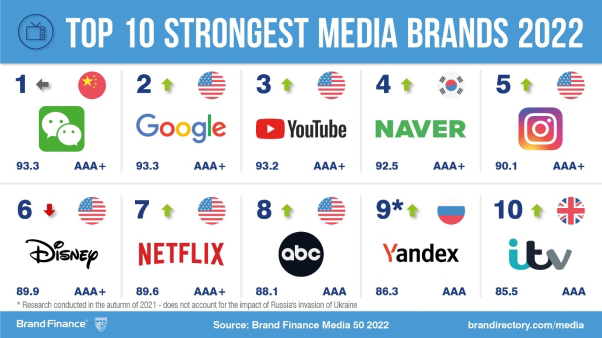
Although its brand value went down by eight percent, it earned the strongest brand title with a Brand Strength Index score of 93.3 out of 100. It also ranked as the third most valuable brand.
The app plays an integral role in day-to-day life in China, with its all-encompassing set of services allowing customers to message, video call, order food, and shop. It also played an integral part in the country’s fight against COVID-19, with more than 700 million people using its services to book vaccinations and tests.
Making an appearance for the first time in the Media 50 ranking is TikTok/Douyin, valued at $59 billion. Its brand value increased by a massive 215 percent, along with its popularity, as more and more people use the app not just to consume content, but also to create it.
With many brands increasing the integration of TikTok into their media plans, the app is enjoying success with both consumers and advertisers.
Other social media platforms too have been benefitting from high volumes of user-generated content resulting in increased investment from brands. Facebook’s brand value, for example, went up 24 percent, while Instagram’s was up 33.5 percent, and YouTube’s 38 percent. All three brands were listed in the Top 10, coming in second, seventh and ninth respectively.
Brand Finance also found that technology brands constituted 66 percent of the total brand value in the ranking. The pandemic has accelerated digital transformation in several industries, and tech-related media brands led this year’s ranking. In fact, eight of the Top 10 brands were tech-related either in the streaming or social media space.
The remaining two were traditional media brands: Disney in fifth place and Universal in tenth place with both seeing their brand value go up 11 percent.
“Media brands globally adapted to the unprecedented changes brought about by the pandemic,” Haigh said in a statement.
“Since users relied on media brands for important information about COVID-19 and entertainment, social media, media outlets and technology brands provided new service offerings and online formats to meet soaring consumer demand.”


