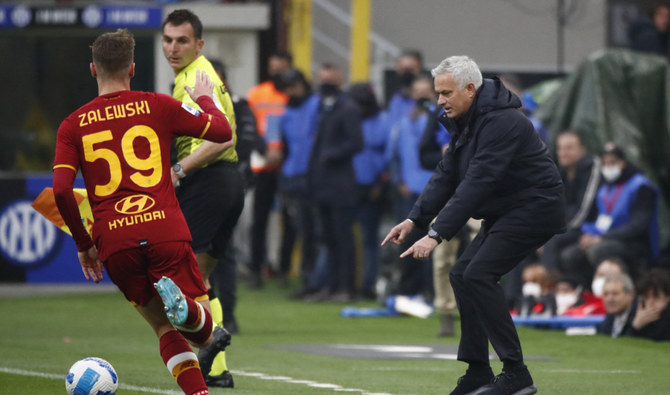

PARIS: The subject of some derision when it was introduced at the start of this season, the new Europa Conference League has turned out to be a hit and now has some of the continent’s most famous names in the semifinals eyeing a rare piece of European silverware.
Leicester City take on Jose Mourinho’s Roma and Feyenoord play Marseille in the first legs of their semifinal ties this Thursday, with the winners advancing to the final in Tirana in late May.
Twenty-three years after the abolition of the Cup Winners’ Cup, the idea behind UEFA’s new third-tier European competition was supposedly to give clubs from smaller countries the chance to play more matches, earn more money and get more exposure.
It has seen the unheralded Norwegians of Bodo/Glimt put six past Roma and later knock out Celtic on their way to the quarterfinals, while the Slovenians of Mura claimed a famous win over Tottenham Hotspur as the English giants were knocked out in the group stage.
Both Bodo/Glimt and Mura started the season in the Champions League but defeats in the qualifying rounds saw them effectively relegated.
It was the same for Leicester and Marseille, who each ended up in the Conference League after being knocked out of the Europa League group stage.
Leicester won last season’s FA Cup and just missed out on Champions League qualification, so their manager Brendan Rodgers appeared to turn his nose up at the idea of going into the knockout phase of the new competition.
“I’ve got to be honest, I don’t even know what the competition is,” he said in an interview with broadcaster BT Sport.
“With all due respect to the competition, I’m not sure what it is. But I’m sure I will find out soon enough.”
Leicester have since knocked out Randers of Denmark, French club Rennes and former European Cup winners PSV Eindhoven on their way to the semifinals.
Their story is hardly the most romantic — after all, the Foxes won the Premier League in 2016 and are the 15th-richest club in the world according to the latest Deloitte Football Money League.
Yet, having lost a Champions League quarter-final to Atletico Madrid five years ago, Leicester are now in a European semifinal for the first time in their history.
Roma’s European pedigree is on another level, with the Italians having reached the European Cup final in 1984 before later losing a UEFA Cup final.
They were Champions League semifinalists only four years ago but this run has certainly captured the imagination.
Over 65,000 fans were at the Stadio Olimpico to see them beat Bodo/Glimt in the quarter-finals and there will be another huge crowd at next week’s second leg.
Mourinho, meanwhile, could complete the sweep of the main European honors having previously won two Champions Leagues as well as the UEFA Cup at Porto and its successor, the Europa League, at Manchester United.
“I don’t want to lie to you guys and tell you this competition doesn’t interest me. It does interest me. I would like to win it,” Mourinho said at the start of the campaign.
The other semifinal brings together two former European Cup winners, with Feyenoord having won that prize in 1970 and Marseille doing so in 1993.
Feyenoord also won the UEFA Cup twice while Marseille have lost in four European finals, including the 1991 European Cup and in the Europa League in 2018.
Both sides have fervent fanbases but, in the age of the super club, Champions League glory is beyond their reach and even success in the Europa League is a big ask.
Far from dismissing the Conference League, both have embraced it, especially Feyenoord, whose adventure began in the second qualifying round last July against Drita of Kosovo and could end 10 months later in Tirana.