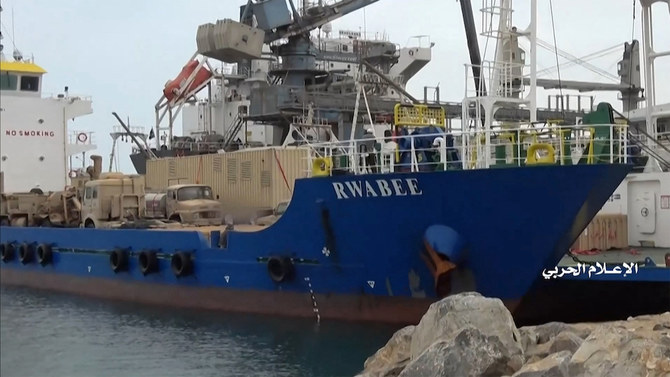
Yemen’s Houthi militia announces release of crew of Emirati ship Rwabee

A view of the Emirati-flagged vessel “Rwabee” in the Red Sea seized by Yemen’s Houthi militia and reportedly carrying Saudi military equipment, at an undisclosed location. (File/AFP)
Short Url
Updated 27 April 2022
Follow

Yemen’s Houthi militia announces release of crew of Emirati ship Rwabee

LONDON: The Houthi militia in Yemen has released the crew of the UAE cargo ship RWABEE that was seized on Jan. 3, the group’s spokesman said on Monday.
The release of the crew — 11 in all according to sources familiar with the matter — was agreed with the assistance of Oman, spokesman Mohammed Abdulsalam said in a tweet.
He said a detained British man was also released. He did not provide more details. Oman’s Foreign Ministry said on Sunday a British man and his wife and child were also released by the Houthis.
The British government earlier identified the man as Luke Symons and said he had been held without charge or trial since 2017.
India welcomed on Monday the release of seven Indian sailors held since the Houthi militia captured the the vessel.
Oman’s government said on Sunday that it had helped secure the release of the seven Indians along with one Filipino, one Indonesian, one Ethiopian, one person from Myanmar, and the Briton.
The Indian foreign ministry said it “would like to thank all concerned parties for the release of the Indian sailors, in particular the Government of Oman.”
When seized in the Red Sea on Jan. 3, the Coalition to Restore Legitimacy in Yemen fighting the Iran-backed Houthis since 2015 said the ship was carrying medical equipment.
Earlier this month, the warring sides in Yemen’s seven-year conflict agreed to a nationwide two-month cease-fire under a UN-brokered deal, giving humanitarian groups a chance to step up aid to Yemen’s hungry millions. 
(With Reuters and AFP)


Israeli decision to extend unlawful control over West Bank condemned

Updated 6 sec ago
Follow

Israeli decision to extend unlawful control over West Bank condemned

  • Hamas seeks sanctions against occupiers
  • Aid groups petition top court to halt ban on Gaza, West Bank ops

ISTANBUL, GAZA: The ‌foreign ministers of Brazil, France, Spain, Turkiye and various other states condemned Israeli decisions that ​introduce sweeping extensions to unlawful Israeli control over the West Bank.

“Changes are wide-ranging, reclassifying Palestinian land as so-called Israeli ‘state land’, accelerating illegal settlement activity, and further entrenching Israeli administration,” said the joint statement, ‌issued by ​the ‌Turkish Foreign Ministry.
Other ​countries to sign the statement included Saudi Arabia, Egypt and Qatar, as well as the heads of the Arab League and Organization of Islamic Cooperation.
They “are part of a clear trajectory that aims to change the reality on the ground and to advance unacceptable de facto annexation,” the countries said.
“Such actions are a deliberate and direct attack on the viability of the Palestinian state and the implementation of the two-state solution.”
Israel’s Cabinet on Feb. 15 approved further measures to tighten Israel’s control ‌over the occupied ‌West Bank and make ​it easier for ‌settlers to buy land, a move ‌Palestinians called a “de-facto annexation.” 
The joint statement said the settlements, and decisions designed to further them, are “a flagrant violation of international law” and a step toward “unacceptable de facto annexation.”
It said they also undermine the ongoing efforts for peace and stability in the region and ​threaten any ​meaningful prospect of regional integration.
Hamas called for sanctions against Israel, welcoming the  joint condemnation by nearly 20 countries.
Hamas hailed the condemnation as “a step in the right direction in confronting the occupation’s expansionist plans, which flagrantly violate international law and relevant UN resolutions.”
The group in a statement urged the countries involved “to impose deterrent sanctions and exert pressure on the fascist occupation government to halt its policies aimed at entrenching annexation, colonial settlement and forced displacement.”
It said the Israeli measures were part of ongoing “aggression” against Palestinians in the West Bank and Gaza.
In addition to roughly 3 million Palestinians, more than 500,000 Israelis live in settlements and outposts in the West Bank, which are considered illegal under international law.
Israel’s current government has accelerated settlement expansion, approving a record 54 settlements in 2025, according to activists.
Meanwhile, more than a dozen international humanitarian organizations have petitioned Israel’s Supreme Court to block an imminent order that would force 37 NGOs to cease operations in Gaza, the West Bank and East Jerusalem, warning of catastrophic consequences for Palestinians.
Organizations including Doctors Without Borders or MSF, Oxfam, the Norwegian Refugee Council and CARE were notified on December 30, 2025 that their Israeli registrations had expired and that they had 60 days to renew them by providing lists of their Palestinian staff.
If they fail to do so, they will have to cease operations in Gaza and the occupied West Bank, including East Jerusalem, from March 1. The petition, described as unprecedented in its scale, seeks an urgent interim injunction from Israel’s top court to suspend the closures pending full judicial review.
The 17 petitioners, which include some of the NGOs hit by the ban, argue the Israeli measures are incompatible with an occupying power’s obligations under international humanitarian law.
The NGOs say compliance would expose local employees to potential retaliation, undermine the principle of humanitarian neutrality and violate European data protection law.
“Turning humanitarian organizations into an information-gathering arm for a party to the conflict stands in total contradiction to the principle of neutrality,” the petition states.
According to the UN, 133 NGO workers have been killed in the Gaza Strip since the war started on Oct. 7, 2023, including 15 MSF employees.
The petitioners say they have proposed practical alternatives to handing over staff lists to Israel, including “independent sanctions screening” and “donor-audited vetting systems.”
The organizations say that they collectively support or implement more than half of all food assistance in Gaza, 60 percent of field hospital operations and all inpatient treatment for children suffering severe acute malnutrition.
Audrey Rayburn, director of AIDA, an umbrella organization of international NGOs working in Palestinian territories, said that NGO presence in Gaza, where foreign media is not allowed, also allows outsiders to witness the war.
The petitioners say enforcement has already begun in practice, with supplies blocked and visas denied to foreign staff.
“We haven’t been able to get international staff inside Gaza since the beginning of January. Israeli authorities denied any entry to Gaza, but also to the West Bank,” MSF head of mission in the Palestinian territories Filipe Ribeiro said last week.
“For the time being, we are still working in Gaza, and we plan to keep running our operations as long as we can,” he added.
The ban comes as Israel hardens its stance toward humanitarian actors in general, having banned the UN agency for Palestinian refugees, UNRWA, from Israel in early 2025.
UNRWA, whom Israel accused of employing people who took part in Hamas’s Oct. 7 attack, also can no longer coordinate with Israeli authorities in the occupied West Bank, as will be the case for the banned, or deregistered, NGOs.
The absence of coordination with Israel complicates operations by denying entry to Israel, the West Bank or Gaza to foreign aid workers or by denying direct contact to plan around Israeli military operations in the Palestinian territory.
“We are arguing that Israel acted here without any authority, because according to the Oslo Accords, the whole registration of organizations issue was handled by the Palestinian Authority,” Yotam Ben-Hillel, an Israeli attorney who filed the appeal for the international organizations, said.