KARACHI: Pakistan’s stocks and currency closed bullish on Monday as the country announced progress in negotiations with the International Monetary Fund (IMF) for the revival of a loan program that originally amounted to $6 billion but could further increase in size.
The IMF confirmed it held “productive meetings” with Pakistani officials, saying its mission chief Nathan Porter would visit the country in May to resume discussions over the seventh review under the program before the fund released the next tranche.
Negotiations between the two sides over the seventh review had stalled after former prime minister Imran Khan’s administration deviated from the program objectives by announcing subsidized fuel prices and electricity tariffs in February.
Pakistan’s finance minister Miftah Ismail told a news conference in Washington the IMF had agreed in principle to extend the bailout package for Pakistan for another year and add $2 billion to the total loan size.
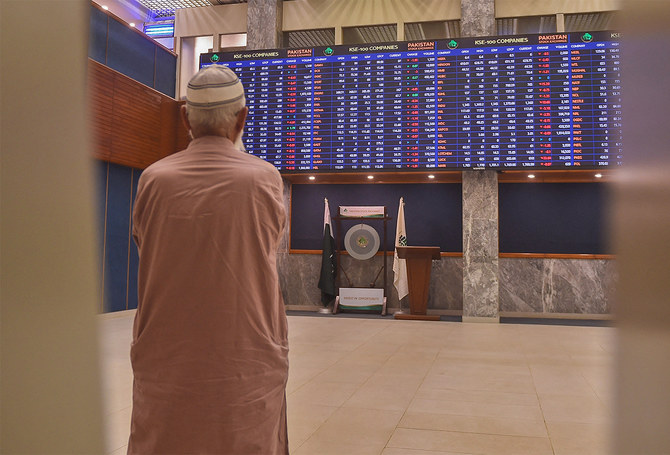
The bulls celebrated the news at the Pakistan Stock Exchange, making the market gain 520 points to close at 46,073 against the weekend session’s bearish close on Friday.
“Stocks showed a sharp recovery while responding to reports of the IMF program extension for a year along with an addition of $2 billion to the $6 billion Extended Fund Facility,” Ahsan Mehanti, CEO of Arif Habib Corporation, told Arab News.
Following the successful IMF talks, Pakistan’s national currency also posted slight gains, with 0.38 percent appreciation.
The rupee closed at Rs186.05 as compared to Saturday’s close of Rs186.75 against the US dollar.
The IMF mission chief for Pakistan said in a statement his team had held fruitful meetings with the Pakistani finance minister.
“We agreed that prompt action is needed to reverse the unfunded subsidies which have slowed discussions for the 7th review,” Porter continued. “Based on the constructive discussions with the authorities in Washington, the IMF expects to field a mission to Pakistan in May to resume discussions over policies for completing the 7th EFF review.”
The breakthrough in talks can potentially lead to an inflow of $1 billion from the IMF, as the seventh review concludes.
“Other bilateral financing avenues, including the World Bank, could also materialize and unlock an additional $1.8 billion to $2 billion in financing,” KASB Securities said in its research report on Monday, adding: “A successful conclusion of the 7th review could provide a near-term respite to the PKR/USD parity.”
The south Asian country is facing financial constraints after the costly imports lifted the current account deficit to $1 billion in March 2022 with accumulated deficit to $13 billion during the current fiscal year.
The annual inflation rate during the month of March also increased to 12.7 percent, as compared to 12.24 percent in February, due to higher food prices.


![]()

Pakistan’s stocks and currency close bullish after headway in IMF talks
Short Url
https://arab.news/ny5mk
Pakistan’s stocks and currency close bullish after headway in IMF talks
- The country’s equities and currency made 1.14 percent and 0.38 percent gains during Monday’s trading sessions
- IMF officials will visit Pakistan in May to resume discussions over the seventh loan program review
Latest updates


© 2026 SAUDI RESEARCH & PUBLISHING COMPANY, All Rights Reserved And subject to Terms of Use Agreement.