

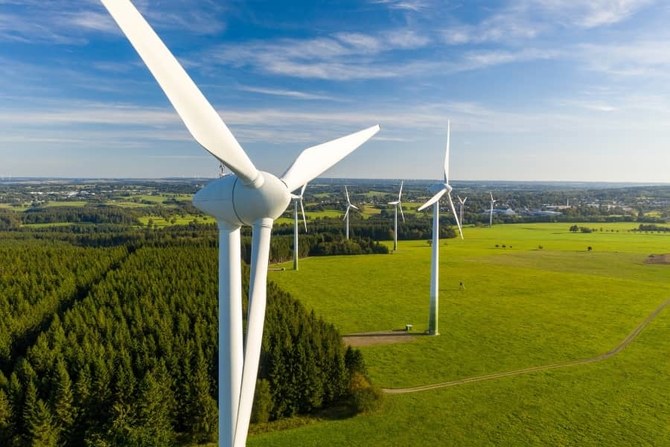
UAE’s Masdar to develop 4GW green hydrogen facilities in Egypt by 2030

The plants are projected to produce as much as 480,000 tons of green hydrogen per year. 
Short Url
Updated 25 April 2022
Follow

UAE’s Masdar to develop 4GW green hydrogen facilities in Egypt by 2030

RIYADH: Masdar, the UAE-based developer and operator of utility-scale renewable energy projects,  has signed landmark agreements which aim to develop 4GW green hydrogen facilities in Egypt by 2030, according to a statement. 

The plants are projected to produce as much as 480,000 tons of green hydrogen per year. 

The plants will be located in the Suez Canal Economic Zone as well as on the Mediterranean coast.

To propel this plan, Masdar and Hassan Allam Utilities have signed a memorandum of understanding with several institutions including the General Authority for the Suez Canal Economic Zone, New and Renewable Energy Authority, the Egyptian Electricity Transmission Co., among others. 

The agreement will help bolster strategic partnerships between the UAE and Egypt in the renewable energy and green hydrogen field.  

The agreement also falls in line with Egypt’s Vision 2030 and sustainable development strategy.

Both the UAE and Egypt are set to host climate conferences in the near future as they intend to have an active role in climate action and slashing carbon emissions in general.


Up to $600m in additional tariffs on Saudi exports to the US

Updated 23 February 2026
Follow

Up to $600m in additional tariffs on Saudi exports to the US

RIYADH: Gulf exports have become targets of US President Donald Trump’s tariffs, which he raised from 10 percent to 15 percent on all countries.

The increase comes after the US Supreme Court ruled that the legal basis Trump had used to impose earlier tariffs was unlawful.

Previously, Gulf countries were among the few that had not raised their tariffs above 10 percent, while many other countries, most notably China, had already been subject to higher tariffs. However, with this latest increase, the Gulf states will be among those affected.

According to the financial analysis unit of Al-Eqtisadiah newspaper, Gulf exports to the US in 2024 amounted to about $26.2 billion, with Saudi Arabia accounting for roughly half of that, at $12.7 billion. These exports are subject to potential additional tariffs of SR637 million ($169 million).

It is likely that tariffs on Saudi exports will grow from $1.3 billion annually to $1.9 billion, a rise of 50 percent, following Trump’s recent increase.

Customs duties on Gulf exports will also increase, from $2.6 billion annually to $3.9 billion.

In 2024, Gulf exports are distributed as follows: $7.5 billion from the UAE, $1.8 billion from Qatar, and $1.6 billion from Kuwait, as well as $1.3 billion from Oman, and finally, $1.2 billion from Bahrain.

Gulf trade with the US in 2024 reached approximately $86 billion, comprised of $26.2 billion in exports and approximately $60 billion in imports, resulting in a Gulf trade deficit of $33.5 billion.

Trump responds to Supreme Court ruling

US President Donald Trump raised the global tariffs from 10 percent to 15 percent in response to the US Supreme Court ruling that his previous tariff implementation mechanism was unlawful.

Trump said in a post on his Truth Social account today: “As President of the US, I will, effective immediately, raise the global tariffs imposed on countries that have been taking advantage of the US for decades with impunity (until I took over!) to the legally permitted and tested level of 15 percent.”

Hours after the Supreme Court ruling on Feb. 20, Trump imposed a 10 percent global tariff on foreign goods, a move aimed at maintaining his trade agenda.

Trump had expressed his displeasure with the Supreme Court’s decision to overturn the tariffs imposed by his administration, asserting that the ruling would not restrict him. He vowed to impose tariffs far exceeding those struck down by the court, indicating that he had stronger alternatives to tariffs, raising questions about his future trade strategy.

The US Supreme Court struck down Trump’s sweeping global tariffs, undermining his signature economic policy and inflicting his biggest legal defeat since returning to the White House.

By a six-three vote, the court ruled that Trump exceeded his authority by invoking the federal emergency powers law to impose his reciprocal tariffs worldwide, in addition to targeted import duties that the administration claims are intended to combat fentanyl smuggling.