

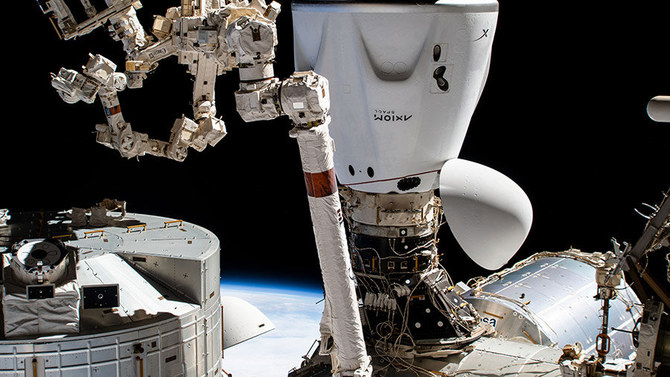
First all-private astronaut team aboard space station poised for flight home

A view of SpaceX Dragon Endeavour that will return the Axiom Mission 1 astronauts back to Earth. (Twitter: @NASA)
Short Url
Updated 25 April 2022
Follow

First all-private astronaut team aboard space station poised for flight home

The first all-private astronaut team sent to the International Space Station (ISS) prepared to depart the orbiting outpost on Sunday for a flight back to Earth, capping a two-week science mission hailed as a milestone in commercial spaceflight.
The SpaceX Crew Dragon capsule carrying the four-man team of Houston-based startup company Axiom Space was scheduled to undock from the ISS, orbiting 250 miles (420 km) above Earth, at about 9 p.m. EDT (0100 GMT Monday) to embark on a 16-hour return descent.
The Axiom astronauts, garbed in helmeted white-and-black spacesuits, were sealed into the capsule with the hatch to the station closed shortly before 7:30 p.m. EDT (2330 GMT), ahead of final uncoupling procedures, a live NASA Webcast showed.
If all goes smoothly, the Dragon capsule, dubbed Endeavour, will parachute into the Atlantic off the coast of Florida on Monday at about 1 p.m. EDT (1700 GMT).
The flight home was postponed for several days due to unfavorable weather conditions at the splashdown zone, extending the Axiom crew’s stay in orbit well beyond its original departure date early last week.
The multinational team was led by Spanish-born retired NASA astronaut Michael Lopez-Alegria, 63, Axiom’s vice president for business development. His second-in-command was Larry Connor, 72, a technology entrepreneur and aerobatics aviator from Ohio designated as mission pilot.
Rounding out the Ax-1 crew were investor-philanthropist and former Israeli fighter pilot Eytan Stibbe, 64, and Canadian businessman and philanthropist Mark Pathy, 52, both serving as mission specialists.
Launched from NASA’s Kennedy Space Center on April 8, they spent two weeks aboard ISS with the seven regular, government-paid crew of the space station: three American astronauts, a German astronaut and three Russian cosmonauts.
The Axiom quartet became the first all-commercial astronaut team ever launched to the space station, bringing with them equipment for two dozen science experiments, biomedical research and technology demonstrations to conduct in orbit.
Axiom NASA and SpaceX have touted the mission as a turning point in the expansion of privately funded space-based commerce, constituting what industry insiders call the “low-Earth orbit economy,” or “LEO economy” for short.
Ax-1 marks the sixth human spaceflight SpaceX has launched in nearly two years, following four NASA astronaut missions to the ISS, plus the Inspiration 4 flight in September that sent an all-civilian crew into Earth orbit for the first time, though not to the space station.
SpaceX, the private rocket company founded by Tesla Inc. electric carmaker CEO Elon Musk, has been contracted to fly three more Axiom astronaut missions to the ISS over the next two years. The price tag for such outings remains high.
Axiom charges customers $50 million to $60 million per seat, according to Mo Islam, head of research for the investment firm Republic Capital, which holds stakes in both Axiom and SpaceX.

Axiom also was selected by NASA in 2020 to build a new commercial addition to the space station, which a US-Russian-led consortium of 15 countries has operated for more than two decades. Plans call for the Axiom segment to eventually replace the ISS when the rest of the space station is retired around 2030.


Progress for Ukraine talks in Paris uncertain with US focus shifting to Venezuela

Updated 06 January 2026
Follow

Progress for Ukraine talks in Paris uncertain with US focus shifting to Venezuela

  • Ukraine’s allies are meeting in Paris to discuss security guarantees after a potential ceasefire with Russia. The Trump administration’s focus on Venezuela could complicate progress
  • France and the UK lead efforts to strengthen post-ceasefire defenses for Ukraine, possibly with European forces

PARIS: Ukraine’s allies are meeting Tuesday in Paris for key talks that could help determine the country’s security after a potential ceasefire with Russia. But prospects for progress are uncertain with the Trump administration’s focus shifting to Venezuela.
Before the US capture of Venezuelan leader Nicolás Maduro, French President Emmanuel Macron had expressed optimism about the latest gathering of so-called “coalition of the willing” nations. For months, they have been exploring how to deter any future Russian aggression should it agree to stop fighting Ukraine.
In a Dec. 31 address, Macron said that allies would “make concrete commitments” at the summit “to protect Ukraine and ensure a just and lasting peace.”
Macron’s office said Tuesday’s meeting will gather an unprecedented number of officials attending in person, with 35 participants including 27 heads of state and government. The US will be represented by President Donald Trump’s envoys, Steve Witkoff and Jared Kushner.
Macron’s office said the US delegation was initially set to be led by Secretary of State Marco Rubio, who changed his plans for reasons related to the military intervention in Venezuela.
Participants seek concrete outcomes on five key priorities once fighting ends: ways to monitor a ceasefire; support for Ukraine’s armed forces; deployment of a multinational force on land, at sea and in the air; commitments in case there’s another Russian aggression; and long-term defense cooperation with Ukraine.
But whether that’s still achievable Tuesday isn’t so clear now, as Trump deals with the aftermath of his decision to effect leadership change in Venezuela.
Ukraine seeks firm guarantees from Washington of military and other support seen as crucial to securing similar commitments from other allies. Kyiv has been wary of any ceasefire that it fears could provide time for Russia to regroup and attack again.
Recent progress in talks
Before the US military operation targeting Maduro, Witkoff had indicated progress in talks about protecting and reassuring Ukraine.
In a Dec. 31 post, Witkoff tweeted that “productive” discussions with him, Rubio, and Kushner on the US side and, on the other, national security advisers of Britain, France, Germany and Ukraine had focused on “strengthening security guarantees and developing effective deconfliction mechanisms to help end the war and ensure it does not restart.”
France, which with the United Kingdom has coordinated the monthslong, multination effort to shore up a ceasefire, has only given broad-brush details about the plan’s scope. It says Ukraine’s first line of defense against a Russian resumption of war would be the Ukrainian military and that the coalition intends to strengthen it with training, weaponry and other support.
Macron has also spoken of European forces potentially being deployed away from Ukraine’s front lines to help deter future Russian aggression.
Important details unfinalized
Ukraine’s President Volodymyr Zelensky said during the weekend that potential European troop deployments still face hurdles, important details remain unfinalized, and “not everyone is ready” to commit forces.
He noted that many countries would need approval from parliament even if leaders agreed to military support for Ukraine. But he recognized that support could come in forms other than troops, such as “through weapons, technologies and intelligence.”
Zelensky said that post-ceasefire deployments in Ukraine by Britain and France, Western Europe’s only nuclear-armed nations, would be “essential” because some other coalition members ”cannot provide military assistance in the form of troops, but they do provide support through sanctions, financial assistance, humanitarian aid and so on.”
“Speaking frankly as president, even the very existence of the coalition depends on whether certain countries are ready to step up their presence,” Zelensky said. “If they are not ready at all, then it is not really a ‘coalition of the willing.’”