Hajj 2022: Saudi Arabia allocates quota of over 80,000 pilgrims to Pakistan

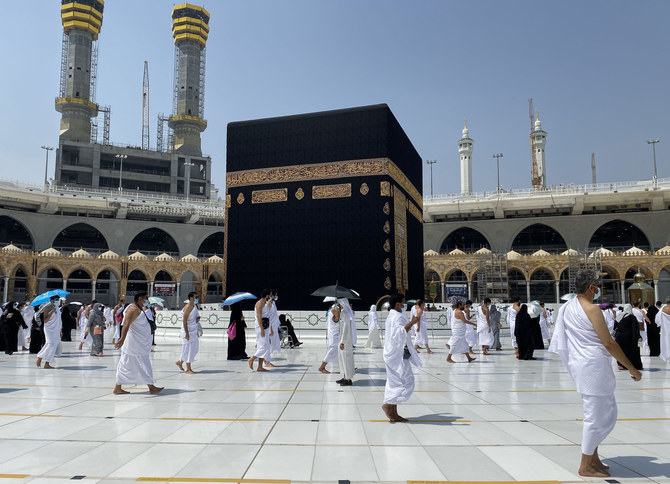
Saudis and foreign residents circumambulate (Tawaf) the Kaaba in the Grand Mosque complex in the holy city of Makkah, Saudi Arabia on October 4, 2020. (AFP/FILE)
Short Url
Updated 24 April 2022
Follow

Hajj 2022: Saudi Arabia allocates quota of over 80,000 pilgrims to Pakistan

  • One million people are expected to perform the ritual after strict COVID-19 restrictions for two years
  • Pakistan will initiate the Hajj application process through designated branches of scheduled banks

ISLAMABAD: Saudi Arabia has allocated a quota of 81,132 pilgrims to Pakistan who will be able to perform the annual Hajj ritual in 2022, reported the country’s state-owned radio channel on Sunday.
Muslims living across the world flock to Makkah and Madinah every year to undertake the spiritual journey which is obligatory for them at least once in their lifetime if they possess enough physical strength and financial ability.
“Saudi Arabia has allotted a quota of 81,132 pilgrims to Pakistan to perform Hajj this year,” stated Radio Pakistan.
It added the country’s religious affairs ministry would initiate the Hajj application process in the next few days through designated branches of scheduled banks.
Thousands of people from Pakistan perform the pilgrimage in Saudi Arabia on an annual basis.
Since the start of the coronavirus pandemic, however, Saudi Arabia closed Hajj for people living in other countries, though Muslims of various nationalities residing in the kingdom were allowed to participate in the ritual under strict health safety protocols.
Earlier this month, Saudi Ministry of Hajj and Umrah announced the kingdom would host a million Hajj pilgrims this year while allowing people residing abroad to participate in the ritual as well.
The ministry noted that those under 65 could also perform the pilgrimage, provided that they had received vaccinations approved by the Saudi health authorities.
Pilgrims from abroad will be required to submit a negative PCR test taken within 72 hours before their time of departure.
Pakistan will announce relevant information related to Hajj to specify this year’s overall cost, possible age limits and vaccination requirements through its Hajj policy, said Radio Pakistan.
Citing sources, it added the applications submitted by individuals and groups would be decided through balloting, while the distribution between public and private Hajj schemes would be done in the 60-40 ratio.


IMF says has made ‘considerable progress’ as Pakistan funding talks continue

Updated 12 March 2026
Follow

IMF says has made ‘considerable progress’ as Pakistan funding talks continue

  • Discussions covered the impact of the Middle East conflict on Pakistan, balance of payments and external financing needs
  • Pakistan’s program implementation under a $7 billion program remained broadly aligned with authorities’ commitments, IMF says

KARACHI: The International Monetary Fund (IMF) has made “considerable ‌progress” ‌in ​talks with ‌Pakistan ⁠over ​its funding ⁠facilities, the Fund said late Wednesday, adding that discussions will continue in the coming days.

The IMF mission, led by Iva Petrova, had started talks with Pakistani officials on the third review of a $7 billion Extended Fund Facility (EFF) multi-year program and for the second review of the $1.4 billion Resilience and Sustainability Facility (RSF) from Feb. 25 to Mar. 11, according to the IMF.

The mission observed that Pakistan’s program implementation under the EFF remained broadly aligned with the authorities’ commitments through end-Feb., with both sides making progress on policies, including fiscal consolidation, a sufficiently tight monetary policy and advancing energy sector reforms.

“While considerable progress was made in the discussions, these will continue in the coming days, including to more fully assess the impact of recent global developments on Pakistan’s economy and the EFF-supported program,” the IMF quoted Petrova as saying.

Both EFF, secured in Sept. 2024, and the RSF, secured in May 2025, are key programs crucial for stabilizing Pakistan’s fragile economy. The IMF team was in the country to assess fiscal performance, energy-sector reforms, and external financing needs before approving the next disbursement.

The ongoing IMF engagement is seen as vital for Pakistan as geopolitical tensions and rising global oil prices pose renewed risks for its economic recovery.

The IMF mission observed that Islamabad paid “particular attention” to deepening structural reforms and made “good progress” in the implementation of their agenda to strengthen climate resilience, including through the completion of reform measures under the RSF.

“Discussions also covered the impact of the conflict in the Middle East on Pakistan’s economic outlook, the balance of payments and external financing needs amid volatile and rising energy prices and tighter global financial conditions,” Petrova said, adding:

“The IMF team and the authorities will continue these discussions with a view to conclude them in the coming days.”