KARACHI: Pakistan’s finance minister, Miftah Ismail, on Friday signaled a hike in the prices of petroleum products in Pakistan in line with the international prices, following his talks with the International Monetary Fund (IMF).
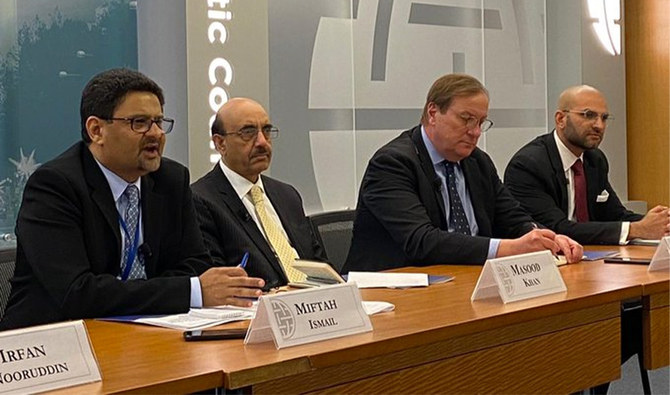
The finance minister said this while highlighting the economic agenda and priorities of the new government at an event hosted by Washington-based Atlantic Council think-tank. Ismail is in Washington to attend 2022 spring meetings of the IMF and the World Bank Group (WBG), and to meet with IMF officials for the revival of stalled $6 billion loan program.
Pakistan and the IMF have resumed talks for the completion of the seventh review under the IMF’s Extended Fund Facility, which has disbursed $3 billion out of the stipulated $6 billion to the South Asian country.
The discussions were stalled after the IMF expressed concerns over the former government’s around $1.7 billion relief package, including freezing of petroleum prices and cut in electricity tariff in response to rising inflation.
“We actually had good discussions with the fund and they have talked about removing the subsidy on fuel. I agree with them. Yes, there should be some targeted subsidy for the very poor because life has become very difficult because of the Ukraine war,” Ismail said.
“We are an elite-benefiting country that almost every subsidy you speak of goes to richest people. We can’t afford to give the subsidies that we’re giving. So we need to curtail these.”
The finance minister informed participants that Pakistan was unable to achieve the desired results, including the increase in foreign exchange reserves, despite the IMF program.
“In IMF program normally after belt tightening in first year some consolidation takes place in second year and third year of the program normally sees exchange reserve going up and some consolidation taking place,” he said.
“This is completely inverted in Pakistan. We lost lot of forex reserves and the IMF program is delayed quite a bit. One of the reasons I am here is to try and set the program back on the track.”
Ismail said his government’s aim was to bring about economic and fiscal stability, which could lead to recovery and growth. The government would ensure that this growth is all inclusive by taking care of the poor segments of the society, he added.
The finance minister informed about the ballooning accumulated losses in the country’s energy sector and termed it a “management failure.”
“Accumulated loss in power sector is about Rs2400 billion and another Rs1500 billion. I am told about gas sector that is not good way to run the country,” Ismail said.
“These are basic management things we have failed to do that is why we keep going to the fund again and again and until we get our focus right we will not be able to fix those things. We are now absolutely sure that we have to do it.”
To a question about his key areas of focus during his stay in office, the minister described the revival of the IMF program as his “top priority.”
“One success for me would be to get the IMF program back on track,” Ismail said. “We want to leave with 50 percent more (currency) reserves than what we have inherited and most importantly, the measure on control of current account deficit. We still would have the deficit may be at 2-3 percent, which is sustainable ... but 6 percent is beyond to afford.”
The minister reiterated his government’s commitment to attract US investment to all sectors of Pakistan’s economy by creating a business-friendly environment. The government recognized the potential of fintech and digital economy, and the sector would be facilitated further, he said.
Ismail said they would take step-wise measures to ensure a robust increase in Pakistan’s exports to resolve the balance of payment and current account deficit issues.
Frederick Kempe, president of the Atlantic Council, in his introductory remarks said Pakistan and the US had a longstanding partnership based on shared values of democratic governance, regional security and economic growth.
The Atlantic Council was particularly working to promote economic cooperation between the two countries, Kempe added.


![]()

Pakistan’s finance minister signals cuts in fuel subsidies amid talks with IMF
Short Url
https://arab.news/wxun7
Pakistan’s finance minister signals cuts in fuel subsidies amid talks with IMF
- Miftah Ismail says there should be some targeted subsidy for poor as things have become very difficult
- The minister says Pakistan is ‘elite-benefiting country’ because almost every subsidy goes to the rich
Latest updates


© 2026 SAUDI RESEARCH & PUBLISHING COMPANY, All Rights Reserved And subject to Terms of Use Agreement.