

US congresswoman visits Pakistani part of disputed Kashmir, draws India’s ire

U.S. Representative Ilhan Omar, along with the President of Azaz Kashmir Sultan Mehmood Chaudhry, speaks to the media during her visit to Muzaffarabad, Pakistan-administrated Kashmir, on April 21, 2022. (REUTERS)
Short Url
Updated 21 April 2022
Follow

US congresswoman visits Pakistani part of disputed Kashmir, draws India’s ire

  • Ilhan Omar says Kashmir is not discussed in the US Congress as much as it needs to
  • New Delhi describes her visit to Pakistan-administered Kashmir as ‘condemnable’

MUZAFFARABAD, Pakistan: Congresswoman Ilhan Omar made a rare visit by a US lawmaker to Pakistan’s part of the disputed Himalayan region of Kashmir on Thursday and said the issue should get more attention from the United States, prompting an angry response from India.
The Muslim-majority Kashmir region has long been the source of tensions between nuclear-armed neighbors India and Pakistan, leading them to fight three wars since winning independence from the British Empire in 1947.
Both countries claim the territory in full but rule it in part.
“I don’t believe that it (Kashmir) is being talked about to the extent it needs to in Congress but also with the administration,” Omar told reporters after visiting the de facto border dividing the disputed territory between Pakistan and India.
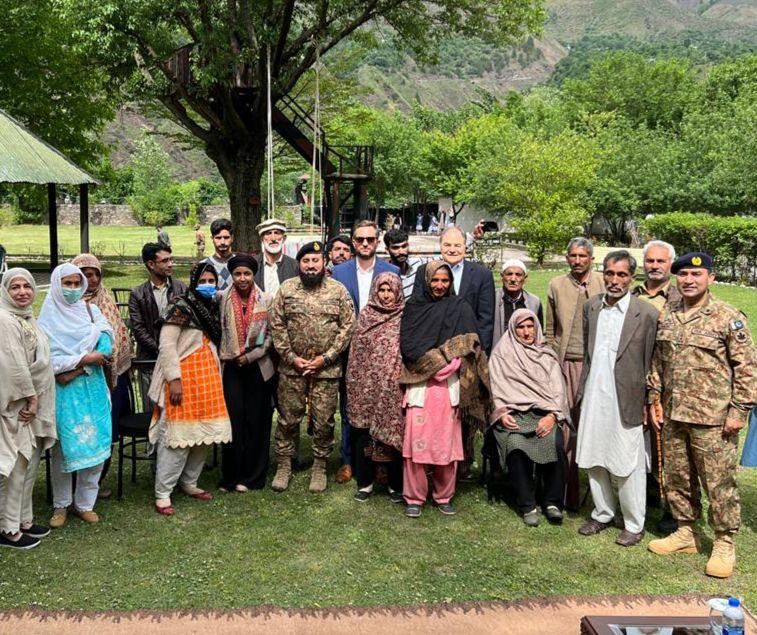


Congresswoman Ilhan Omar (fourth left) visits Pakistan-administrated Kashmir on April 21, 2022. (Pakistan's Ministry of Foreign Affairs)

Omar, a Somali American who belongs to President Joe Biden’s Democratic Party, is the first naturalized citizen of African birth to sit in the US Congress.
Earlier this month she questioned what she called the reluctance of the US government to criticize Indian Prime Minister Narendra Modi’s government on human rights.

Days later, US Secretary of State Antony Blinken said the United States was monitoring what he described as a rise in human rights abuses in India by some officials, in a rare direct rebuke by Washington of New Delhi’s rights record.
India has long faced allegations of rights abuses in its portion of the territory, charges New Delhi denies.
It tightly controls access to Kashmir for foreign observers, including the UN.
“On the question of Kashmir, we held a hearing in the foreign affairs committee (of Congress) to look at the reports of human rights violations,” said Omar, who arrived in Islamabad on Tuesday and has met Pakistan’s leaders.
New Delhi sharply criticized Omar’s visit.
“Let me just say that if such a politician wishes to practice her narrow-minded politics at home, that’s her business,” said Arindam Bagchi, spokesperson for India’s foreign ministry.
“But violating our territorial integrity and sovereignty ... makes this ours and we think the visit is condemnable.”


Pakistan plans 3,000 EV charging stations as green mobility push gathers pace

Updated 14 January 2026
Follow

Pakistan plans 3,000 EV charging stations as green mobility push gathers pace

  • Roadmap unveiled by energy efficiency regulator and a private conglomerate amid early-stage EV rollout
  • New EV Policy and related plans aim to install 3,000 EV stations by 2030, including 240 stations in current fiscal year

ISLAMABAD: Pakistan’s energy efficiency regulator and a private conglomerate have unveiled an approved roadmap to establish 3,000 electric vehicle (EV) charging stations across the country, state-run Associated Press of Pakistan (APP) reported on Tuesday.

The announcement comes as Pakistan looks to build out basic EV charging infrastructure, which remains limited and unevenly distributed, largely concentrated in major cities. Despite policy commitments to promote electric mobility as part of climate and energy-efficiency goals, the absence of a nationwide charging network has slowed broader EV adoption.

Pakistan’s EV ecosystem is still at a formative stage, with progress constrained by regulatory approvals, grid connectivity issues and coordination challenges among utilities, regulators and fuel retailers. Expanding charging infrastructure is widely seen as a prerequisite for scaling electric transport for both private and commercial use.

According to APP, the roadmap was presented during a meeting between Malik Group Chief Executive Officer Malik Khuda Baksh and National Energy Efficiency and Conservation Authority Managing Director and Additional Secretary Humayon Khan.

“Baksh ... in a meeting with Khan, unveiled the approved roadmap for establishing 3,000 electric vehicle charging stations across Pakistan,” APP reported. “Khan reaffirmed the authority’s full institutional backing and pledged to expand the initiative to 6,000 EV charging stations nationwide.”

The discussion reviewed hurdles delaying the rollout, including EV charger imports, customs duties, regulatory documentation and inter-agency coordination.

APP said Khan welcomed the proposal and sought recommendations for “internationally compliant EV charger brands,” while asking for a detailed “issue-and-solutions report within three days” to facilitate timely implementation of the national green mobility initiative.

Despite the issuance of 13 licenses by NEECA and the arrival of five EV charging units at designated sites, progress has been slowed by procedural bottlenecks, officials said. These include delays in electricity connections, prolonged installation of separate meters and pending no-objection certificates from power distribution companies and oil marketing firms, which continue to stall operational readiness.

Pakistan’s electric vehicle ecosystem is still in its early stages, with charging infrastructure far behind levels seen in more advanced markets. The government’s New Energy Vehicle Policy and related plans aim to install 3,000 EV charging stations by 2030, including 240 stations planned in the current fiscal year, but actual deployment remains limited and uneven, mostly clustered in major cities and along key urban corridors.

Despite regulatory backing, including the 2024 Electric Vehicles Charging Infrastructure and Battery Swapping Stations framework, progress has been slow. Many proposed stations have yet to become operational due to delays in grid connections and approvals, and public maps of nationwide charging coverage are not yet available.

Private players are beginning to install more chargers, and there are over 20 public EV charging points reported in urban centers, offering both slower AC chargers and faster DC options. However, such infrastructure is still sparse compared with the growing number of electric vehicles and the government’s long-term targets.