

Unai Emery banishes bitter memories to lead Villarreal to unexpected glory

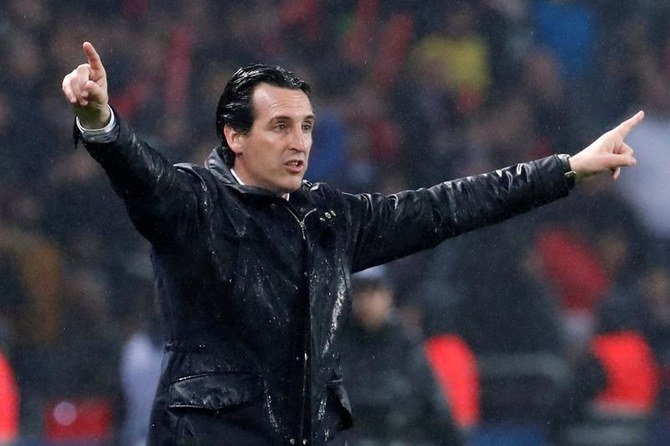
Coach Unai Emery (File photo: Reuters)
Short Url
Updated 19 April 2022
Follow

Unai Emery banishes bitter memories to lead Villarreal to unexpected glory

  • Having beaten Juventus and Bayern Munich, the Spanish club will face Liverpool in the Champions League semifinal next week

It’s 9:30 a.m., and I’m about to interview what is certain to be a beaming Unai Emery.

It’s May 2015, and the then 44-year-old Spanish coach had just led Sevilla to a second successive Europa League triumph after beating Ukrainian side FC Dnipro in Warsaw.

At Sevilla’s training ground, the ambitious coach, about to head off on a well earned summer holiday, spoke generously and confidently about his ability to improve the club, what it would require and what he demands from players.

Having previously managed Almeria, Valencia and Spartak Moscow, Emery had no desire to coach another team, and the sparkle in his eyes showed a man who believed an even better future awaited Sevilla. He was happy being the right man at the right time in Andalusia.

Despite his success, it would have been hard to imagine at the time that, seven years on, he would find himself eyeing a UEFA Champions League final while the likes of Barcelona, Atletico Madrid and his former club enviously watched from the sidelines.

In hindsight, that he would become one of Europe’s most in-demand coaches was inevitable.

A year after our interview, he were celebrating an unprecedented hat-trick of Europa League wins, after defeating Liverpool 3-1 in Basel.

In 2016 he joined Paris Saint-Germain, the latest manager tasked with winning the coveted Champions League.

Not only did that dream not materialize, but Emery presided over one of the most notorious collapses in European football history in his first season. Having beaten Barcelona 4-0 at home in the round of 16 of the Champions League, the French team suffered a meltdown at Camp Nou, losing 6-1 in the most embarrassing of eliminations.

From that moment he was on borrowed on time in Paris, and despite winning Ligue 1 in 2017-18, he packed his bags in the summer for Arsenal, where he had the unenviable task of replacing club legend Arsene Wenger.

He lasted just over a year, despite leading the club to a final in his beloved Europa League, where they lost 4-1 to Chelsea.

Which brings us to Villarreal. Once again, home comforts have brought out the best in Emery. As have European competitions.

In his first season at the Estadio de la Cerámica, Emery led his new club to fourth in La Liga and to a triumph in — of course — the Europa League, against Manchester United.

Belatedly, Emery was getting the acclaim he deserved as he banished the negativity and ridicule he attracted at Arsenal.

Today, Emery’s stock has never been higher.

Having guided Villarreal to second place in a Champions League group that included United, Atalanta and Young Boys, Emery pulled off one of the finest achievements of his career by beating Juventus on 4-1 on aggregate in the round of 16, after an astonishing 3-0 win Turin.

Things then got better, beating heavily-favoured Bayern Munich 2-1 over two legs, after a last-gasp equalizer in the return fixture at the Allianz Arena.

It was arguably Emery’s finest hour and a half of football.

Now, Jurgen Klopp’s Liverpool again stand in the way, this time of a dream Champions League final.

Emery’s legendary status at the club nicknamed the Yellow Submarine is secure.

Villarreal is a small city with a population of just over 50,000, and few of them would have expected a march to the Champions League semifinals, never mind further.

Emery’s Villarreal and Carlo Ancelotti’s Real Madrid now carry Spain’s hopes against England’s Liverpool and Manchester City when the penultimate round of the world’s biggest club competition kick off next week.

As Villarreal head to the cauldron of Anfield, Emery will no doubt remain calm, as is his style.

He is known for his pragmatism and flexible tactics, depending on his opponent, as Bayern and star forward Robert Lewandowski found out to their cost when met with Villarreal’s rearguard action in that remarkable second leg in Bavaria.

With a mixture of ambition, realism and humility, Emery won the day.

The bitter memory of loss to Barcelona 2017 will probably never leave Emery, but after yet another season where his former club PSG — now with Lionel Messi, Kylian Mbappe and Neymar — have failed to win Europe’s ultimate prize, he has proven himself one of European football’s enduring survivors.

How international academies are shaping Saudi football’s next generation

Updated 05 January 2026
Follow

How international academies are shaping Saudi football’s next generation

  • Building a unified national footballing philosophy in Saudi Arabia is no simple task

Saudi Arabia’s football transformation has been impossible to ignore since the arrival of Cristiano Ronaldo at the end of 2022. An influx of global stars followed, and with it, unprecedented attention on the Saudi Pro League.

Yet beneath the spotlight, a more pressing question emerged amongst domestic fans: “What is the long-term strategy for developing local players?”

Building a unified national footballing philosophy in Saudi Arabia is no simple task. The sheer size of the Kingdom presents logistical challenges unlike those faced by smaller neighbouring nations, making grassroots development harder to centralize. In this landscape, the work of individual institutions can contribute significantly to the broader football ecosystem.

One such contributor is Juventus Academy Saudi Arabia, an official extension of one of world football’s most historic clubs, operating under the umbrella of Al-Shoaibi Group. Arab News spoke to head of public relations at Juventus Academy, Malak Al-Awami, based in Alkhobar, to understand how the academy fits into the Kingdom’s long-term football vision.

“Saudi Arabia is experiencing a transformational moment under Vision 2030, prioritizing youth development and active lifestyles,” Al-Awami explained. “The  academy arrives at a perfect time to contribute to a world-class methodology while helping nurture the next generation of Saudi footballers.”

At Juventus Academy, success is deliberately defined beyond results and trophies.

“We’re not just training players,” Al-Awami said. “We’re shaping future leaders for the Kingdom.”

That philosophy has been reflected in how the academy balances Juventus’ global philosophy with local Saudi culture. While all coaches undergo Juventus’ training standards, cultural understanding remains a priority.

“All of our coaches are guided to respect Saudi values, culture and communication styles,” Al-Awami said. “Technical excellence matters, but the coach’s character is just as important as their certification.”

One of the academy’s defining features has been its inclusivity and cultural awareness. Players can join as young as four years old and continue until the age of 18, with programs open to both boys and girls.

That inclusivity has had a tangible impact. Juventus Academy played a role in the formation of Khobar FC, a women’s team that competed in the inaugural season of the SAFF Women’s Second Division League.

“We even used the same kit style as Juventus, getting approval from the club itself,” revealed Al-Awami.

Operating as an extension of the academy, the team finished just a few points behind established clubs like Al-Nahda and Al-Fateh in their regional group.

Al-Awami noted that the group is also exploring complementary initiatives aimed at elite player development beyond the academy itself. Among them is the planned Superior Striker Project, a specialized program designed to bring international attacking expertise to Saudi Arabia through short-term clinics for youth and professional players.

It is this broader contribution that highlights the growing importance of international academies in Saudi Arabia. Beyond providing structured training, they are helping build communities, instil values and strengthen the foundations of the domestic football pyramid. 

When asked about what success would look like for Juventus Academy in 5-10 years, Al-Awami was clear. “It is definitely not about trophies or big contracts,” he said, before adding, “it is the legacy we leave behind. If, in 10 years we see confident young Saudi players competing at elite levels, local coaches growing through our programs, and families trusting football as a tool for personal development, then we will know that we have truly succeeded.”

Juventus Academy Saudi Arabia builds on Al-Shoaibi Group’s original ambition in 2018: to create meaningful football opportunities for families in the Kingdom. Today, that ambition has evolved into a structured pathway contributing to Saudi football future, blending global expertise with local identity to help shape the next generation.