

Pakistan’s new federal cabinet takes oath after issuance of list of ministers

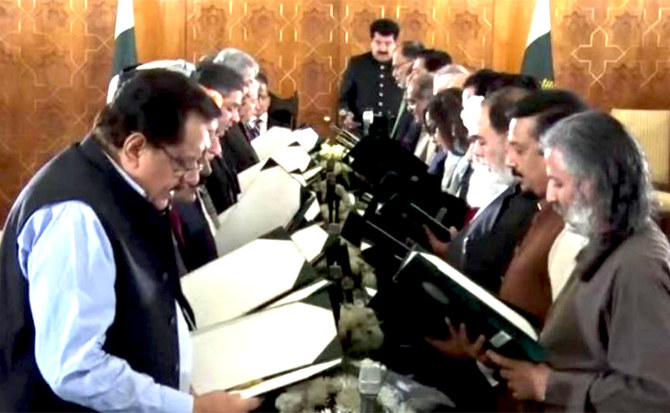
In this photo, Pakistan’s new federal cabinet taking oath in Islamabad on April 19, 2022. (Screengrab from APP)
Short Url
Updated 19 April 2022
Follow

Pakistan’s new federal cabinet takes oath after issuance of list of ministers

  • The list mentions the names of 30 federal ministers, four ministers of state and three advisers
  • Legal experts say all policy actions by the prime minister remain ‘illegal’ in the absence of the cabinet

ISLAMABAD: Pakistan’s new federal cabinet on Tuesday took oath after the cabinet division issued a list of 30 federal ministers, four ministers of state and three advisers to the prime minister.
Prime Minister Shehbaz Sharif, the younger brother of three-time former prime minister Nawaz Sharif, was elected to the top political office of the country on April 11 after the ouster of Imran Khan through a no-trust vote in Pakistan’s parliament.
However, he could not unveil his cabinet earlier even about a week after his election, with a legal expert saying it rendered all policy actions and decisions by the prime minister “illegal” and “unconstitutional.”

The oath was administered to the cabinet members by Senate Chairman Sadiq Sanjrani while the PM sat right next to him. 

Sharif is now leading a coalition government of over eight parliamentary parties, while Khan’s Pakistan Tehreek-e-Insaf (PTI) party has tendered resignations en masse from the National Assembly, citing an alleged US conspiracy to topple his government.
The new prime minister was said to be struggling with the distribution of ministries among coalition partners as per their strength in the National Assembly until recently.
“The consultation [for the cabinet] is complete and I will be announcing the details shortly,” Marriyum Aurangzeb, who speaks for Sharif’s Pakistan Muslim League-Nawaz (PML-N) party, told reporters Monday afternoon.
Khawaja Muddassir, a foreign media coordinator of Jamiat-e-Ulema-e-Islam-Fazl (JUI-F) that is one of the key coalition partners of the government, said cabinet members would be taking oath on Tuesday.
“Our four lawmakers will be part of the federal cabinet,” he told Arab News, dismissing reports of a deadlock on the distribution of portfolios.
“The portfolios of our ministers are also decided and will be announced after the oath-taking ceremony,” Muddassir said.
The JUI-F lawmakers, expected to be the part of the cabinet, include Maulana Asad Mehmood, Senator Talha Mehmood, Abdul Wasay and Abdul Shakoor.
Bilawal Bhutto Zardari, chairman of the Pakistan Peoples Party (PPP), is also said to have been shortlisted for the post of the foreign minister, though his name is not included in the list issued by the cabinet division.
Legal experts say the prime minister’s policy actions and decisions would remain “illegal” and “unconstitutional” in the absence of the cabinet.
“The constitution clearly says the government means a federal cabinet,” Barrister Ahmed Pansota told Arab News. “So, all government decisions must be endorsed and approved by the cabinet.”
He said the Supreme Court had also made it clear through a judgment that a prime minister alone could not take policy decisions as the government would remain incomplete without the cabinet.
“The prime minister is required under the law and constitution to unveil his cabinet at the earliest to run all state functions smoothly,” Pansota added.


Pakistan Railways targets $3.6 billion revenue amid track expansion, service upgrades

Updated 4 sec ago
Follow

Pakistan Railways targets $3.6 billion revenue amid track expansion, service upgrades

  • Government plans new railway lines and modern trains with security cameras, Wi-Fi and dining cars
  • Revival of a robust railway system is seen as key as Pakistan pushes to become a regional trade hub

ISLAMABAD: Pakistan Railways has set a target of generating Rs 1 trillion ($3.6 billion) in revenue by June as the government expands railway tracks and upgrades passenger services with amenities such as Wi-Fi and modern dining cars, Federal Minister for Railways Hanif Abbasi said on Tuesday.

Pakistan Railways was once the backbone of long-distance travel and freight movement across the country, connecting major cities and ports soon after independence. However, decades of underinvestment, aging infrastructure and competition from road transport led to a steady decline in services and reliability.

As Pakistan seeks to position itself as a regional trade and transit hub, the government has renewed focus on rebuilding a robust rail network for both passengers and cargo.

“Pakistan Railways has set a target of achieving Rs 1 trillion in revenue by June 2026,” Abbasi said, according to an official statement. “Pakistan Railways will be transformed into a modern, safe and profitable organization,” he added.

The minister said work has already begun on digitization, outsourcing, construction of new railway tracks and improvement of passenger facilities.

He said the Asian Development Bank has approved a $2 billion loan for the construction of a 480-kilometer new railway track between Karachi and Rohri, a project expected to cut travel time by at least five hours.

Groundbreaking for the project is planned for July 2026, with completion expected within two and a half to three years.

Under the Reko Diq project, Abbasi said work is underway on a 900-kilometer railway track from Rohri to Nokundi, including construction of 500 kilometers of new track and upgrading of 400 kilometers of existing track.

The 87-kilometer Nokundi–Taftan line has also been included to strengthen rail connectivity with Iran.

The minister said a 54-kilometer People’s Train route is being launched in Balochistan at a cost of Rs 4 billion ($14.4 million), while eight regional routes will be developed in Punjab.

Provinces have also been offered the option to operate branch lines, with Punjab, Sindh and Balochistan allocating funds and consultations underway with Khyber Pakhtunkhwa.

Abbasi said Pakistan is also advancing rail connectivity with Kazakhstan, Uzbekistan and Iran and that the Islamabad–Tehran–Istanbul railway service will be launched after security clearance.

Passenger services are being upgraded alongside infrastructure expansion, he continued.

“Cleanliness and improvement work at Rawalpindi Railway Station has been completed, while three prime trains have already been upgraded, and more trains will be upgraded by June 30,” the minister said. “By December 31, all major trains will be upgraded, featuring security cameras, Wi-Fi, hostesses and modern dining cars.”

He added that Wi-Fi routers have been installed at railway stations, ticket booking has been enabled through the Rabta mobile application and a 1,700-kilometer fiber-optic network is being laid.

Karachi and Lahore railway stations are being upgraded for security, while progress is underway on a Rs 8.9 billion ($32 million) digital systems agreement with the Frontier Works Organization and a $85 million project with DP World at Pipri Yard.

Abbasi said 155 railway stations have been shifted to solar energy and Pakistan Railways recently recorded its highest-ever daily revenue of Rs 300 million ($1.1 million).

The minister also said a new Lahore–Rawalpindi track, backed by provincial funding, will cut travel time between the two cities to about two and a half hours once completed.