

PM Sharif presses for completion of Diamer-Bhasha Dam until 2026

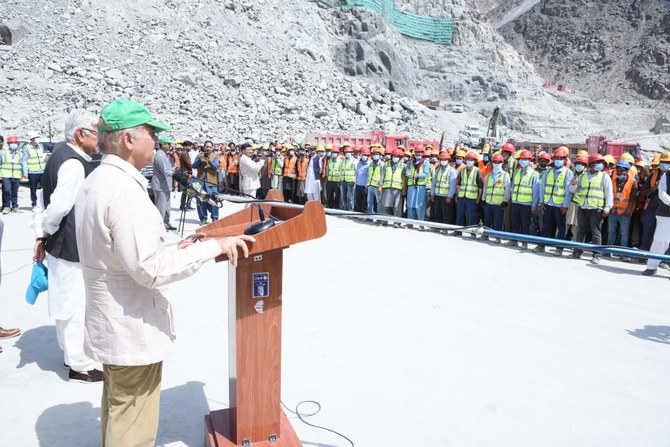
Pakistani Prime Minister Shehbaz Sharif addressing local & Chinese Engineers and Labourers at Diamir Bhasha Dam construction site on 17th April, 2022. (PM Office)
Short Url
Updated 17 April 2022
Follow

PM Sharif presses for completion of Diamer-Bhasha Dam until 2026

  • Diamer-Bhasha is the third multipurpose dam project in Pakistan after Tarbela and Mangla
  • The project will be used for water storage, flood mitigation, irrigation and power generation

ISLAMABAD: Prime Minister Shehbaz Sharif on Sunday instructed relevant authorities to complete the Diamer-Bhasha Dam project by 2026 instead of 2029, saying that nothing was impossible to achieve in life.

The multipurpose dam is being built on the Indus River between Kohistan district in Khyber Pakhtunkhwa province and Diamer district in Gilgit Baltistan region.

After the Tarbela and Mangla projects, Diamer-Bhasha is the third multipurpose dam project that Pakistan is working on. It will be used for water storage, flood mitigation, irrigation and power generation.

Sharif visited the construction site of the dam earlier today and commended the authorities for their work while urging them to speed up efforts to complete the dam well before 2029.

“I will insist to please go into the timeline again and assess where we can cut corners and if we can advance its date from 2029 to 2026 or 2027, it will be a miracle,” he said.

“It is possible, nothing is impossible in this world, if we put our act together,” he added.

After being briefed on the project by Chairman Water and Power Development Authority (WAPDA) Lt Gen Muzammil Hussain, the prime minister expressed satisfaction with the construction work.

He directed the chief secretary and chairman WAPDA to finalize the proposal of a 300-bed hospital within a week, adding that thousands of engineers, workers and technicians would need medical facilities in the time to come.

Sharif was also accompanied by his close aides including former prime minister Shahid Khaqan Abbasi, Khawaja Muhammad Asif and Marriyum Aurangzeb.


Pakistani president arrives in Iraq to deepen trade, energy cooperation

Updated 20 December 2025
Follow

Pakistani president arrives in Iraq to deepen trade, energy cooperation

  • Visit follows recent high-level contacts as Islamabad seeks to expand limited commercial ties with Baghdad
  • Talks are expected to cover investment, manpower and facilitation of Pakistani pilgrims visiting holy sites in Iraq

ISLAMABAD: President Asif Ali Zardari arrived in Iraq on Saturday on an official visit aimed at expanding cooperation in trade, energy and investment, as Pakistan seeks to deepen ties with Baghdad after years of limited engagement.

Pakistan and Iraq established diplomatic relations in 1947 and have traditionally maintained cordial ties, though commercial links remain modest, with officials and business groups identifying scope for cooperation in construction services, pharmaceuticals, manpower and agricultural exports.

“President Asif Ali Zardari arrived in Baghdad on a four-day official visit to Iraq,” his office said in a post on X. “He was received by Culture Minister Dr. Ahmed Fakkak Al-Badrani. During the visit, meetings with senior Iraqi leadership are expected to advance cooperation and further strengthen Pakistan-Iraq relations.”

Zardari’s visit follows a series of recent high-level contacts between the two countries, reflecting efforts to broaden bilateral engagement beyond traditional diplomatic ties and explore collaboration across economic, political and people-to-people domains.

According to Pakistan’s foreign office, the president is expected to hold meetings with Iraq’s senior leadership to discuss cooperation in various areas such as trade and investment, energy, technology, education and manpower.

He is also expected to discuss regional and international issues with Iraqi officials.

Earlier this month, Pakistan’s Interior Minister Mohsin Naqvi met his Iraqi counterpart, Abdul Ameer Al-Shammari, on the sidelines of meetings in Brussels, where both sides agreed to enhance cooperation on security and facilitate travel for Pakistani Shia pilgrims to Najaf and Karbala.

The two officials discussed measures to ensure the smoother movement of these pilgrims and their compliance with visa regulations.