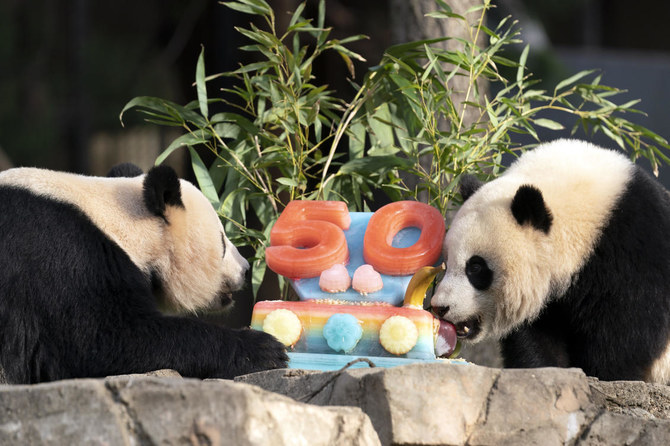
WASHINGTON: The “cake” was made from frozen fruit juice, sweet potatoes, carrots and sugar cane and it lasted about 15 minutes once giant panda mama Mei Xiang and her cub Xiao Qi Ji got hold of it.
The National Zoo’s most famous tenants had an enthusiastic breakfast Saturday in front of adoring crowds as the zoo celebrated 50 years of its iconic panda exchange agreement with the Chinese government.
Xiao Qi Ji’s father Tian Tian largely sat out the morning festivities, munching bamboo in a neighboring enclosure with the sounds of his chomping clearly audible during a statement by Chinese ambassador Qin Gang.
The ambassador praised the bears as “a symbol of the friendship” between the nations.
Pandas are almost entirely solitary by nature, and in the wild Tian Tian would probably never even meet his child. He received a similar cake for lunch.
In addition to hailing the 1972 agreement sparked by President Richard Nixon’s landmark visit to China, Saturday’s celebration also highlighted the success of the global giant panda breeding program, which has helped bring the bears back from the brink of extinction.
Xiao Qi Ji’s birth in August 2020 was hailed as a near miracle, due to Mei Xiang’s advanced age and the fact that zoo staff performed the artificial insemination procedure under tight restrictions shortly after the COVID-19 pandemic shut the entire zoo. At age 22, Mei Xiang was the oldest giant panda to successfully give birth in the United States.
Normally they would have used a combination of frozen sperm and fresh semen extracted from Tian Tian. But in order to minimize the number of close-quarters medical procedures, zoo officials used only frozen semen.
“It was definitely a long-shot pregnancy,” said Bryan Amaral, the zoo’s senior curator for mammals.
In honor of that long shot, the now 20-month-old cub was given a name that translates as “little miracle.” His birth in mid-pandemic sparked a fresh wave of panda-mania, with viewership on the zoo’s panda-cam livestream spiking by 1,200 percent.
“I know how passionate people are about pandas,” Amaral said. “I’m not surprised by that passion at all.”
Sure enough, crowds started streaming straight for the panda section at 8 a.m. when the zoo opened. Sisters Lorelai and Everley Greenwell, age 6 and 5, ran toward the enclosure chanting “Pandas! Pandas!”
They watched the cub tumble around, try to wrestle his mom and tear the zero off the giant 50 emblazoned on the ice cake.
“They knew this was coming,” said their mother Kayleigh Greenwell of Mount Ranier, Maryland, said of her girls. “We’ve been talking about it all week.”
The zoo’s original 1972 panda pair, Ling-Ling and Hsing-Hsing, were star attractions at the zoo for decades, but panda pregnancies are notoriously tricky and none of their cubs survived.
Mei Xiang and Tian Tian arrived in 2000, and the pair has successfully birthed three other cubs: Tai Shan, Bao Bao and Bei Bei — also by artificial insemination. All were transported to China at age 4, under terms of the zoo’s agreement with the Chinese government.
Similar agreements with zoos around the world have helped revitalize the giant panda population. Down to just over 1000 bears in the 1980s, the species has since been removed from the lists of animals in danger of extinction.


![]()

Pandas devour ice cake to celebrate 50 years at National Zoo
Short Url
https://arab.news/857xw
Pandas devour ice cake to celebrate 50 years at National Zoo
- The National Zoo celebrated 50 years of its iconic panda exchange agreement with the Chinese government
- The Chinese ambassador praised the bears as “a symbol of the friendship” between the nations


Latest updates


Recommended


© 2026 SAUDI RESEARCH & PUBLISHING COMPANY, All Rights Reserved And subject to Terms of Use Agreement.