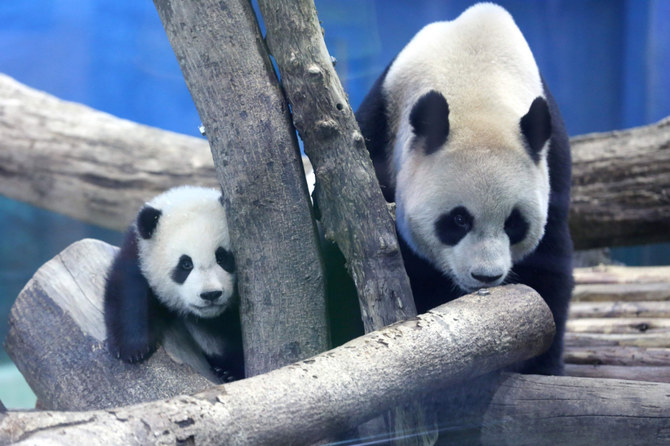
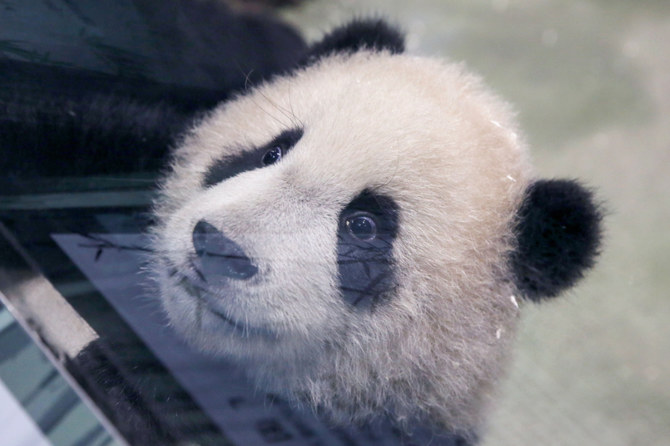
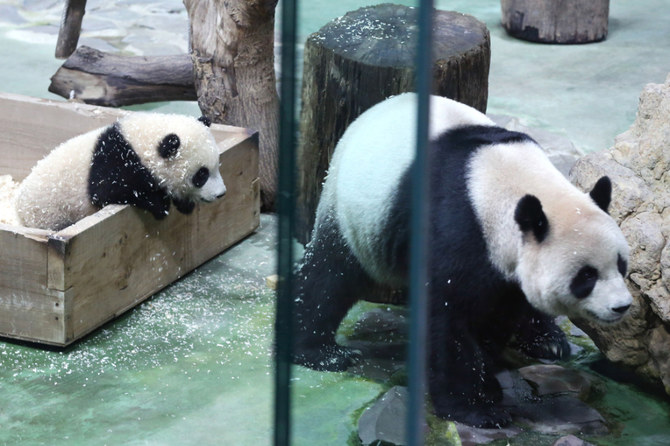
TAIPEI: A second Taiwan-born giant panda made her media debut on Monday, clambering over a wooden climbing frame and playing with sawdust to the sound of clicking cameras.
The cub was born on June 28 to Tuan Tuan and Yuan Yuan, who were gifted by China in 2008 to mark then warming relations between the two rivals.
China usually only loans its pandas to foreign zoos, but gave the breeding pair — whose names combine to mean “reunion” or “unity.”
China views Taiwan as part of its territory and has vowed to one day bring the self-ruled democratic island back into the fold, by force if necessary.
Yuan Bao, which means “round baby” in Chinese, was unveiled to some 150 reporters and invited guests alongside her mother at Taipei Zoo.
Taipei mayor Ko Wen-je said the cub had “grown well.”
She now weighs over 13 kilogrammes (30 pounds), up from 186 grams (6.5 ounces) at birth.
Taiwan’s zoo has seen a flurry of births this year, including a gorilla, koala, Malayan tapir and pangolin.
Yuan Yuan gave birth to a daughter Yuan Zai in 2013 — the first giant panda born in Taiwan. The family has been the top attraction at the zoo.
According to the World Wildlife Fund, just over 1,800 are believed remaining in the wild.

Second Taiwan-born panda cub makes media debut
https://arab.news/5eyr6
Second Taiwan-born panda cub makes media debut
- Yuan Bao, which means “round baby” in Chinese, was unveiled to some 150 reporters and invited guests alongside her mother at Taipei Zoo.
These shy, scaly anteaters are the most trafficked mammals in the world
CAPE TOWN, South Africa: They are hunted for their unique scales, and the demand makes them the most trafficked mammal in the world.
Wildlife conservationists are again raising the plight of pangolins, the shy, scaly anteaters found in parts of Africa and Asia, on World Pangolin Day on Saturday.
Pangolins or pangolin products outstrip any other mammal when it comes to wildlife smuggling, with more than half a million pangolins seized in anti-trafficking operations between 2016 and 2024, according to a report last year by CITES, the global authority on the trading of endangered plant and animal species.
The World Wildlife Fund estimates that over a million pangolins were taken from the wild over the last decade, including those that were never intercepted.
Pangolins meat is a delicacy in places, but the driving force behind the illegal trade is their scales, which are made of keratin, the protein also found in human hair and fingernails. The scales are in high demand in China and other parts of Asia due to the unproven belief that they cure a range of ailments when made into traditional medicine.
There are eight pangolin species, four in Africa and four in Asia. All of them face a high, very high or extremely high risk of extinction.
While they’re sometimes known as scaly anteaters, pangolins are not related in any way to anteaters or armadillos.
They are unique in that they are the only mammals covered completely in keratin scales, which overlap and have sharp edges. They are the perfect defense mechanism, allowing a pangolin to roll up into an armored ball that even lions struggle to get to grip with, leaving the nocturnal ant and termite eaters with few natural predators.
But they have no real defense against human hunters. And in conservation terms, they don’t resonate in the way that elephants, rhinos or tigers do despite their fascinating intricacies — like their sticky insect-nabbing tongues being almost as long as their bodies.
While some reports indicate a downward trend in pangolin trafficking since the COVID-19 pandemic, they are still being poached at an alarming rate across parts of Africa, according to conservationists.
Nigeria is one of the global hot spots. There, Dr. Mark Ofua, a wildlife veterinarian and the West Africa representative for the Wild Africa conservation group, has rescued pangolins for more than a decade, which started with him scouring bushmeat markets for animals he could buy and save. He runs an animal rescue center and a pangolin orphanage in Lagos.
His mission is to raise awareness of pangolins in Nigeria through a wildlife show for kids and a tactic of convincing entertainers, musicians and other celebrities with millions of social media followers to be involved in conservation campaigns — or just be seen with a pangolin.
Nigeria is home to three of the four African pangolin species, but they are not well known among the country’s 240 million people.
Ofua’s drive for pangolin publicity stems from an encounter with a group of well-dressed young men while he was once transporting pangolins he had rescued in a cage. The men pointed at them and asked him what they were, Ofua said.
“Oh, those are baby dragons,” he joked. But it got him thinking.
“There is a dark side to that admission,” Ofua said. “If people do not even know what a pangolin looks like, how do you protect them?”