Clashes at Al-Aqsa draw regional, international condemnation

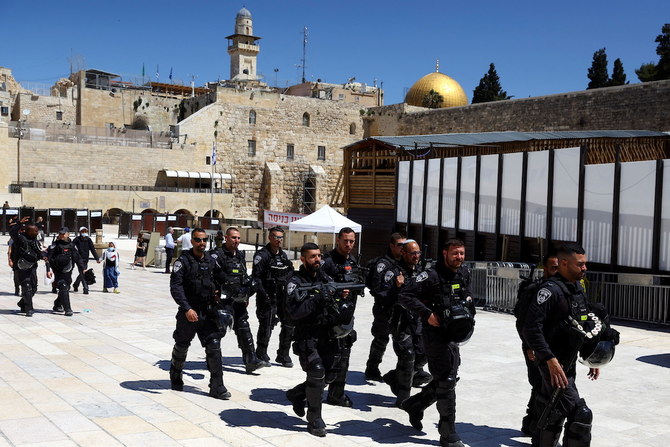
Israeli security forces patrol the compound that houses Al-Aqsa Mosque, following clashes with Palestinian protesters in Jerusalem’s Old City April 15, 2022. (Reuters)
Short Url
Updated 16 April 2022
Follow

Clashes at Al-Aqsa draw regional, international condemnation

  • The UN and EU said they were ‘deeply concerned’ by the recent upsurge in violence
  • Germany, France, Italy, Spain and regional countries and organizations condemned the violence in East Jerusalem

LONDON: The international community on Friday expressed deep concern over a recent upsurge in violence in the occupied West Bank and clashes between Palestinians and Israeli police at the Al-Aqsa Mosque.
At least 152 Palestinians were injured in clashes with Israeli riot police and 400 worshipers have been arrested inside Jerusalem’s Al-Aqsa mosque compound on Friday, the latest outbreak in a recent upsurge of violence that has raised fears of a slide back to wider conflict.
The UN said it was “deeply concerned by the deteriorating security situation in Jerusalem during these holy days,” adding that the provocations must stop.
“I call on political, religious, and community leaders on all sides to help calm the situation. Allowing tensions to spiral further only risks another escalation,” Ton Wennesland, UN special coordinator for the Middle East Peace Process, said in a statement.
He said the UN was in close contact with key regional partners to calm the crisis and also urged Israeli and Palestinian authorities to “immediately deescalate the situation and prevent any further provocations by radical actors.”

The clashes come at a particularly sensitive time. Ramadan this year coincides with Passover, a major weeklong Jewish holiday beginning Friday at sundown, and Christian holy week, which culminates on Easter Sunday. The holidays are expected to bring tens of thousands of faithful into Jerusalem’s Old City, home to major sites sacred to all three religions.
The UAE, an Arab nation which has diplomatic ties with Israel, strongly condemned the actions at the holy site, and underscored the need for self-restraint and protection for worshipers.

The European Union also said it was following the situation with deep concern and called for violence to stop immediately.
“Further civilian casualties must be prevented as a priority,” said Peter Stano, spokesperson for the EU’s external affairs. “The status quo of the holy sites must be fully respected (and) Palestinian-Israeli security cooperation is essential.”
Stano reiterated the EU’s call on all parties to engage in de-escalatory efforts, and said all leaders have a responsibility to act against extremists.
The foreign ministries of Germany, France, Italy and Spain condemn the violence on Friday in East Jerusalem in a joint statement.
“We call on all sides to exercise maximum restraint as well as to refrain from violence and from all forms of provocation,” spokespersons for the ministries said in their statement.
Neighboring Jordan, which has custodianship over the holy site, and the Palestinian Authority issued a joint statement accusing Israel of “a dangerous and condemnable escalation that threatens to explode the situation.”
The Palestinian Foreign Ministry said it “holds Israel fully and directly responsible for this crime and its consequences.”

Nabil Abu Rudeineh, spokesperson for Palestinian President Mahmoud Abbas, said the international community should intervene immediately to “stop Israeli aggression against Al-Aqsa mosque and prevent things from going out of control.”
Arab League chief Ahmed Aboul Gheit warned against igniting the situation in the Al-Aqsa Mosque and blamed the Israeli occupation forces, saying they were committing serious aggression against the Palestinians and their right to perform rituals inside Al-Aqsa during the Muslim holy month of Ramadan.
“Israeli attacks on worshipers represent a continuation of the series of Israeli transgressions and provocations that aim to divide Al-Aqsa spatially and temporally,” he said, expressing solidarity with Jerusalemites and Palestinians.
Secretary-general of the Gulf Cooperation Council condemned Israeli police and special forces for storming the mosque compound and urged Israel to respect the historical and legal status quo in occupied Jerusalem and its sanctities and to stop all illegal measures.
Nayef Al-Hajjraf also called on the international community to assume its responsibilities to preserve the safety of Al-Aqsa Mosque and worshipers, and the need for Israel to abide by its obligations as an occupying power in accordance with international humanitarian law.
The Organization of Islamic Cooperation said it holds Israel “fully responsible” considers this dangerous escalation an attack on sacred sites of the entire Islamic nation, and a flagrant violation of international resolutions.
It also called on the international community, especially the UN Security Council, to put an end to these repeated violations, and to provide protection for the Palestinian people and the holy sites.
Egypt also condemned the Israeli raid.
(With Reuters and AP)


Hezbollah saw new war with Israel as inevitable and rearmed for months, sources say

Updated 4 sec ago
Follow

Hezbollah saw new war with Israel as inevitable and rearmed for months, sources say

  • The details of Hezbollah’s recent efforts to rearm have not been previously reported
  • The head of Hezbollah’s media office, Youssef Al-Zein, told Reuters that Hezbollah would not comment on its military operations

BEIRUT: Lebanese armed group Hezbollah spent months restocking its arsenal of rockets and drones, using support from Iran and its own weapons factories to prepare for a new war with Israel, six sources familiar with the group’s preparations said.
Down but not out after its devastating 2024 conflict with Israel, Hezbollah had concluded that another round of fighting was inevitable — and that this time, it could face an existential threat, according to the sources.
Reuters spoke to three Lebanese sources briefed on Hezbollah’s activities, two foreign officials in Lebanon and an Israeli military official, who all spoke on condition of anonymity as they were not authorized to speak to the press.
The details of Hezbollah’s recent efforts to rearm have not been previously reported.
The head of Hezbollah’s media office, Youssef Al-Zein, told Reuters that Hezbollah would not comment on its military operations, though he said the group had decided to “fight to the last breath.”

PAYING SALARIES, REPLENISHING STOCKPILES
Founded by Iran’s Revolutionary Guards in 1982, Hezbollah launched rockets and drones at Israel on Monday to avenge the death of Iran’s Supreme Leader Ali Khamenei, pulling Lebanon into the war raging across the Middle East.
Although the decision caught some of its own officials off guard, Hezbollah had been readying its military stockpiles and its command-and-control structure for an eventual rematch with Israel, the six sources said.
To do so, it had drawn on a monthly budget of $50 million, most of it from Iran and earmarked for fighters’ salaries, according to one of the Lebanese ⁠sources, who has ⁠been briefed on the group’s finances and military activities. One of the foreign officials confirmed the $50 million budget.
It was not immediately clear how long the group had been relying on that monthly budget and how it compared to its previous financial resources.
The group has said funds from Iran helped finance rents for people displaced by the 2024 war. Around 60,000 Lebanese, most of them from the Shiite Muslim community from which Hezbollah draws its popular support, remained displaced over the last year, with their homes still in ruins.
Hezbollah had also worked to replenish its drone and rocket stashes through local manufacturing, the first Lebanese source, the foreign officials and the Israeli military official said. The Israeli military official said Hezbollah had used Iranian funding both to smuggle arms and make its own weapons, but added that its manufacturing capability had been diminished.
The second foreign official said the group had stationed new rockets and ⁠Iranian-made logistical materials in southern Lebanon before the latest war began.
Hezbollah’s media office did not immediately respond to questions on its rearmament and Iranian support for it.
Israeli military spokesperson Lt. Col. Nadav Shoshani told Reuters that Hezbollah “had a lot of arms left” and was also seeking to rearm. “They were trying to smuggle and we were preventing that,” Shoshani said.

PACE OF FIRE BUILDS UP
In 2024, a punishing two-month war with Israel ended with a ceasefire brokered by the United States. Hezbollah halted its attacks on Israel, which continued strikes on what it said were Hezbollah’s efforts to rebuild military capabilities.
Israel also kept troops in five hilltop positions in southern Lebanon.
Last year, Lebanon also began confiscating Hezbollah weapons in the country’s south — but Israel said the group was rearming faster than it was being disarmed.
Speaking to Reuters weeks before Hezbollah entered the regional war, the first Lebanese source confirmed that the group had been rebuilding its military capabilities “in parallel” with Israel’s campaign to destroy them.
The pace of Hezbollah’s attacks this week provides clues about its weapons stocks.
The group launched 60 drones and rockets on March 2, the first day it attacked Israel, and a similar number the following day, said the second foreign official, who tracks Hezbollah’s activities closely.
But on March 4, Hezbollah launched more than double that number of projectiles, a sign it had been able to draw from its larger ⁠caches, the official said.
ALMA, an Israeli think ⁠tank that monitors security on Israel’s northern border, said it assessed that Hezbollah’s arsenal on the eve of its attack included approximately 25,000 rockets and missiles, most of them short- and medium-range.
A video published by Hezbollah on March 4 showed a fighter setting up a drone in a wooded area. Riad Kahwaji, a Dubai-based defense analyst and founder of the Institute for Near East and Gulf Military Analysis, identified the drone in the video as a Shahed-101, which he told Reuters could be produced locally.

HEZBOLLAH EXPECTED A FIGHT FOR SURVIVAL
Hezbollah has also dispatched fighters from its elite Radwan force back to southern Lebanon, Reuters reported this week. They had been withdrawn from the area after the 2024 conflict.
Israeli strikes after the 2024 ceasefire included the targeting of what Israel said were Hezbollah training camps. In late February, the Israeli military said it struck eight military compounds used by the Radwan force to store weapons and prepare for a confrontation.
The Israeli official and the first foreign official said Hezbollah had been struggling to recruit new operatives as a result.
The group lost 5,000 fighters in the 2024 war, an unprecedented blow to its fighting force, though the second Lebanese source said it still had some 95,000 fighters left.
In the lead-up to its entry into the current regional war, Hezbollah had become convinced Israel would carry out a major strike on the group that would seek to “disable its ability to retaliate,” the first Lebanese source said.
A third foreign official familiar with Hezbollah’s thinking said that assessment had driven the group’s decision to launch the first salvo, fearing Israel would eventually turn its attention from Iran to Hezbollah.
“They knew they were next on the list,” the official said.