

UK government under pressure to repatriate child, mother from Syria

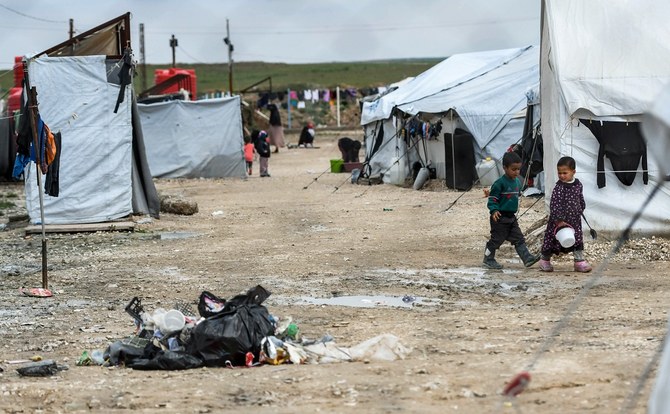
Children at Al-Hawl refugee camp in Syria’s Al-Hasakeh governorate. (AFP)
Short Url
Updated 14 April 2022
Follow

UK government under pressure to repatriate child, mother from Syria

  • Despite multiple requests to repatriate the family the mother and son remain incarcerated
  • Decision described by Conservative MP Andrew Mitchell as “hard to fathom”

LONDON: The UK government is facing increased pressure to repatriate a young boy and his gravely ill mother from a Syrian detention camp as fears mount that she may die, leaving the child orphaned.

An explosion in 2019 inside the camp, where the pair have been held for several years, left the mother with shrapnel in her head, but despite multiple requests to repatriate the family the mother and son remain incarcerated in Syria — a decision described by Conservative MP Andrew Mitchell as “hard to fathom.”

Mitchell told The Guardian: “Ministers are asking us to believe that this British woman who can barely walk is such a threat that she cannot be brought home for life-saving treatment.

“The government’s position is surely hard to fathom. Has the UK really become so fearful and so cruel? I urge the government not to risk making an orphan of a young British boy and bring this family home.”

According to the paper, the condition of the mother, whose name has been withheld, has worsened recently, with doctors warning she is unlikely to survive without medical intervention.

The co-executive director of the legal charity Reprieve, Maya Foa, who has visited the pair, said their tent was recently set alight, with the young boy forced to drag his mother from the fire and that he now refused to play with other children as he feared he may not be there to save her should another fire be lit.

The Foreign Office said that it was reviewing the case as a “matter of priority,” but played up security concerns.

It added: “There may be British children in camps in Syria who are innocent victims of the conflict. Where we become aware of unaccompanied or orphaned British children in Syria, we will work to facilitate their return, subject to national security considerations.”

However, Labour MP Apsana Begum condemned this as a policy of “separating children from mothers,” putting them in a situation “that no parent should ever have to face.”

She told The Guardian: “The fact that the government would adopt this brutish approach to tear British families apart shows everything that’s wrong with its counter-productive and unbearably callous policy towards British nationals in north-east Syria.”


Fledgling radio station aims to be ‘voice of the people’ in Gaza

Updated 15 February 2026
Follow

Fledgling radio station aims to be ‘voice of the people’ in Gaza

  • The electricity crisis is one of the most serious and difficult problems in the Gaza Strip, says Shereen Khalifa Broadcaster

DEIR EL-BALAH: From a small studio in the central city of Deir El-Balah, Sylvia Hassan’s voice echoes across the Gaza Strip, broadcast on one of the Palestinian territory’s first radio stations to hit the airwaves after two years of war.

Hassan, a radio host on fledgling station “Here Gaza,” delivers her broadcast from a well-lit room, as members of the technical team check levels and mix backing tracks on a sound deck. “This radio station was a dream we worked to achieve for many long months and sometimes without sleep,” Hassan said.

“It was a challenge for us, and a story of resilience.”

Hassan said the station would focus on social issues and the humanitarian situation in Gaza, which remains grave in the territory despite a US-brokered ceasefire between Israel and Hamas since October.

“The radio station’s goal is to be the voice of the people in the Gaza Strip and to express their problems and suffering, especially after the war,” said Shereen Khalifa, part of the broadcasting team.

“There are many issues that people need to voice.” Most of Gaza’s population of more than 2 million people were displaced at least once during the gruelling war.

Many still live in tents with little or no sanitation.

The war also decimated Gaza’s telecommunications and electricity infrastructure, compounding the challenges in reviving the territory’s local media landscape. “The electricity problem is one of the most serious and difficult problems in the Gaza Strip,” said Khalifa.

“We have solar power, but sometimes it doesn’t work well, so we have to rely on an external generator,” she added.

The station’s launch is funded by the EU and overseen by Filastiniyat, an organization that supports Palestinian women journalists, and the media center at the An-Najah National University in Nablus, in the occupied West Bank.

The station plans to broadcast for two hours per day from Gaza and for longer from Nablus. It is available on FM and online.

Khalifa said that stable internet access had been one of the biggest obstacles in setting up the station, but that it was now broadcasting uninterrupted audio.

The Gaza Strip, a tiny territory surrounded by Israel, Egypt, and the Mediterranean Sea, has been under Israeli blockade even before the attack on Oct. 7, 2023, which sparked the war. Despite the ceasefire, Israel continues to strictly control the entry of all goods and people to the territory.

“Under the siege, it is natural that modern equipment necessary for radio broadcasting cannot enter, so we have made the most of what is available,” she said.